Navigating dental care without insurance in Texas: Big bills and decaying teeth
On a Saturday afternoon in March, Terry Ford was driving his pickup truck home from a catfish lunch with his 7-year-old son.
Ford’s son said he had a toothache.
“I have an owie, Daddy!” Ford remembered him saying.
Ford looked in his son’s mouth, but couldn’t immediately see any issues. He gave him a Tylenol and added his son’s name to the waiting list for a pediatric dentist.
Months later, when Garrett finally got in the dental chair for an exam, the dentist had bad news: Garrett had an infection under two teeth. He would need oral surgery, and because of his age, the surgery would have to be in a hospital.
But neither Ford nor his son has medical or dental insurance. Without insurance, the surgery and hospital stay would cost thousands of dollars that Ford didn’t have. Ford, 61, had previously worked as a service electrician. But a COVID-related slowdown had dramatically decreased his hours, and there was no extra cash to spare. Ford said realizing the few options he had to help his son made him feel desperate.
“I’m a fix-it person,” Ford said. “That’s what I do in my work. When you can’t fix things, that’s the true definition of helplessness.”
Add Garrett’s infection, and the accompanying bill, to the millions of Texas residents who don’t have dental insurance. There is no precise estimate for how many Tarrant County residents don’t have dental insurance, but the number is likely at least double the number of residents without health insurance, local experts said.
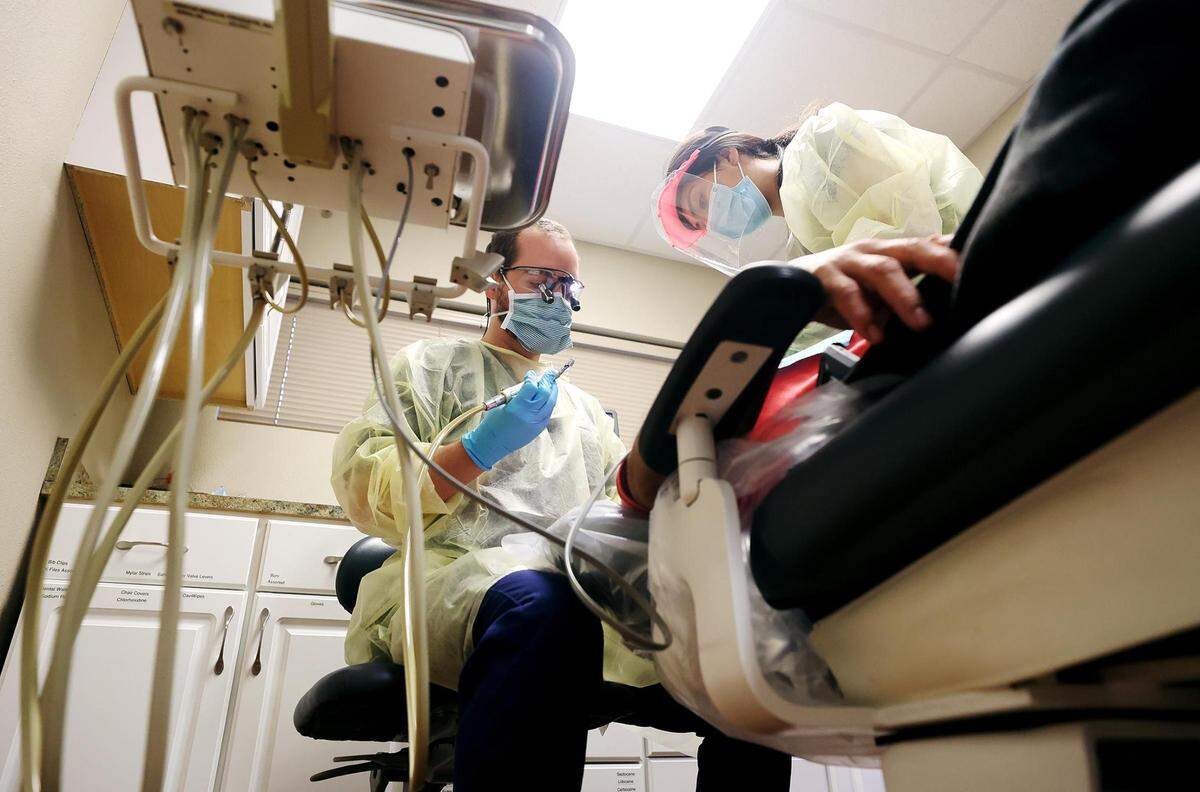
And while dental disease affects children and adults in the state, children in particular experience tooth decay and other problems more often than their peers in other states, according to a report from the Texas Health Institute. Almost 67% of Texas third graders have cavities, compared to a nationwide average of about 52%, according to the institute’s report.
Without dental insurance, many families and individuals simply have no way to pay for preventive dental care, so they go without, Fort Worth dentists said. Without regular cleanings, small problems fester, leading to tooth decay, gum disease, infections, and abscesses. And those who can’t afford a $125 dental cleaning can’t afford the thousands of dollars they need for dental surgery.
A last resort
Garrett Ford and his dad caught a break when their dentist recommended they call Gill Children’s, a Fort Worth nonprofit that considers itself a “last resort” provider for kids. The agency will help kids in need cover any expense necessary as long as there’s no other agency, organization, or group that can help.
Increasingly, the nonprofit’s funding has gone toward paying for children’s dental care, said executive director Peyton Lehrer. In the last decade, about 50% of the nonprofit’s annual spending on kids has paid for dental needs, according to the group’s records, making it the single biggest expense the group pays for year in and year out.
“We’ve heard from dentists who will encounter kids that need 14 pulpotomies,” Lehrer said, referring to the procedures necessary when the soft pulp inside a child’s baby tooth becomes infected. “When a child that young needs that much dental work, they need to go under anesthesia, which increases the cost of the treatment plan considerably. And there’s no other agency that can assist with that need.”
For the kids Gill Children’s has helped, their average dental treatment plan was $4,866, Lehrer said. Without Gill Children’s, those families would have faced a $5,000 out-of-pocket expense to keep their children healthy and, in many cases, to keep them out of pain, she said.
Saving Smiles
Garrett’s infection might have been caught earlier had he been a student at one of the 21 Fort Worth area schools where a long-running dental health program has been able to reverse the deteriorating oral health of children.
Save a Smile, which is part of the Center for Children’s Health at Cook Children’s, started in 2003 as dentists and physicians in Tarrant County increasingly began to recognize oral diseases as a public health crisis, said Dr. Tonya Fuqua, the group’s director.
In the schools where Save a Smile operates, the group starts with a simple idea: Give every child in that school a dental screening, and identify the kids with the most urgent tooth decay.
For kids without any form of insurance and who aren’t eligible for Medicaid, Save a Smile will connect them with a network of dentists who offer their services for free. Medicaid and CHIP are only available to families who make a certain amount of money, and are not offered to county residents who aren’t U.S. citizens.
On a recent Friday at Tarrant County Community College’s dental school, about 19 kids got a free dental cleaning through the program. For some, it was the first time they’d been to the dentist.
One of those children was 7-year-old Khiara Gonzalez.
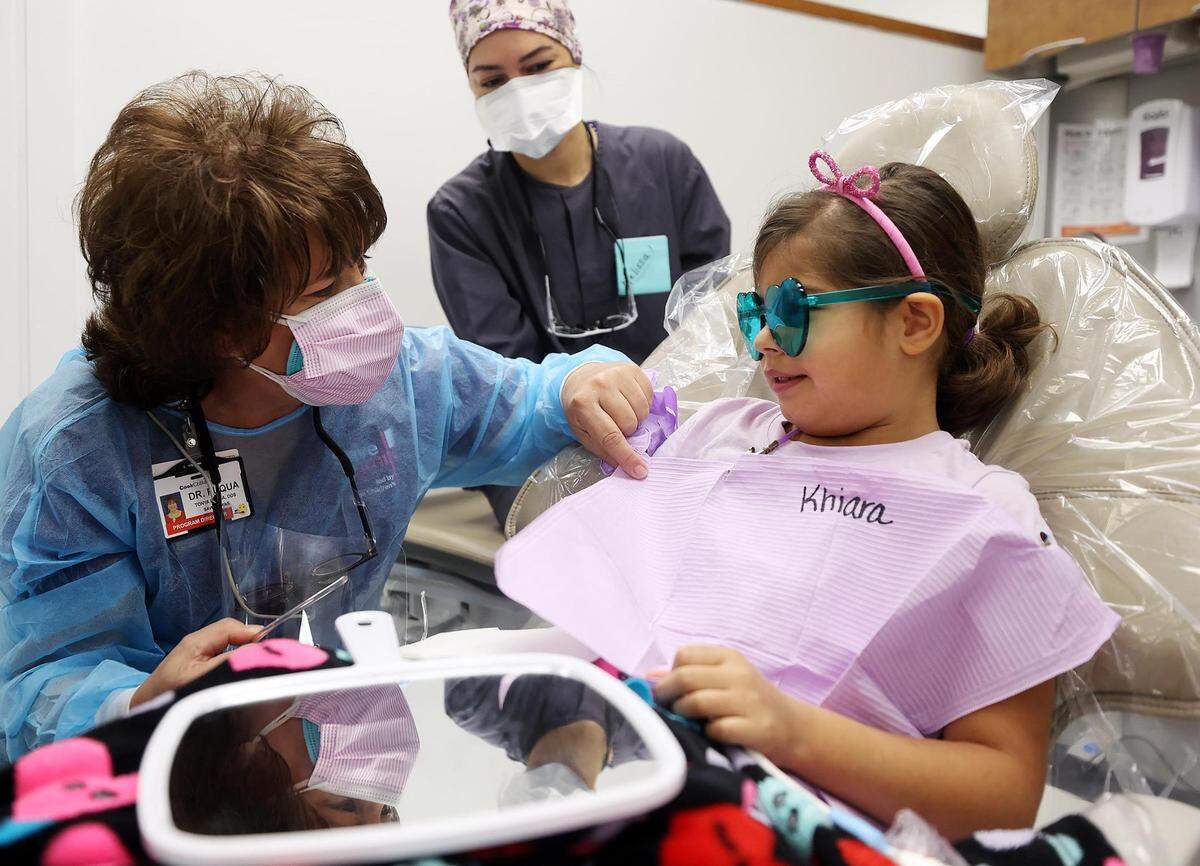
Khiara was not happy to be in a dental chair, terrified of the atmosphere despite the bright glasses and fuzzy blankets offered to the kids to make the dentist seem just a little bit less scary.
Khiara cowered in her dental chair, crying as a dental hygiene student tried to explain how she would clean the girl’s teeth and remove plaque. Some of Khiara’s teeth were already showing signs of decay.
Fuqua sat by Khiara’s side, and quietly talked to her in Spanish. Fuqua took her dental tools one at a time and used them to gently poke and prod the skin, to show her they wouldn’t cut or injure her when they were used on her teeth. Eventually Khiara agreed that the scary and sharp instruments didn’t hurt that much after all. Fuqua and the dental hygiene students she was supervising continued to clean Khiara’s teeth and complete a full dental exam in the first dental visit the first-grader has had since her family immigrated to the U.S. from Mexico.
Khiara was one of 19 kids who received a free dental cleaning and exam via Save a Smile.
For many of the kids, it was the first dental cleaning and exam they’d ever received in their lives. The program was created as local dentists and physicians began to recognize tooth decay among local children as a public health crisis, Fuqua said.
But Save a Smile can help only a fraction of Tarrant County area kids.
The program started in 2003, three years after a landmark report from the U.S. Surgeon General labeled oral disease a “silent epidemic” that was particularly pronounced among the nation’s poor children and older adults.
The surgeon general’s office published an updated report in January, almost two decades later. Although there were some signs of improvement, overall, little had changed, the report found.
Although fewer young children have untreated cavities than they did 20 years ago, the discrepancy between poor patients and rich patients hasn’t changed. In 2000, almost twice as many poor children (those in families earning less than 100% of the federal poverty level) between 2 and 9 had at least one untreated cavity when compared to their wealthy counterparts, according to the surgeon general’s report. In 2015, that ratio was the same, according to the CDC: Almost one in five children in families earning $26,500 or less in a year poor children had an untreated cavity, compared to one to 10 children in a family earning more than $79,500 a year.
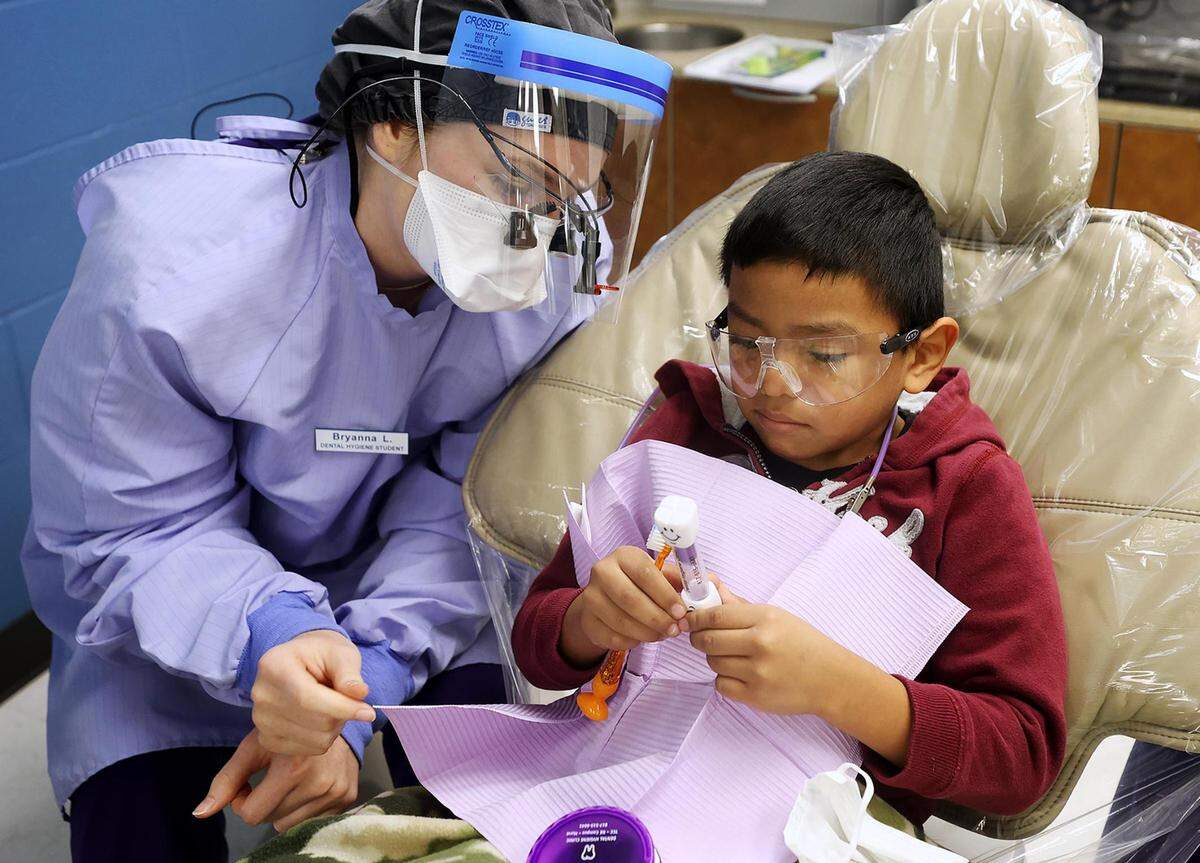
For kids and adults without dental insurance, one of the primary providers of low-cost dental care comes through Federally Qualified Health Centers, health clinics that receive federal funding to provide low-cost care in areas that are considered medically underserved.
In Tarrant County, there are three of these health centers run by the North Texas Area Community Health Centers. These centers provide primary care to about 11,000 patients last year, most of whom had no health insurance. But right now, none of the locations offer dental care, leaving a major gap in the county’s oral health care safety net.
The health center hopes to eventually offer dental care to its patients, and has even reserved a portion of its new building for a future dental clinic. But for now, the cost of creating and maintaining those services remains too high.
“I think it will be several years before we’re able to add dental care to our services,” said Dr. Patricia Rodriguez, the chief medical officer at the health center.
This story was originally published January 14, 2022 at 12:51 PM.