Why there’s reason for hope that Texas can equitably distribute the COVID vaccine to kids
Almost a year after the first COVID-19 vaccines were provided to U.S. health care workers, and 10 months after the vaccines became available to the general public, the country’s vaccine rollout appears to have stagnated.
Only half of county residents are fully vaccinated against COVID-19.
But even as the U.S. faced considerable challenges during the COVID-19 vaccine rollout for adults, experts who have studied vaccination efforts in school-age children are noticing a possible reason for optimism. By and large, they say, the U.S. has actually achieved moderate success at getting kids protected from preventable diseases through vaccines.
The nation’s childhood immunization program is a rare example where racial, ethnic, and socioeconomic disparities have essentially been eliminated.
“We have a strong infrastructure in the U.S. that allows children regardless of their sociodemographic characteristics … to get vaccinated at no cost,” said Dr. Angela Shen, visiting scientist at the Vaccine Education Center at the Children’s Hospital of Philadelphia. “The infrastructure in the United States has developed over the years to make sure that we get every child, and that equity isn’t an issue.”
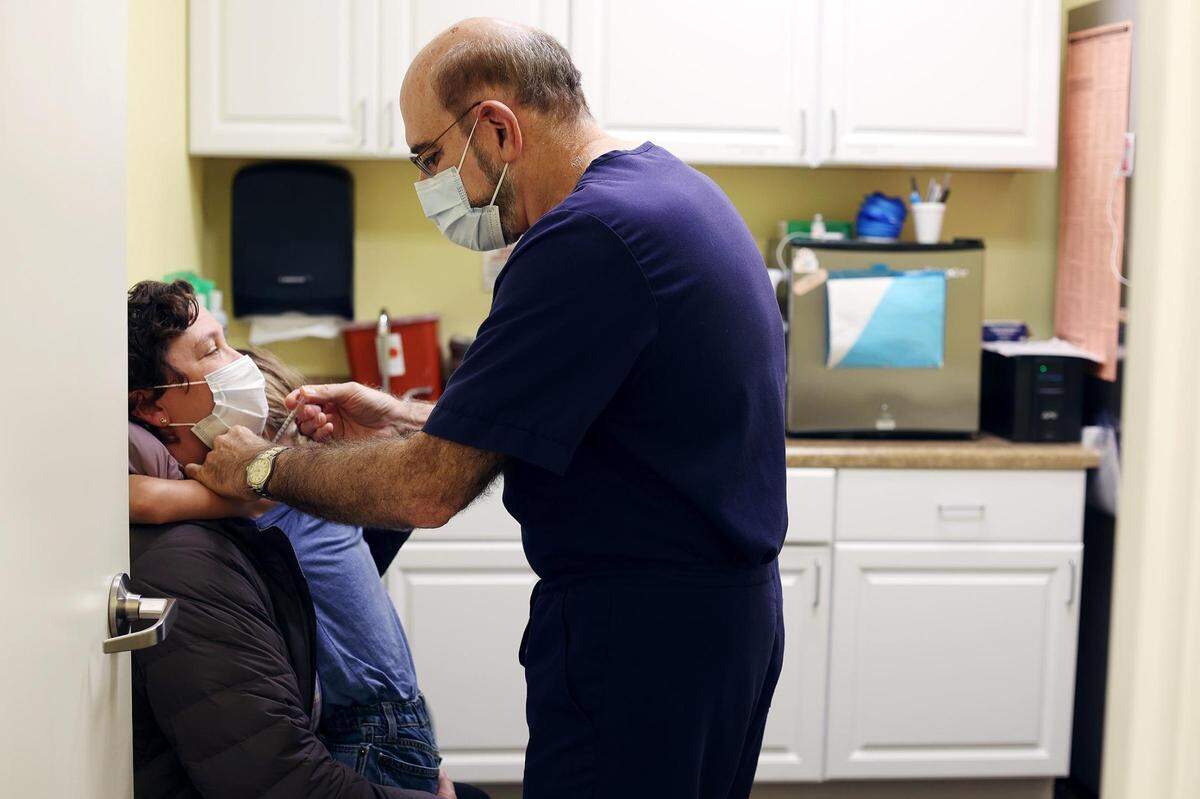
That system includes clinics like Lone Star Children’s Medical, located at La Gran Plaza in Fort Worth. The clinic is one of dozens in Tarrant County that provides free vaccines to uninsured and underinsured kids. All of the clinic staff are bilingual, said pediatrician Dr. Steven Levy, and the clinic treats a large number of low-income children on public insurance programs like Medicaid.
On a recent Friday, six-year-old Hailey Hicks sat anxiously on top of the crinkly paper covering an exam room chair at the clinic. Hailey had just watched her 12-year-old brother get his COVID-19 vaccine, and now it was her turn. Her big brother held her left hand, her mother held her right, and her doll Mary sat on her lap as a nurse quickly pricked her small shoulder.
Clinics like the one where Hailey was vaccinated are part of the country’s relatively strong system for vaccinating kids against preventable diseases. Even as the COVID-19 vaccination rate hovers just above 51%, almost 93% of Tarrant County kindegarteners had received the measles, mumps and rubella vaccine, according to state data. Although pediatricians would like to see even greater uptake, the country’s relative success at vaccinating children against diseases like measles could highlight a path for distributing the COVID-19 vaccine.
Why is it so hard to vaccinate adults?
The U.S. has achieved some major milestones in vaccinating adults against COVID-19.
Nationwide, 86% of adults age 65 and over have been vaccinated, meaning that one of the demographic groups most at risk of dying from COVID-19 has received protection through the vaccine, according to the U.S. Centers for Disease Control and Prevention. In Texas, 82% of that population is fully vaccinated, according to state data.
But vaccine rollouts are also about providing community-level protection by immunizing enough of a population so that the virus in question can’t continue to circulate and mutate, as has happened with the Delta variant of the SARS-CoV-2 virus this summer. By that measure, Texas still has a long way to go. Statewide, about 54% of all Texans are fully vaccinated as of Wednesday, according to state and federal data, and about 51.1% of all Tarrant County residents are fully vaccinated.
Part of the reason it’s been so difficult to inoculate adults is that most adults don’t get regular vaccines. Usually only about half of American adults get a flu shot. And unlike some countries, the U.S. isn’t used to operating mass vaccination programs for adults. Most adults will get vaccines, if they get them at all, at a doctor’s office or a pharmacy, experts said.
“We don’t vaccinate adults in the same way that we vaccinate kids, which was why the rollout was really, really difficult,” Shen said. “(We) don’t mass vaccinate thousands of people a day in the Astrodome - until this past year.”
Another barrier to vaccinating adults that is particularly challenging in Texas is the high rate of Americans without health insurance.
Unlike adults, children have a higher rate of health insurance. In Texas, 12.8% of children do not have insurance, compared to about one in every four adults between the ages of 19 and 64, according to census data. Parents are also and are accustomed to getting regular vaccines from their pediatrician.
“We’ve already had so many conversations with families about vaccines and the importance of vaccines,” said Dr. Christina Robinson, a Fort Worth pediatrician . “I think in a lot of cases, we are already ahead of the game there. Because you have already had these conversations.”
The Vaccines for Children program
In 1994, the U.S. launched the Vaccines for Children program, designed to make essential childhood vaccines free and accessible to children without insurance or who were underinsured.
Before the program launched, “children from poorer, often nonwhite families had lower vaccination rates and higher rates of vaccine-preventable illnesses than those who were white, more well-off, or both,” according to a study analyzing almost 20 years of children’s vaccine data.
The study found the biggest increases in vaccination rates among low-income Hispanic children. In 1995, 85% of low-income Hispanic children had received the measles, mumps and rubella vaccine. By 2011, uptake had increased to almost 92%, on par with low-income white children and just a few percentage points behind rich white children, according to the research.
The Vaccines for Children program has worked in concert with state policies requiring certain vaccinations for children to attend school, Shen said.
This progress, however, has been eroded by anti-vaccine disinformation campaigns, which have pushed a growing number of parents to refuse vaccinations for their children and seek exemptions from their state’s vaccine requirements for school.
In Texas, the number of people who requested vaccine exemptions increased 60% between 2015 and 2019, according to a report from the state’s health coordinating council. The increase in exemptions in Texas has coincided with increases in preventable diseases. In 2019, Texas had 22 cases of measles, which can cause brain swelling and death. The disease was previously declared eliminated in the U.S. in 2000.
Barriers remain
These factors - a higher health insurance rate and a strong relationship with pediatricians - could make it easier to vaccinate children against COVID-19. Public health officials have already said kids’ vaccines will not be distributed in mass vaccination sites, and families can go to their local pediatrician’s office or pharmacy to get the shot.
But the successes achieved by the Vaccines for Children program and school policies won’t automatically translate into high uptake for the COVID-19 vaccine in kids.
One challenge is that only kids age 5 and older are currently eligible for the COVID-19 vaccine, which coincides with a gap in routine vaccines. After kids receive their fifth dose of the diphtheria, tetanus, and pertussis vaccine at age 5, they aren’t scheduled for another vaccine until age 11 (with the exception of the seasonal flu vaccine).
“For a lot of children who are between the age of 5 and 11, they come in once a year for their physical and then otherwise it’s only when they’re sick,” Robinson, the Fort Worth pediatrician, said. “So it’s really about being able to recapture that population if they’ve already had their physical before the vaccine rollout.”
Another challenge in vaccinating children, experts said, is their parents own belief about the vaccine
“Right now, the biggest driver of children that get vaccinated are whether adults are vaccinated,” said Dr. Yvonne Maldonado, the chief of the pediatric infectious diseases department at the Stanford University School of Medicine.
The questions and barriers that adults may face before deciding to or being able to get the vaccine won’t disappear for their children, experts said, but parents will be able to talk to their child’s pediatrician about their concerns. Surveys show that adults trust their own physician or their children’s pediatrician more than any other source when it comes to information about the COVID-19 vaccine.
Although some pediatricians, like Levy at the clinic at La Gran Plaza, have eagerly signed up to distribute the COVID-19 vaccine, it’s unclear how many pediatricians’ offices will be included in distribution plans, or else get the support they needed to give the vaccine to their patients.
“There are still thousands of (Vaccines for Children) providers in the country who haven’t enrolled as COVID vaccine providers,” Shen said.