
Neighbors worry about industrial development impacting iconic Dinosaur Valley
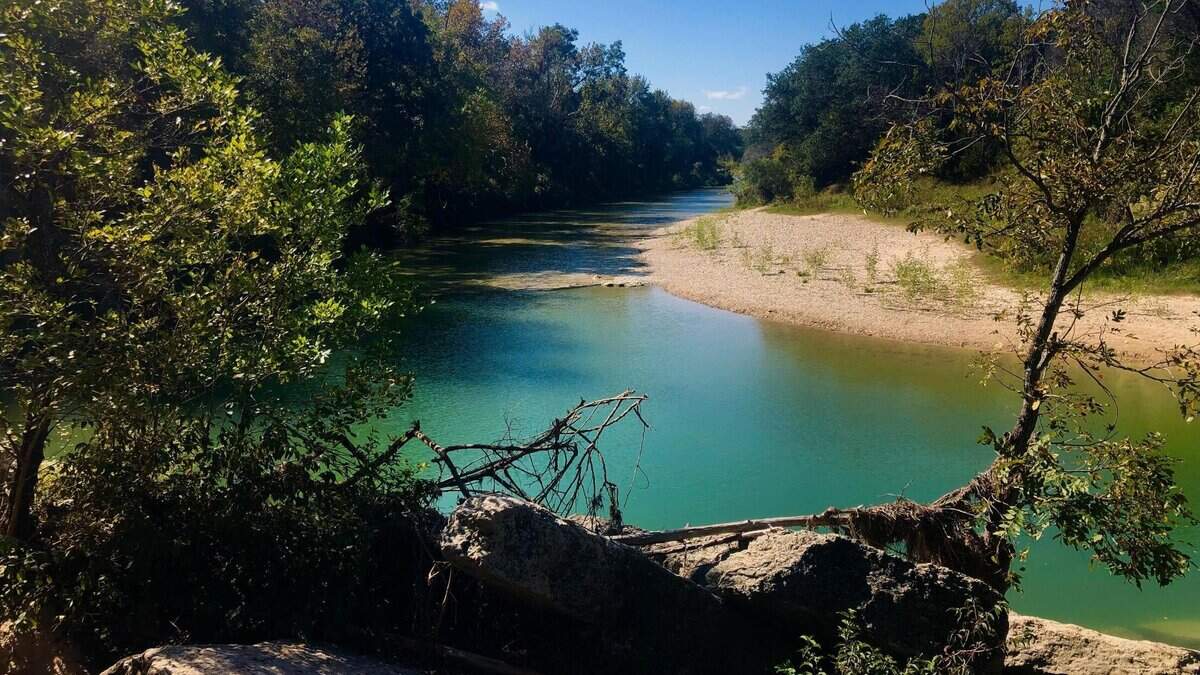
Somervell County residents and elected officials worry that proposed industrial developments, including a power transmission line, a power plant and a data center complex near the iconic Dinosaur Valley State Park will result in pollution and runoff that will harm the delicate ecosystem and also impact the local economy which is driven by tourism.
The park, touted as the most visited in the state and home to the 113 million year-old dinosaur tracks, is a 1,525-acre oasis about an hour southwest of Dallas/Fort Worth near Glen Rose where thousands of visitors come for hiking, camping and to see the dinosaur tracks on the bottom of the Paluxy River.
Brian Crawford and his wife Laura helped form the nonprofit, Protect the Paluxy Valley, to fight against encroaching development impacting the rural area.
“Dinosaur Valley is a part of Glen Roe’s identity, and the Paluxy River flows through Glen Rose and is a source of drinking water and tourism,” Brian Crawford said.
There are concerns that runoff from construction at Comanche Circle, a planned 2,600-acre data center complex, about four miles from the park, will cover the dinosaur tracks in silt. According to Protect the Paluxy, the runoff would flow in to Paluxy above the dinosaur tracks.
Protect the Paluxy Valley is holding an informational meeting at 6:30 p.m. Tuesday at The Expo at Glen Rose, 202 Bo Gibbs Blvd., to get the word out about the threats to the park’s future.
Proposed projects near the park
There are three proposed industrial projects near the park.
Comanche Circle
Comanche Circle, on the Hood and Somervell county line near Tolar, is about seven miles from downtown Glen Rose and four miles from the park.
On June 9 during a contentious meeting, the Hood County commissioners voted 3-1 to approve a concept plan from Florida-based Sailfish Investors, the first step to determine if Comanche Circle will go forward. Although many who spoke questioned why a water use and traffic study with January dates were not available to the public until early June, the majority of the commissioners stated that they took an oath to uphold the law as counties don’t have authority to regulate.
Ryan Hughes, founder and managing partner of Sailfish Investors, said in an email that the concept plan lasts for two years, and that he intends to submit the site development plan during that time frame. When asked about how many buildings will be included in the 2,100-acre data center plans, Hughes said the number is “fluid” pending final engineering reports, but they will cover less than 50% of the land.
Hughes pushed back on claims that runoff from construction will impact the Paluxy River near the dinosaur tracks.
“As the third closest proposed data center to Dinosaur Valley State Park, there is a better chance that the earth is flat than Comanche Circle harming Dinosaur Valley State Park in any way,” Hughes said.
Oncor transmission line
Oncor Electric is proposing to build the Dinosaur-Longshore 765 kilovolt transmission line which would bring electricity from North Texas to the Permian Basin, over 200 miles away. One of the proposed routes would skirt a portion of the park.
Kerri Dunn, an Oncor spokesperson said in an email: “Oncor recognizes the cultural, educational, and ecological importance of Dinosaur Valley State Park. Oncor must present a geographically diverse set of routes in our application as part of regulatory requirements, and none of the routes under consideration enter or cross the park.”
Dunn added that hearings on the project concluded May 11 and State Office of Administrative Hearings judges will issue final route recommendations to the Public Utility Commission of Texas, which will determine the final route for the Dinosaur-Longshore transmission line.
The 765 kilovolt line is needed to ensure grid reliability as Texas continues to grow, she said.
Fort Worth Power Corp., a subsidiary of Black Mountain Power, received an air permit from the Texas Commission on Environmental Quality in February 2025 to build a combined cycle power plant bordering the northeast side of the park. Black Mountain is developing a $10 billion data center campus in Fort Worth.
According to the TCEQ, the “combined cycle” power plant will consist of 2 blocks each containing three gas-fired combustion turbine generators and one heat recovery steam generator. Each combustion turbine generator will be nominally rated at 62 megawatts (of electrical power.
A TCEQ spokesperson said in an email that the permit is active, and the company must notify the state when construction begins.
The company also does not have to notify the TCEQ if electricity will be used to power a data center.
Rhett Bennett, CEO of Black Mountain Power, did not respond to emailed questions from the Star-Telegram concerning whether the electricity generated at the power plant will be sold to the grid or used for data centers. The Star-Telegram also asked when the power plant will be built.
The Texas Department of Parks and Wildlife did not respond to emails seeking comments on the concerns about Dinosaur Valley.
History of Dinosaur Valley State Park
According to the park, an 11-year-old boy first discovered the tracks after a 1908 flood scoured the Paluxy Riverbed, exposing the limestone.
Dinosaur Valley State Park opened in 1972 to preserve the valuable track sites and for people to learn about them and enjoy them.
Concerns about runoff
Thad Scott, professor of biology and director of the Center for Reservoir and Aquatic Systems at Baylor University, said Protect the Paluxy Valley contacted him for his thoughts concerning the natural resources of the river.
“What they wanted to know from me were my concerns about the natural resources and the state park downstream with a valuable natural history exhibit,” he said.
Scott said construction has a lot of potential to cover up the dinosaur tracks.
“The bottom of the river is the treasure,” he said. “That’s what we want to protect.”
The concept plan for Comanche Circle also calls for waste water treatment, and Scott said harmful algae blooms in shallow bodies of water such as the Paluxy River are a growing concern throughout Texas as more and more people flock to the state.
He added that Texas does a good job of regulating pathogens in wastewater, but needs to do more to regulate nutrients, such as fertilizer.
Local economy
Chip Joslin is in his first term as Precinct 3 Somervell County commissioner. Before that, Joslin was mayor pro tem in Glen Rose.
He worries about the potential damage to Dinosaur Valley and what it could mean to the county’s economy and to Glen Rose.
“Dinosaur Valley accounts for a quarter of a million dollars a year,” he said.
“We are a tourist destination. People either supplement their living or make their living through tourism.”
Joslin said Somervell County is the second smallest county in Texas in terms of geography, and it just doesn’t have the land for such massive development.
“We don’t have the land that other counties have. To be covered up with data centers is a horrific situation.”