Is your kid’s e-bike legal? Fort Worth police outline rules

E-bikes, e-scooters and other “low-powered” vehicles that have proliferated across the city in recent years were a topic of discussion at Tuesday’s Fort Worth Public Safety Committee meeting.
Speaking to the committee, Deputy Police Chief Sean Kenjura clarified which of those types of vehicles are permitted on public roadways and sidewalks and which are restricted.
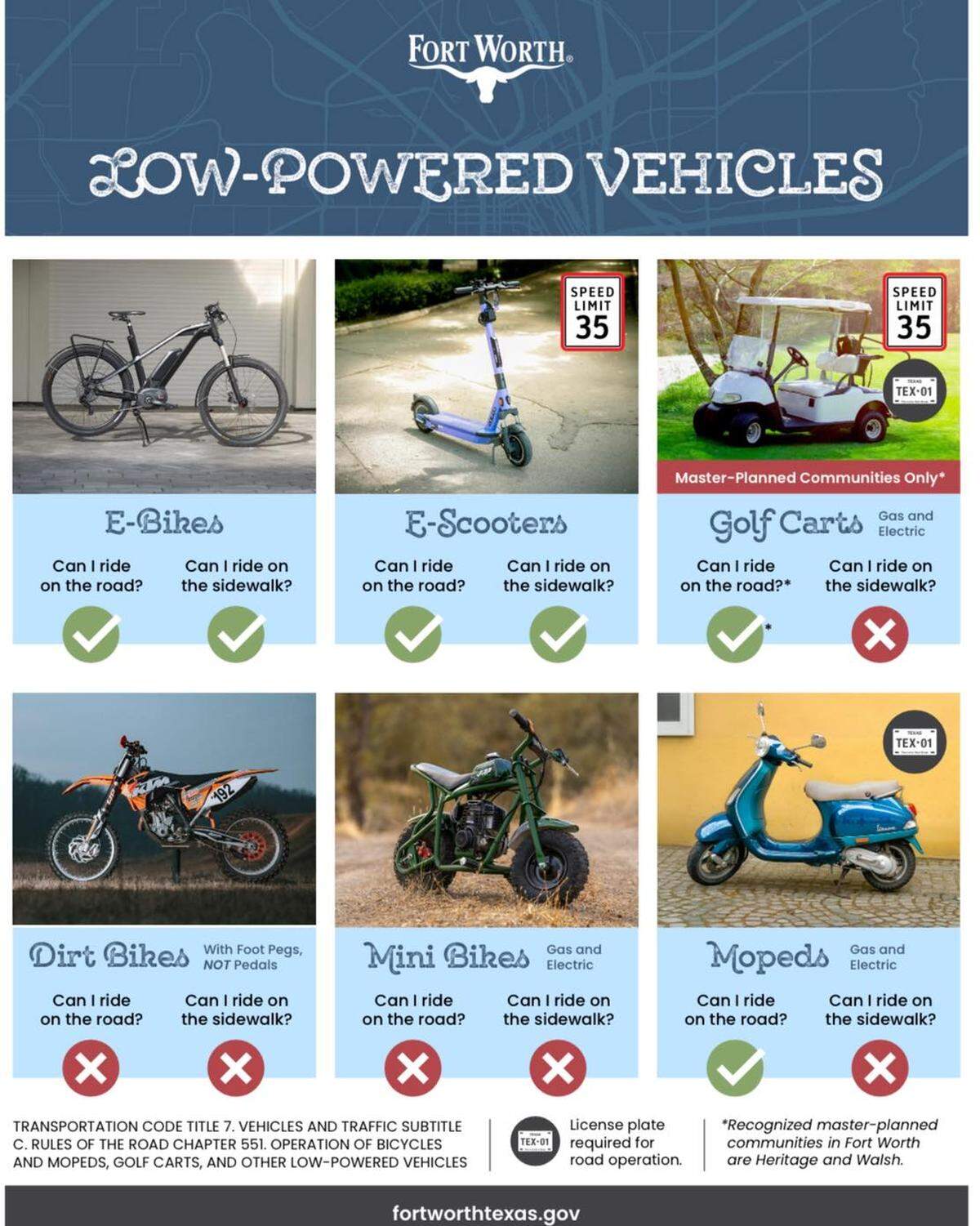
E-bikes are regulated like traditional bicycles, and they are allowed on streets, bike paths and sidewalks with few limitations. Helmets, though, are required for riders under age 18.
E-scooters can be ridden on bike paths and sidewalks, but they are restricted to streets with a posted speed limit of 35 mph or less.
However, mini bikes, pocket bikes, electric dirt bikes, electric off-road scooters, electric ATVs and electric side-by-side off-road vehicles are prohibited everywhere in the city except on private property. Still, Kenjura said Fort Worth police have encountered those vehicles operating on public streets and sidewalks.
“Some of these vehicles will travel up into the 50-, 60-mph range and higher,” Kenjura said.
Residents in far north Fort Worth, like those in the Heritage neighborhood, have complained about riders — particularly kids — operating electric dirt bikes recklessly in residential areas, creating a safety concern. Kenjura said devices like electric dirt bikes and mini bikes can be powerful enough to exceed the capabilities of young riders.
Those devices are not classified the same as the electric bicycles, which have pedals but are motor assisted. If the device has a throttle like a motorcycle, it’s not allowed on city roads or sidewalks.
Similar safety complaints have been made around TCU, where students can often be found riding e-scooters on campus sidewalks and adjacent roadways. Earlier this year, TCU adopted new guidelines that say students and university employees must operate personal mobility devices at a safe speed, obey traffic signs and signals, yield to pedestrians and slow down in areas with heavy pedestrian traffic.
Kenjura said neighborhood homeowners’ associations can adopt rules to limit the use of electric mobility devices, but only if the HOA owns and maintains the streets and sidewalks. If those are owned and maintained by the city, city and state laws apply.
Fort Worth Council Member Carlos Flores asked Kenjura about golf carts. Golf carts are permitted on roadways in master-planned communities, but only where the posted speed limit doesn’t exceed 35 mph.
Council Member Michael Crain asked Kenjura if the same helmet laws that apply to bikes also apply to e-scooters. Right now, city ordinances governing bicycles don’t mention scooters, but Crain previously told the Star-Telegram he wanted that changed.
Kenjura told Crain the police department was working on a comprehensive update to the city’s safety ordinances that will address concerns related to e-scooters and other mobility devices. A draft of those changes will be presented to the City Council soon, said Kenjura.
In recent days, council members Charles Lauersdorf and Macy Hill posted information on Facebook outlining the types of mobility devices that are permitted in Fort Worth, and where those devices can be operated.