Inside Texas Health’s life-or-death drill preparing rural paramedics
The paramedics leaned over their patient, who had just been drowning in an indoor water park. One paramedic began chest compressions, pushing hard and steady on the patient’s chest. Another prepared to intubate the patient, whose pulse was dropping rapidly.
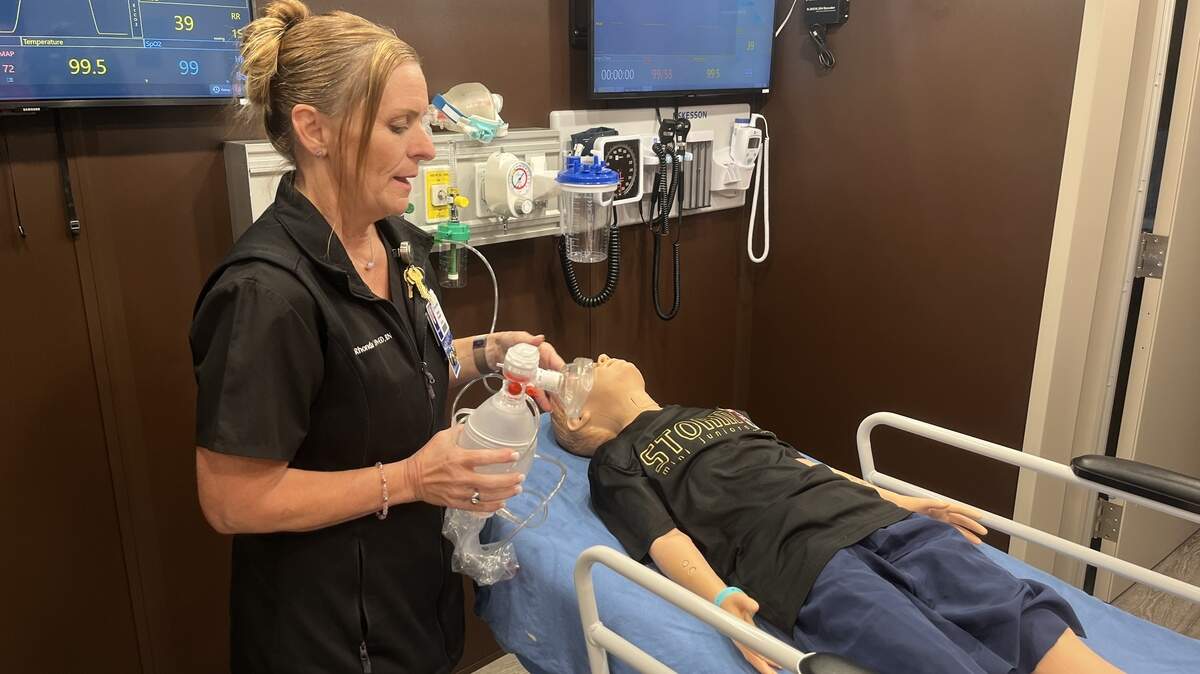
The patient, a 5-year-old boy, was actually a lifelike manikin. The paramedics, part of Johnson County Emergency Services District, were practicing how to respond to different emergency scenarios using Texas Health Resources’ new mobile simulation training unit.
The mobile unit, which went to Cleburne to train Johnson County paramedics on Thursday, April 23, is equipped to train medical personnel for a range of different emergencies. The goal of the mobile unit is to bring lifelike training health care providers in rural areas who might not be able to make it to the simulation lab at Texas Health Harris Methodist Fort Worth Hospital.
“We target rural areas that find it difficult to bring their staff to downtown Fort Worth,” said Rhonda Thompson, program manager for the mobile simulation training unit.
“The new unit enables us to increase our training time with EMT teams, interact with rural health facilities and fire departments, and establish beneficial relationships with school nurses and students,” Laura McWhorter, Texas Health Resources Foundation president, said in a statement.
On Thursday, paramedics practiced responding to a patient who had drowned in a water park using a pediatric manikin.
“This guy can be programmed to do anything a human can do,” Thompson said. He can talk, blink, cough, or have an asthma attack. His heart can beat rapidly or stop completely, and his chest can rise and fall in accordance with his heartbeat.
“Anything that we would do to a real patient, we can do to this manikin,” Thompson said.
For the Johnson County paramedics, Thursday’s training gave them an opportunity to practice emergency scenarios under realistic circumstances.
“This has been a huge asset for us,” said Chloe Carothers, a firefighter and paramedic with Johnson County ESD. “Having this be so close to real life…it has helped so much with confidence, with actually utilizing our treatments and protocols to provide treatments to our patients.”
The mobile simulation lab and its equipment cost $1.3 million in total, and was paid for through donations.
This story was originally published April 23, 2026 at 3:22 PM.