Arlington raises awareness about sex trafficking ahead of World Cup
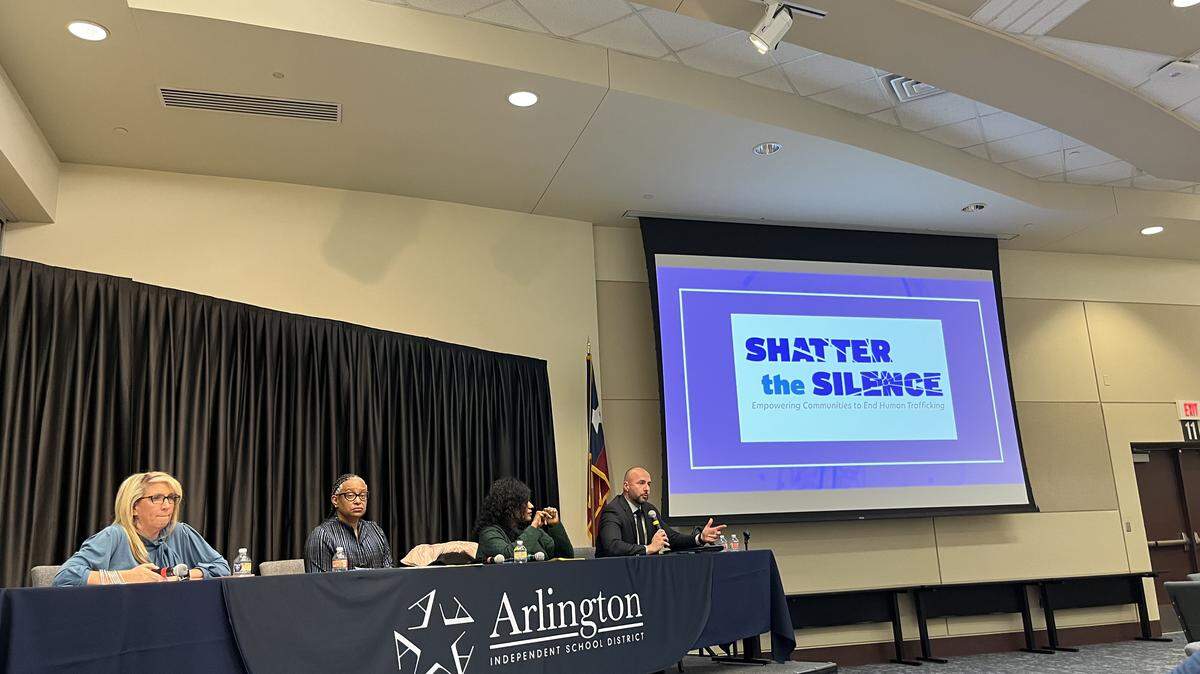
A ballroom inside an Arlington school district administration building was a packed house on Jan. 29 as dozens of parents and students listened to a panel of experts discuss an ever-present fear for parents — sex trafficking.
The event was “Shatter The Silence,” a collaboration between Arlington ISD and local organizations to promote awareness about sex trafficking ahead of the 2026 FIFA World Cup, which will bring millions of people to Arlington’s AT&T Stadium.
Texas has the second-highest number of reported sex trafficking cases in the United States, and Dallas is one of the nation’s top 10 cities for trafficking, according to the Texas Department of Health and Human Services. The state’s vast network of highways, and its proximity to the border, make it a target for trafficking.
At the event in Arlington, parents and students listened to several presentations about the different types of scams that can lead to sex trafficking, recommendations for keeping children safe, and information about how the Arlington Police Department tackles sex trafficking.
Sex trafficking doesn’t happen when a stranger takes a child, said Sonya Brooks, director of youth prevention for the Fort Worth office of anti-trafficking group Unbound. It can take many forms, and educating children and parents early is critical, said Brooks. “Sextortion,” the act of threatening or coercing someone into sending explicit images online, has become increasingly common among young adults.
“Oftentimes, we want that education to start taking place when kids are in middle school or high school,” Brooks said. “In the culture that we live in, we need to start educating our kids younger. We need to start in fourth and fifth grade, because our kids are a lot more sophisticated.”
Additionally, Brooks said, immediate family or friends are more likely to traffic a young person than a stranger.
“Kids can be exploited by family members, they can be exploited by friends,” Brooks said. “There are students who literally are exploited by their best friends in school.”
Also among the event’s speakers was Brooke Morris of Richland Hills, the founder and executive director of Aisling, a Texas nonprofit that advocates for survivors of sex trafficking.
Morris is not just an advocate, though — her family has personally affected by sex trafficking. In 2022, Brooke Morris’ 15-year-old daughter was attending a Dallas Mavericks game at American Airlines Center with her father, Kyle Morris.
The teenager left her seat to go to the bathroom — and never came back.
Police in Oklahoma found the young girl a week and a half later, Brooke Morris said, after a private investigator discovered that her image had been posted in online advertisements. Several people were arrested.
Since their daughter’s ordeal, Brooke Morris and her husband Kyle have started an organization to fight sex trafficking and testified before the Texas Senate’s criminal justice committee in favor of a bill that would change how the state responds to reported runaways, which is how their daughter’s disappearance was reported. Kyle is challenging Rep. David Lowe in the March 3 Republican primary for House District 91.
Morris’ message for the parents and students in attendance was to be vigilant, and to have important conversations with your child.
“Things are totally within your control, until they’re not within your control,” Brooke Morris told the crowd. “Be aware, but also don’t be blind to it.”
The speakers took questions from concerned parents, who asked about the use of artificial intelligence to create pornographic images — a growing threat on social media — and what law enforcement will do about trafficking as the World Cup approaches.
“Anytime major events like that come, we anticipate traffickers traveling across different states, over to our city — we’ll be ready,” said Arlington Police Department sergeant Tarik Muslimovic, who works with the department’s human exploitation and trafficking unit. “We’ll have a robust plan in place in both proactive and reactive ways.”
Large-scale sporting events attract fears of sex trafficking, with such a large influx of people converging on one city.
There are lots of statistics about sex trafficking online, but in reality, it’s difficult to properly measure just how prevalent it is in any one place, said Kathleen Preble, a professor at UT Arlington’s School of Social Work who researches human trafficking.
“We as a nation do not have a way of taking all of the baseline information across the United States and putting it into a data set, and being able to crunch the numbers ... and saying that these are the top 10 worst states in the United States for human trafficking,” Preble told the Star-Telegram. Preble was not at the Arlington event, but offered context for understanding the issue.
Rather than obsess over specific numbers or prepare their children for one scenario, Preble encouraged parents to simply open a dialogue.
“I want parents to have open and honest conversations about consent, starting in preschool,” Preble said. “There’s a lot of stuff to be really scared about ... but here’s the thing, keep it simple.”
Ashleigh Johnson, who has two teenage boys in the Arlington school district, said the event gave her more information about the role of technology in sex trafficking and made her feel motivated to protect her community.
“I just want to make sure that, if I can help people, that I know the signs,” Johnson said.