
How UTA researchers used fishing pants to make heart stress tests more accurate
AI-generated summary reviewed by our newsroom.
- UTA researchers developed MRI-compatible pants to simulate exercise stress.
- Lower-body negative pressure shifts blood flow to better mimic real-life activity.
- Early tests show promise in improving cardiac imaging accuracy and safety.
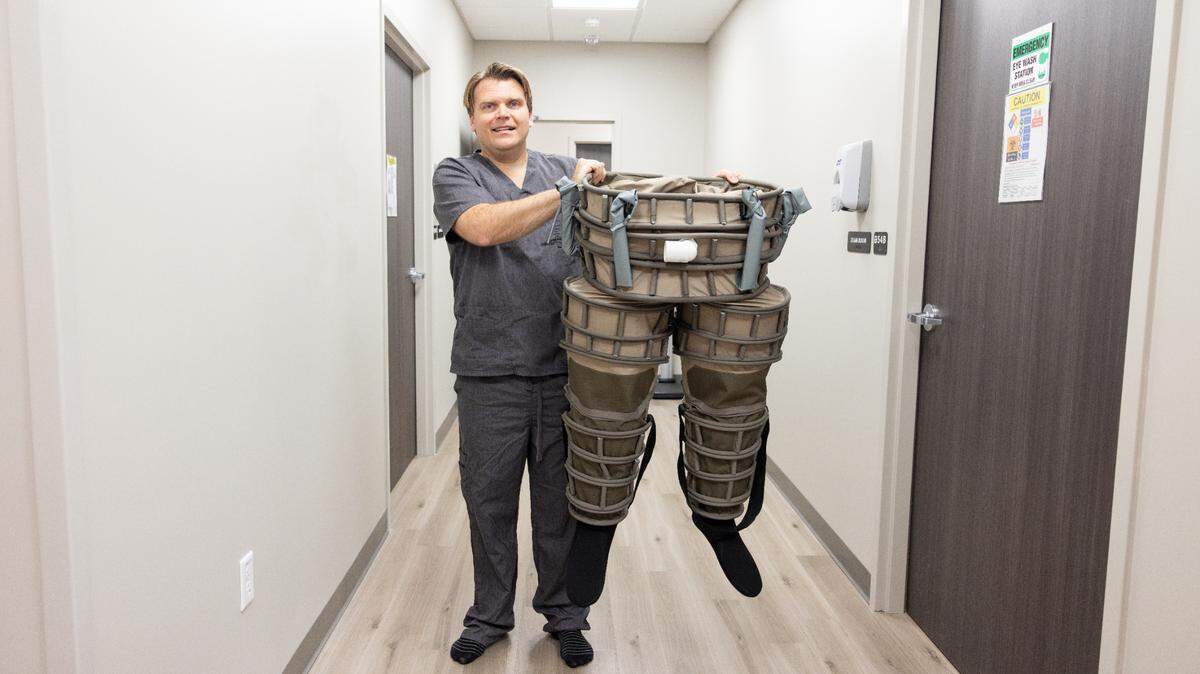
Researchers at UT Arlington are using traditional MRI machines with a twist: exercise pants. The NASA-inspired negative pressure pants mimic exercise activity in patients as they undergo testing,
Researcher Michael Nelson and doctoral student Brandon Hathorn wanted to find a more accurate way to test patients that went beyond regular cardiac stress testing.
Nelson, an associate kinesiology professor, is also the director of the clinical imaging research center and the Center for Healthy Living and Longevity at UTA. He said the topic has interested him for more than 15 years.
He said it always bugged him that doctors look at hearts by having patients lay down during imaging. That causes the blood from their legs to flow up and circulate to the heart.
The team visited Cabela’s, found fishing waders, and added a vacuum port and PVC pipes to maintain the pants’ shape. The pants allow for leg motion that mimics exercise.
“We image their heart effectively in a state that is not representative of their day-to-day lives,” Nelson said. “People move around, people get up, they walk, get the mail, they mow their lawn, and they walk around the grocery store, and that’s when they experience their symptoms or have different experiences. So, for me it’s really important to recapitulate activities of daily living when we when we image the heart.”
The researchers were inspired by Neeki Ashari, a human spaceflight engineer who developed mobile gravity pants for NASA.
In November 2024, UT Arlington opened its $6.2 million Clinical Imaging Research Center, which features an MRI machine that provides enough space for exercise studies, according to a press release.
Nelson said lower body negative pressure has been used for a long time. It’s a tool that draws a little bit of blood from the upper body into the lower body, just like what happens with gravity.
All together, Hathorn said that the cost of making the pants was less than the university’s lab budget of $5,000.
The study’s preliminary data, collected from nine healthy young males, has received positive feedback. The data will be used to improve the design of the pants as the study transitions to new demographics.
“I think we’re encouraged,” Nelson said. “We’re by no means claiming victory yet, but I’m convinced — but I’m convinced that this is the way of the future for exercise cardiac MRI.”
Nelson’s team at UTA has also collaborated with researchers at the University of Alberta on a study that demonstrates the use of MRIs to measure venous oxygen levels, which gauge how well the body extracts oxygen from the blood. They found that this is a less invasive method than inserting a catheter, which reduces risk to patients, Richard Thompson, a professor at the University of Alberta and senior author of the study, said in a statement.
“Imagine feeling like you’re working at your absolute maximum most of the day?” Nelson said in a press release. “Being able to noninvasively identify specific mechanisms limiting someone’s capacity, whether it is the heart, the muscles, or both, will allow for targeted treatments to improve quality of life and longevity.”
This story was originally published June 17, 2025 at 12:17 PM.