
After beating rare cancer, Texas pilot eases burden for patients seeking treatment
More than a decade ago Marc Semmelmann knocked on death’s door. In fact, death had answered and welcomed him in, but his life was stunningly spared before he crossed the threshold.
The 56-year-old Semmelmann, who lives in Fort Worth, remains the only known survivor in the world of a rare cancer named dedifferentiated chondrosarcoma. These tumors have a high degree of malignancy, poor curative effect, easy recurrence, and metastasis.
He still can’t explain the miracle, but he’s taking it to help others with cancer in a way he knows best.
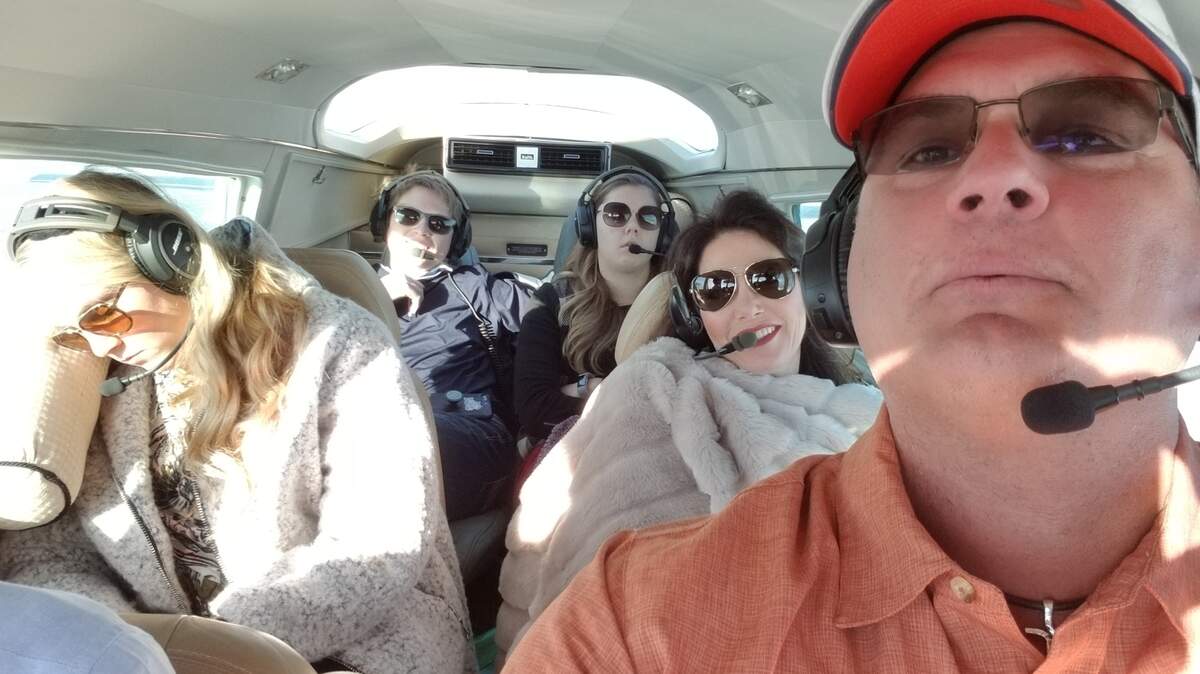
Semmelmann, who got his pilot’s license after receiving his reprieve from death, flies people with cancer in North Texas to M.D. Anderson in Houston for treatment as part of Raquel’s Wings For Life. The nonprofit organization, based in Decatur, has a mission to eliminate the burden on the patient and family in the form of cost and drive time, with pilots such as Semmelmann donating their planes and time to take patients back and forth from treatment free of charge.
”Marc is a walking miracle,” said his friend Steve Smith. “His story is perhaps the most inspirational I’ve ever heard. If ever someone needs proof that miracles happen, just take a look at Marc. There’s no way in the world he should be here, and yet he is, and I am one of many who are thankful.”
The diagnosis
Semmelmann vividly remembers when his doctor told him his life was nearing its end.
”I am a man of faith, and the day he came in to my hospital room he said, ‘Son, you’re going to need to get your affairs in order because you have at best six months to live,’” he remembered. “That night after it all settled in, God and I had a huge argument. I was red-faced, mad, angry, blood pressure up, really angry at God. It wasn’t because I was afraid to die, it was all because I have a wife and three kids that I am still responsible for. I needed to raise them and take care of them so they could be old enough to be on their own. I couldn’t leave my wife alone to do that by herself.
”After about an hour of this argument, my blood pressure went down and my tears evaporated. I didn’t hear God talk to me, but there was this sudden peace that came over me that made me feel like ‘He’s got this. I’m not going to die. Trust the doctors, let them do what they do, be a good patient and I’ll make it.’”
Semmelmann said from that moment on he had confidence that he was going to beat the cancer that was believed to be unbeatable.
”Of course, there were doubts during this battle, but I kept going back to my faith and my feeling of comfort he gave me during that argument,” he said.
Aggressive cancer treatment
A former football player for the University of Texas, successful businessman, father of three, and devoted husband, Semmelmann had everything to live for, and yet no one had ever recovered from the deadly diagnosis he received. He was going to have to defy medical science.
What’s more, if the extremely aggressive cancer didn’t kill him, the treatment likely would, he was told.
But Semmelmann figured he had nothing to lose. If he was going to die, he was going down fighting.
”The doctor had decided that he was going to be more aggressive than he ever had. Most patients with this diagnosis were older than me and not in the physical shape I was in,” he said, adding with a chuckle, “Not that I was in great shape, but better than most and I had youth on my side — if 43 is youthful.
”I remember just allowing them to do whatever they wanted to me ... running drugs through my body. I went from 240 pounds down to 180 in about nine months. I went from having hair and normal skin color to not a hair on my body — nose hairs, eyelashes, eyebrows, etc., gone — and completely gray skin color.”
Semmelmann would check in to M.D. Anderson to start chemo treatment. The plan was to have a 24-hour drip of chemo and then a day or two later he would be able to go home and deal with all the repercussions, such as vomiting, sickness, loss of appetite.
However, the chemo was — as he put it — frying his kidneys. So he had to stay in the hospital for up to two weeks with each treatment, basically comatose, depending on the recovery of his kidneys. Then, he’d be transported home for about a week before returning for another treatment.
”I would start to come out of it and be able to communicate some to my family. Then, I would go back to M.D. Anderson and the process started all over again,” Semmelmann recalled. “It obviously got continuously worse as the chemo kept taking the life out of me.”
In the end, though, it restored his life, something that had never happened before or since with another human being.
”I asked the doctor at one point a couple of years later if he believed in miracles or mistakes. His comment was that people that have best results are those that have a great support group, family, previous good health and a purpose to live for and ‘prayers to whatever God I believed in,’” Semmelmann said. “He was never emotional or amazed at what happened, not sure if that is just his clinical bedside manner or what. Maybe doctors see miracles more often than they let on, and always project the worst.”
Giving back to Raquel’s Wings
Raquel’s Wings flew Semmelmann to M.D. Anderson. He credits them with helping save his life.
”That five-hour drive back and forth is a real beating, especially with all the effects of chemo. It took out a lot of the wear and tear on my body,” he said.
Semmelmann began to help with Raquel’s Wings annual bike rally, the Eighter from Decatur. Then, he said, Fabio Labrada, who started Raquel’s Wings in 2005, tried to talk him into flying.
”I took a discovery flight and was hooked,” he said. “At that point I decided to become a pilot and wanted to give back what was given to me, taking patients back and forth.”
Labrada said Semmelmann is an inspiration to many and a blessing to his organization.
“His will to survive and fight to be around for his family was so strong, he wasn’t going to let the cancer win,” Labrada said. “And when he did pull through it he was determined to give back to the organization by going through the training to get his pilot license and picking up as many trips that he can. He’s a part of our family.”
Semmelmann joked that as a result, instead of having a midlife crisis at 50 and buying a red Corvette, he bought his first plane. The physical activities that he was once able to do are no longer possible, so the mental challenge and things to learn about flying became his new “physical activity.”
His dad still lives in the Houston house Semmelmann grew up in, so he volunteers for overnight trips because he has a place to stay and it’s a chance to visit his father.
”I typically fly a couple of trips a month, depending on the schedule,” he said.
Semmelmann said he has made probably more than 100 flights to M.D. Anderson. He’s even made some friendships along the way, and he always does his best to keep them positive.
”I try to instill some hope that they can overcome,” he said. “I tell them my story and it seems to give them some comfort and hope that they will have a great outcome as well.”
Kelly Bramlett, the mother of a little girl flown by Semmelmann to M.D. Anderson many times, called him “Texas grit personified.” The connection inspired Bramlett to also work with Raquel’s wings and Semmelmann partners with the nonprofit the Bramletts began in Abby’s honor following her death.
“To say he is a hero is an understatement. With Marc, it wasn’t just the fact that he was donating his plane and his time, it was that he was sharing his journey and taking part in ours,” Bramlett said. “Marc faced cancer and all the terror that goes with it. He and his family walked the same path of fear, doubt, pain and the unknown as we were. Knowing he had been there made it somewhat comforting to be in his presence.
“He gave us hope. With each trip, Marc invested in Abby’s world.”
New normal
Semmelmann calls life today a “new normal.” He has neuropathy in his feet and hands. He said the doctor told him those nerves could/would very slowly grow back over time and that some damage would most likely be permanent.
”There was and still is, a time where I would just like to amputate my feet at the ankles because they hurt so bad,” he said.
The surgery required the removal of the right half of his pelvis. It was replaced with a cadaver bone. Because of that and all the muscles that were attached, he has no groin muscle on his right leg and only half of a hamstring.
He has only one leg that functions correctly and he’s lost a lot of his hearing.
”The physical limitations have created a new normal and you just deal with it,” he said.
But he is dealing with it as an alive and happy man, surrounded by his wife of 30 years, Susan, and their three children.
And yes, the experience did change Semmelmann’s outlook on life.
”Some things that I used to get upset about don’t really bother me anymore. Life is too short to worry about things you can’t control and the things you can control, you just do the best you can,” he said. “I think I enjoy things more than I did before. I can sit back and watch a situation, my kids, other kids, adults, etc. and just smile at the situation and fun that they may or may not be having.
”I am getting to live and experience a great journey. It’s something I wish everybody could experience but wouldn’t wish it on anyone.”