
‘An extraordinary time.’ Murals spread the word about TCU in nation’s biggest cities
TCU might be little in size, but it’s big in accomplishments.
Its enrollment of just over 12,000 is small compared to the likes of the University of Texas and Texas A&M, but the accomplishments of alumni rank among the nation’s best.
With alumni coast to coast, TCU has become renowned for its success. From Broadway to Hollywood, and from the halls of Congress to a football team that came within one game of winning a national championship TCU, while not yet a household name, is certainly a name most in the know, well, know.
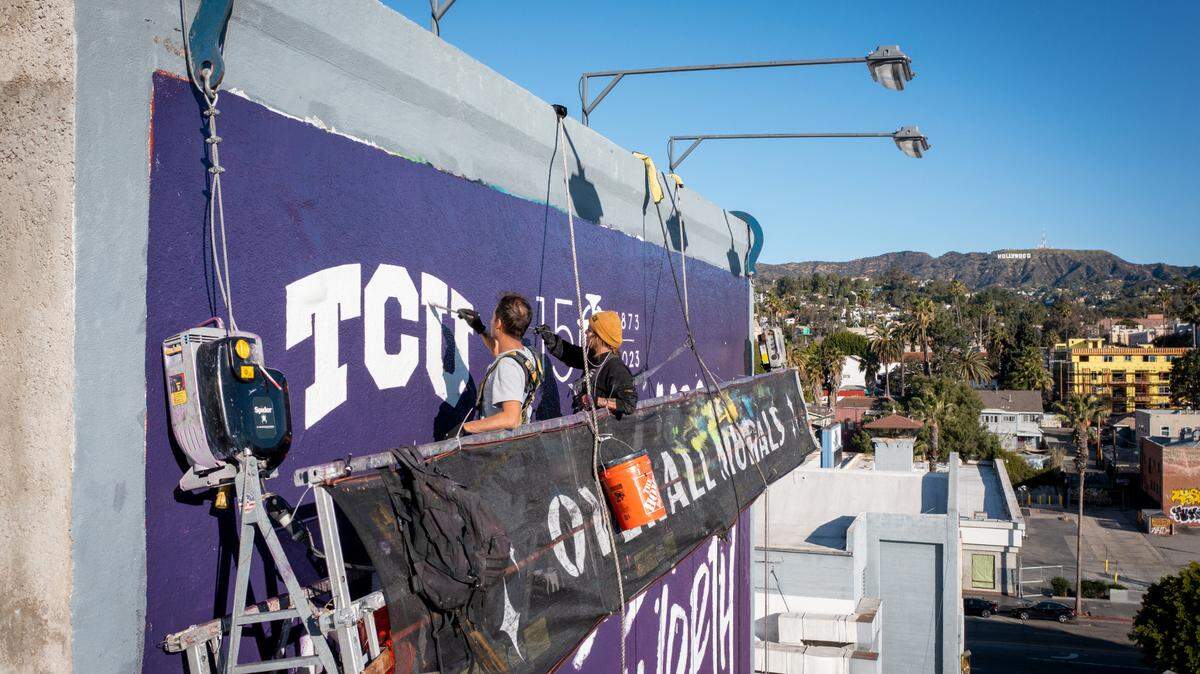
And for those who don’t know, as TCU celebrates its 150th anniversary this year, murals are going up in major cities throughout the United States as a reminder of the school’s impact on society. They are part of the university’s Lead On marketing campaign.
The murals were created for TCU by Los Angeles-based designer Mark Gerardot and hand-painted on the sides of the buildings by vendors Overall Murals in Los Angeles and Colossal Media in New York.
“This is an extraordinary time in TCU’s history,” TCU Chancellor Victor J. Boschini said. “We are showing the world what Horned Frogs can do when we Lead On — together. Our innovative murals across the country give us an even greater opportunity to connect with and celebrate our powerful community of students, faculty, staff, alumni and fans.
”We’ve just begun our 150th year and this campaign captures the character and tenacity of our leaders.”
It started with a mural that went up in October in New York featuring Broadway star and 2012 TCU graduate John Devereaux. Then, on the heels of TCU’s game against Georgia for the national college football championship, one went up in Los Angeles featuring 2008 graduate and TV producer Katherine Beattie, who is also an advocate in Hollywood for inclusion and the portrayal of people with disabilities in film and TV.
Beattie is also a fearless athlete who competes in wheelchair motocross and parasurfing. In 2016 she became the first woman to land a backflip in a wheelchair.
“I am so grateful to everyone at TCU for nurturing and expanding my gifts,” said Devereaux, who is in the supporting cast of the touring company of “Hamilton.”
In fact, he stepped into the starring role of George Washington when the musical came to Bass Hall in January. He is an understudy for three leading roles.
“It is so meaningful to be celebrated like this and to know that I am viewed as a leader in my community,” Devereaux continued. “I truly believe that the stage is a platform for joy. I stand on the shoulders of those who came before me, and I pray that my shoulders will be strong to hold those who will stand on mine.”
Beattie is working on the popular TV series “NCIS: Los Angeles.” Being from LA, she said being featured on the mural in her hometown makes it even more special.
”They asked if I would be the subject of the mural and I said, ‘Are you sure?’” Beattie said with a laugh. “I’ve had a couple months to wrap my mind around it. It’s surreal, pretty wild, but also very cool to see myself up there promoting my alma mater.”
TCU wasn’t in Beattie’s original plans. She originally planned to attend Wisconsin, but visited the campus in 2004 with her twin sister, who wanted to go to TCU.
”I’d never heard of it, but when I set foot on campus I said, ‘This is it,’” Beattie said. “So I went there and she actually ended up going to Wisconsin. I stole TCU from her.
”It ended up being the perfect fit for me.”
For the 2011 Rose Bowl, when the Horned Frogs defeated the Wisconsin Badgers 21-19, Beattie ordered a custom-made shirt that was part TCU/part Wisconsin.
Another Mural is planned for Nashville in April and Chicago in June. The last one will go up in Fort Worth in the fall as the sesquicentennial celebration comes to an end. The identities of who will be on those has not been released.
Response to murals
Tracy Syler-Jones, TCU vice chancellor for marketing and communication and chair of TCU’s 150th executive committee, said the response to the murals has been outstanding. She said because the murals are hard to miss, they are reaching a vast audience, some of whom might not be as familiar with TCU — which, of course, is a big part of the campaign.
”The murals give us a unique opportunity to tell the stories of our incredible alumni in a truly large and unexpected way, and to highlight the vast array of leadership qualities TCU develops and nurtures in all our students,” she said. “TCU has seen growth and engagement across the country with new fans and within our alumni base. This, of course, can be attributed in part to our football team’s outstanding season — but also to the impact of TCU’s celebrated Lead On marketing campaign, which was paired with our 150th to go bolder and brighter.”
But it’s not only the stars who have made TCU what it is, Syler-Jones stressed.
”So many of our alumni are making an impact in their respective careers, even if they aren’t well known,” She said. “That’s the idea behind our mural campaign — our alumni lead from where they are and become forces for the greater good because of their daily work.”
Growth of TCU
According to the university’s archives, TCU’s story began when brothers Addison and Randolph Clark, both Fort Worth-based ministers/teachers, had a dream of creating a college where men and women could acquire a classical education and develop character. However, they didn’t want their dream to take place in what they referred to as “Hell’s Half Acre” because of the cattle industry and upcoming new railroad.
So, they started their college in Thorp Spring, just outside of Granbury. With just 13 students, they opened the doors of AddRan Male and Female College, one of the first co-ed institutions west of the Mississippi. Within five years, enrollment swelled to 450 and the Clarks and their spouses sold everything they owned to invest in a larger building. But for the college to continue, an endowment would be needed.
The Clarks forged an affiliation with the Christian Church (Disciples of Christ) to “adopt” their school, giving it a new name and ensuring its future.
AddRan moved to Waco in 1895, where a number of traditions began. Football arrived in 1896, followed by women’s sports in the next couple of years. In 1897-98, the school’s first yearbook was named The Horned Frog and students chose school colors — purple for royalty and white for a clean game.
The name was officially changed to Texas Christian University in 1902, and as the years progressed folks came to know it as simply TCU. The campus was moved to Fort Worth in 1910 after a fire destroyed the Waco campus. Fort Worth leaders had wanted a university for some time, feeling it would soften the rowdy cowtown image.
This year, the university will graduate its 100,000th student as well as the first class of students from the Anne Burnett Marion School of Medicine.
”Since 1873, TCU’s growth has been marked by outstanding and visionary leaders that brought us to this moment in history,” Boschini said. “I believe the foundation of our success has been our deep culture of connection, academic excellence and unmatched student experience — and this foundation will ensure we thrive for the next 150 years.
”We find our passion and pursue it. In corporations, in classrooms, in operating rooms, and even on screens large and small, you’ll find Horned Frogs leading on.”
This story was originally published March 7, 2023 at 6:00 AM.