
Cerebral palsy afflicted her brother. So North Texas doctor is driven to find a cure.
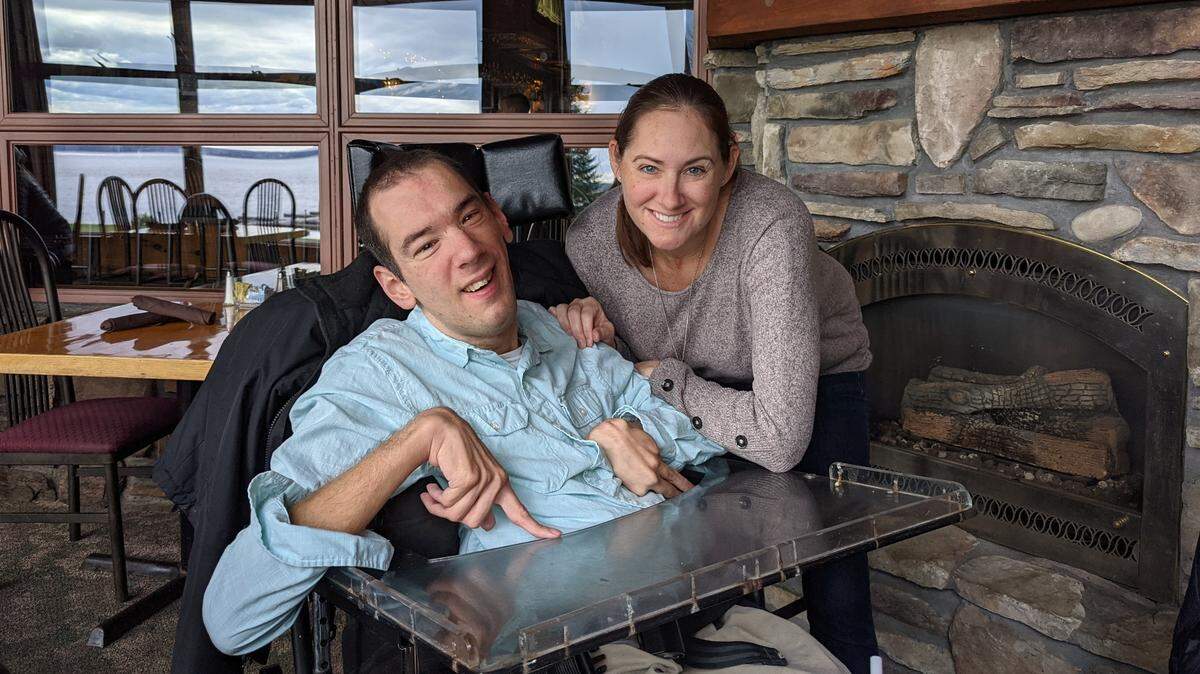
Inspired by her brother, Dr. Rachel Bailey of Trophy Club has a clear mission in life.
Every day she fights to eradicate neurological disorders, including finding a cure for cerebral palsy, a disease that has afflicted her younger brother Matt since he was an infant.
Though extremely limited in doing virtually everything, Matt continues to be sociable and do all he can to interact in a world where he is surrounded by people who daily do routine things he has never enjoyed.
“Although Matt’s development was significantly delayed and he is physically challenged, he is completely cognizant and aware of his situation and the world around him,” Bailey explained. “This adds an additional mental burden for him as he grew up with four physically-abled siblings and he is fully aware of his limitations and what he cannot do.
“He is very sociable, but his physical and speech limitations can make it difficult for him to have the same level of personal interactions with friends and strangers as others. Having witnessed firsthand how this disease impacted not only Matt’s life, but our entire family’s, I am driven to try to find effective treatments for neurological disorders in the hopes that I can prevent others from having a similar experience.”
Matt, 38, has never been able to walk, has very limited use of the left side of his body and impaired use of his right side. He also contends with body stiffening and scoliosis, has difficulty with speech and with chewing and swallowing, which are a concern for choking.
Matt has always needed constant care and help with his everyday tasks.
“As a sibling, I grew up contributing to the daily management of his disorder and frequently attended his doctor and physical therapy appointments. ... I was drawn towards the medicine/science field and wanted to better understand and treat disorders that could completely derail a life,” Bailey said.
“Being only three years apart, I was very close with my brother and helped take care of him in some shape or form nearly every day of my childhood.”
Also focused on pediatric disorders
So Bailey, who watched all of this growing up with a brother she dearly loves, became a neuroscientist.
She is an assistant professor in the Center for Alzheimer’s and Neurodegenerative Diseases and Department of Pediatrics at the University of Texas Southwestern Medical Center. She heads a research lab that develops gene therapies for neurological disorders.
She was first exposed to neuroscience at the Mayo Clinic in 2005 and worked on protein aggregation as a cause of neurodegenerative diseases, such as Alzheimer’s.
Bailey finished her PhD in Neuroscience in 2013 at the University of Florida. Though she was enjoying her graduate work, which involved studying afflictions such Alzheimer’s, she wanted more.
“I wanted my research to have a more immediate impact on peoples’ lives as well as to work on pediatric disorders,” Bailey said.
To this end, she joined the Gene Therapy Center at the University of North Carolina. There, she focused on pediatric disorders. It was also when she first began working with family foundations to develop novel gene therapies for children who had no other treatment option.
“Being able to help these families while being able to do transformative scientific research defined what I wanted to specialize my life’s work in,” she said.
Making a difference in families’ lives
Today, Matt lives near their parents in upstate New York, where they grew up. He resides in a group home for adults with special needs. And though she lives in Texas, he’s always just a memory away.
She remembered being there for Matt when, as a youngster he would get frightened in the night after being put to bed in the bedroom next to hers.
“With his condition his emotions were often amplified and at that time he was not yet able to speak beyond a few words, so he would often cry and scream to express his fears and frustrations,” she said. “My father worked nights and it was difficult for my mom to comfort him immediately as she was taking care of the house and other kids. So when I would hear him cry I used to get up and lie down next to him until he calmed and fell asleep, before going back to my own bed.”
Not everyone with cerebral palsy is as challenged as Matt and some with less debilitation can live up to around 70 years. For someone like Matt, however, the lifespan is typically less.
However, if Bailey and the many others working toward a common goal are successful, not only will life be extended, but so will the quality.
“My goal is for my research to make a positive difference in someone’s life during my lifetime,” she said. “I want to do what I can to help people and families that may be similarly affected by a devastating neurological disorder like mine was.”