2024’s total solar eclipse path will cross Texas. Here are the best places to see it.
Texas will be the prime viewing destination for a total solar eclipse in just under two years, when the moon blocks the entirety of the sun.
On April 8, 2024, the eclipse will trace a narrow path of totality (complete darkness) across 13 states, with the longest duration in Texas and the shortest in Maine. Because the eclipse will enter the United States through Texas and into Arkansas, Texans will be first to experience it. The sky will become very dark for a few minutes, as if it were night.
Texans in the path of a total solar eclipse will also be able to see the sun’s corona, its outer atmosphere, otherwise obscured by the sun’s brightness.
The last total solar eclipse in 2017, the first seen in the contiguous U.S. since 1979, didn’t make its way through Texas. This time, Texas will be the state where more people will witness totality than anywhere else in the U.S., according to National Eclipse.
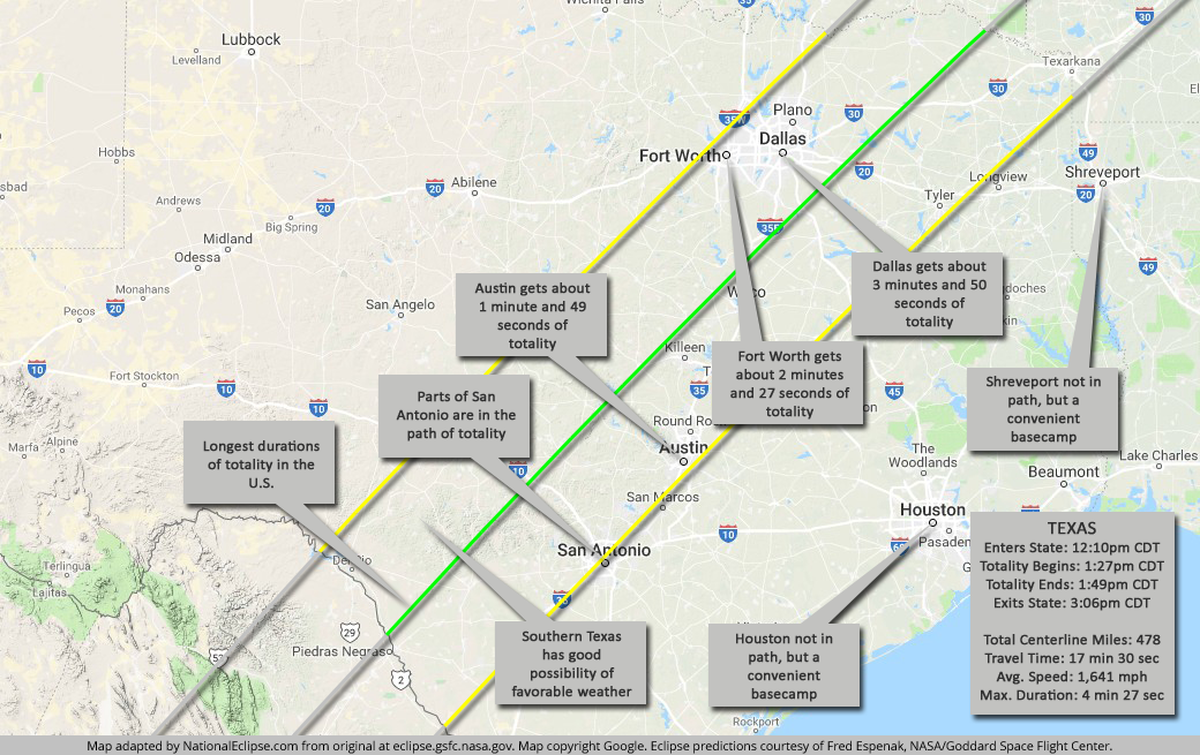
That’s not only because Texas is such a large state and the path of totality covers so much ground, but also because Texas is where the eclipse will cross the three largest cities — San Antonio, Dallas and Austin. Texas is also considered to have the best eclipse-day weather prospects in the country.
When will the total solar eclipse happen in Texas?
The eclipse will begin in Texas at approximately 12:10 p.m., with totality beginning at about 1:27 p.m. It exits the state at approximately 3:06 p.m., with totality coming to an end at about 1:49 p.m.
Totality will last about two minutes in San Antonio, Austin and Fort Worth, and about four minutes in Dallas. The longest duration of totality in Texas will be 4 minutes, 26 seconds, at Eagle Pass, on the U.S.-Mexico border.
From the Mexico-Texas border to the Texas-Oklahoma border, the moon’s shadow travels approximately 478 miles in 17 minutes, 30 seconds, at an average speed of 1,641 mph.
Where will be the best place to see the eclipse in Texas?
Clear skies make the best conditions for eclipse viewing.
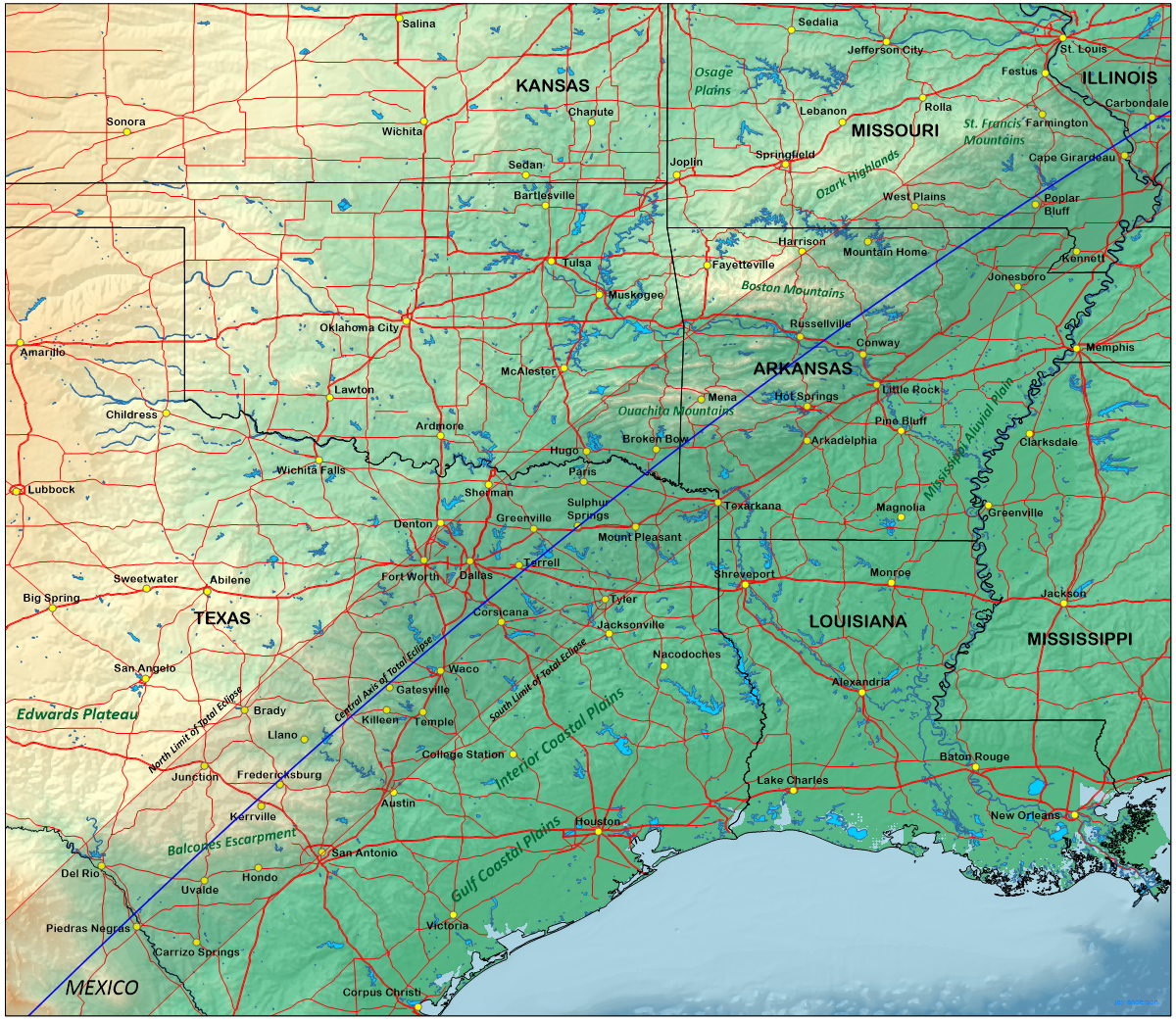
Eclipse weather forecasting site eclipsophile.com says that, in Texas, “the north [or west] side of the track has a notably sunnier April climate than the south [or east].” The best weather for viewing will lie between the Texas cities of Junction and Brady.
What Texas cities will see the total solar eclipse?
These are the Texas cities in the path of totality for the total solar eclipse, according to National Eclipse. Some of the best places to view the eclipse in Texas will be the Reunion Tower and Stonehenge II, according to Forbes.
- Del Rio, 1:28:27 p.m., 3:21 minutes
- Brackettville, 1:28:40 p.m., 4:17 minutes
- Carrizo Springs, 1:28:54 p.m., 2:54 minutes
- Crystal City, 1:29:01 p.m., 3:20 minutes
- Uvalde, 1:29:33 p.m., 4:16 minutes
- Carta Valley, 1:29:58 p.m., 2:33 minutes
- Concan, 1:30:06 p.m., 4:25 minutes
- Leakey, 1:30:26 p.m., 4:24 minutes
- Rocksprings, 1:30:43 p.m., 3:20 minutes
- Bandera, 1:31:48 p.m., 4:04 minutes
- Ingram, 1:31:57 p.m., 4:26 minutes
- Kerrville, 1:32 p.m., 4:25 minutes
- Comfort, 1:32:22 p.m., 4:12 minutes
- Harper, 1:32:22 p.m., 4:21 minutes
- Junction, 1:32:23 p.m., 3:05 minutes
- Boerne, 1:32:39 p.m., 3:37 minutes
- Fredericksburg, 1:32:51 p.m., 4:24 minutes
- San Antonio, 1:32:51 p.m., 2:11 minutes
- Mason, 1:33:23 p.m., 3:44 minutes
- Llano, 1:34 p.m., 4:22 minutes
- Marble Falls, 1:34:26 p.m., 4:14 minutes
- Burnet, 1:34:45 p.m., 4:21 minutes
- Brady, 1:34:50 p.m., 1:46 minutes
- San Saba, 1:34:58 p.m., 3:44 minutes
- Lampasas, 1:35:18 p.m., 4:24 minutes
- Copperas Cove, 1:35:53 p.m., 4:23 minutes
- Georgetown, 1:35:59 p.m., 3:19 minutes
- Round Rock, 1:36 p.m., 2:52 minutes
- Austin, 1:36:01 p.m., 1:49 minutes
- Killeen, 1:36:12 p.m., 4:17 minutes
- Pflugerville, 1:36:15 p.m., 2:22 minutes
- Harker Heights, 1:36:19 p.m., 4:12 minutes
- Gatesville, 1:36:39 p.m., 4:24 minutes
- Temple, 1:37:05 p.m., 3:46 minutes
- Woodway, 1:37:44 p.m., 4:13 minutes
- Waco, 1:37:55 p.m., 4:13 minutes
- Hillsboro, 1:38:36 p.m., 4:22 minutes
- Stephenville, 1:39:05 p.m., 33 seconds
- Granbury, 1:39:23 p.m., 2 minutes
- Corsicana, 1:39:55 p.m., 4:10 minutes
- Arlington, 1:40:19 p.m., 3:17 minutes
- Fort Worth, 1:40:24 p.m., 2:27 minutes
- Dallas, 1:40:37 p.m., 3:50 minutes
- Irving, 1:40:37 p.m., 3:26 minutes
- Fairfield, 1:40:42 p.m., 2:28 minutes
- Garland, 1:41:05 p.m., 3:49 minutes
- Plano, 1:41:21 p.m., 3:26 minutes
- Athens, 1:41:31 p.m., 3:22 minutes
- Canton, 1:41:40 p.m., 4:06 minutes
- Greenville, 1:42:12 p.m., 4:08 minutes
- Commerce, 1:42:37 p.m., 4:12 minutes
- Mineola, 1:42:37 p.m., 3:46 minutes
- Lindale, 1:42:49 p.m., 3:11 minutes
- Sulphur Springs, 1:42:52 p.m., 4:21 minutes
- Tyler, 1:43:22 p.m., 1:57 minutes
- Paris, 1:43:53 p.m., 4 minutes
- Pittsburg, 1:44:06 p.m., 3:33 minutes
- Mount Pleasant, 1:44:09 p.m., 3:54 minutes
- Gilmer, 1:44:15 p.m., 2:30 minutes
- Clarksville, 1:44:28 p.m., 4:20 minutes
- New Boston, 1:45:39 p.m., 3:38 minutes
- Texarkana, 1:46:47 p.m., 2:28 minutes
Use the interactive Google eclipse maps to look at the overall path. Click here to find out about the eclipse events happening in your city. Want to know what the eclipse will look like? Try out this eclipse simulator.
How to view a solar eclipse safely
A total solar eclipse is the only type of solar eclipse where you can briefly remove your eclipse glasses, during the few moments when the moon is completely blocking the sun, according to NASA.
Looking directly at the sun is unsafe except during the brief totality phase of a total solar eclipse, when it will be completely dark. Have on eclipse glasses while the sun is not yet fully eclipsed. Once the sky suddenly turns dark, then you can take off your eclipse glasses.
When will the next total solar eclipse be?
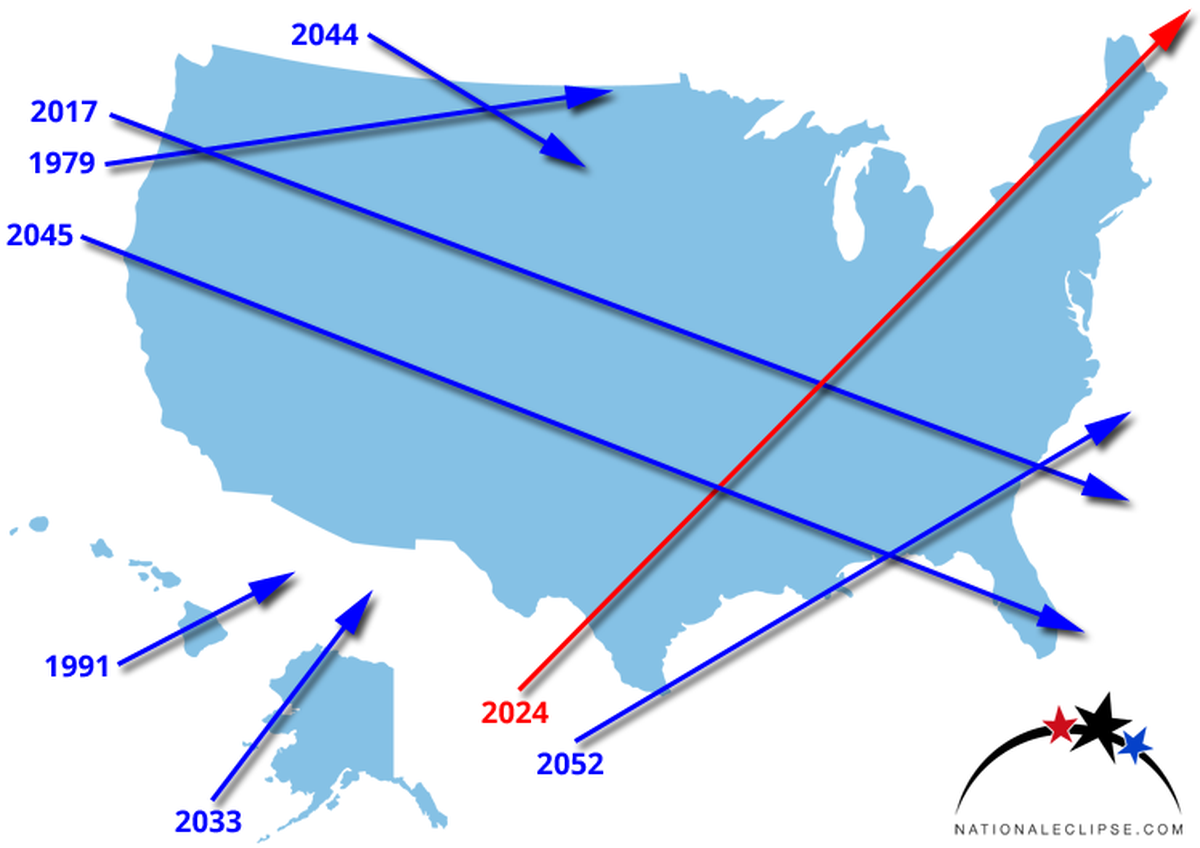
Alaska will get a total solar eclipse in 2033. Totality will be seen in Montana and North Dakota in 2044. Another coast-to-coast eclipse will come to America in 2045, entering in California and exiting in Florida. In 2052, a total solar eclipse will skim parts of six Southern states.
This story was originally published April 11, 2022 at 11:36 AM.