Azle family, homeless due to COVID, lived in sheds until ‘guardian angel’ stepped in
Madison Lechuga, 14, began to weep as soon as she sat down in front of Kim Sikes, her counselor and confidant at Santo Forte Junior High School.
She had told herself on that day in December 2020 she was going to hold it together, to not give any indication what had been going on with her grandmother, Alma Sepulvida — who’s raised her like a mother — or her family’s living situation. But it all came pouring out.
After the COVID-19 pandemic became a reality for North Texans in the spring of 2020, Sepulvida, a house cleaner, started losing contracts one by one. The 58-year-old Mexican immigrant couldn’t pay rent for several consecutive months and, by December, her landlord had ordered her out of her home of 11 years. Her sister offered her Irving residence as a place to stay, but her three youngest kids didn’t want to change schools. So she took the only housing she could find on her budget: Two sheds.
The side-by-side wooden structures, about 12 feet long and 10 feet wide, didn’t have running water, electricity or natural gas. The family walked to a RaceTrac gas station to freshen up, carrying fresh clothes and Ziploc bags of toiletries underneath their arms. At night, if someone had to go to the bathroom, they used a plastic bucket outside. They slept underneath mountains of blankets.
Lechuga described it all to Sikes in her office, through muffled tears. Sikes, who’s employed by Communities in Schools of Greater Tarrant County, asked her why she hadn’t said something sooner.
“I was like, ‘Cause she told me don’t say anything,’” Lechuga said, referring to her grandmother. “She was scared we were going to be pulled apart from her.”
Sikes called Sepulvida that same day to tell her CIS wanted to help her, and reassured her no one from their organization or any other intended to split her family.
Though the call was like the grandmother’s worst nightmare come to life, the feeling of fear was quickly replaced by an overwhelming sense of relief. The burden was no longer only on her shoulders.
“I expected this rough patch to go away within a month or so, but as time kept going I saw no way out,” Sepulvida said. “I really thank God that she did finally say something, because I wasn’t going to.”
Sikes and CIS had helped the family once before in the pandemic, offering to pay two months of rent when Sepulvida’s business first began to suffer. She was unaware the family was in trouble again, however, until Lechuga broke down in her office.
The help came quickly — Sikes was able to bring a mobile home onto the property so the family could use its electricity. She brought portable heaters from the middle school to help with the frigid nights. She began working with an anonymous donor to try to find a permanent shelter.
It was the beginning of a journey that ended in a way no one in the family ever anticipated, with them moving into a place in rural Azle they can call their own. The one-level brown house is right down the street from Eagle Mountain Lake and has a sprawling front yard where neighborhood cats and chickens roam.
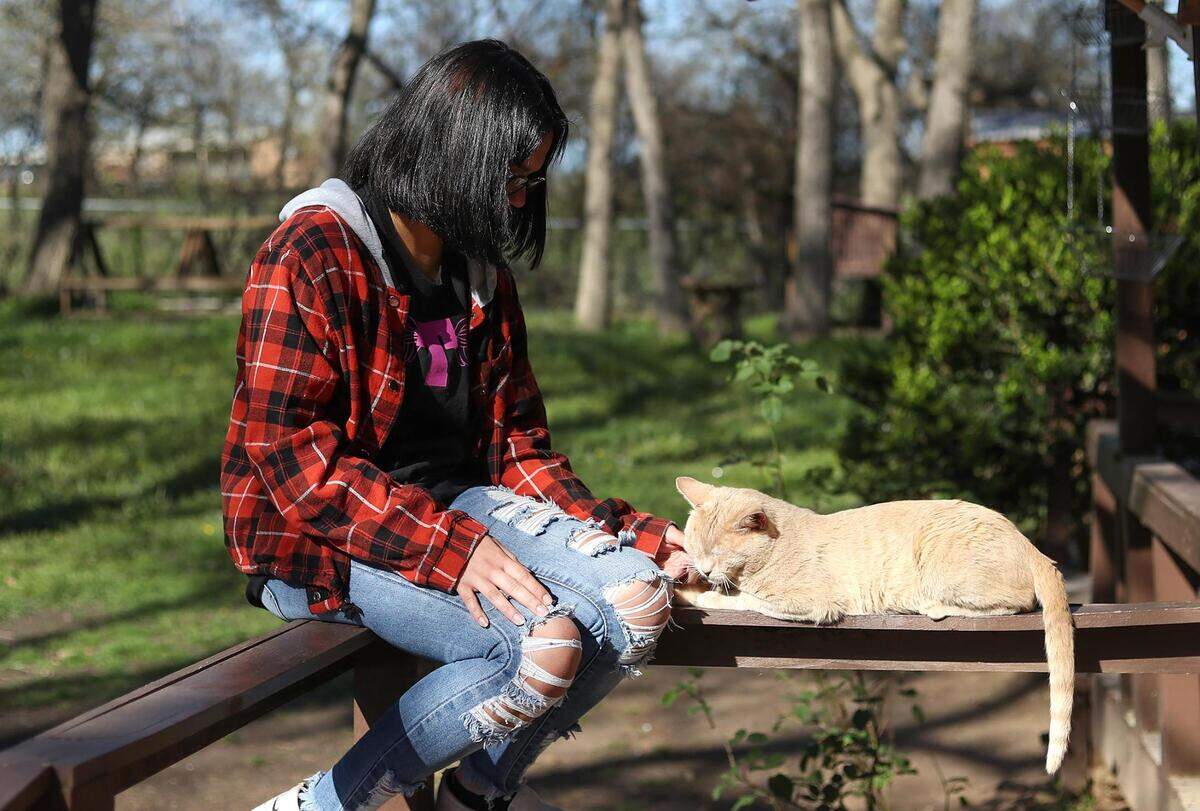
Sepulvida and Lechuga, seated on their front porch on a chilly morning last week, shared their story with the Star-Telegram.
They described how pride and fear had led them to a position where, though they had a roof over their heads, they were for all practical purposes living like they were homeless. They described how the support of friends and strangers brought them back.
‘I didn’t want them to see where I was’
The rise of COVID in America has led to a corresponding rise in a “hidden homeless population,” with more citizens quietly seeking refuge in their vehicles, RVs and campers, experts told USA Today in February. People of color, including Mexican immigrants like Sepulvida, are far more likely to become homeless than white Americans.
In Fort Worth, there was a 6% increase in homeless residents in 2020 compared to 2019, according to the Tarrant County Homeless Coalition.
Data from the United Way also shows Fort Worth has had the fourth most evictions in the U.S. during the pandemic, with 8,792.
When Sepulvida’s customers began to cancel at the start of COVID, she tried to find other ways to make money, applying for jobs such as a door-to-door Avon Cosmetics salesperson. Lechuga, too, put in applications at a movie theater and a restaurant. But the grandmother and granddaughter couldn’t find work.
One month went by with Sepulvida missing rent, and then two months, and then three. At that point, her landlord informed her she would need to pay him something or be evicted, which was when Sikes and Santo Forte Junior High School stepped in to cover two months of payments.
Sepulvida fell behind, however, the moment that money ran out. Her landlord ordered her to leave by Dec. 7, she said, when his nephew would move onto the property and they would begin tearing down the home.
She pleaded with him that she had no work and nowhere to go, and her family was struggling, she said.
He said to her, she recalled, everyone was struggling.
“I was like, ‘Oh my God, why, after all these years?,’” Sepulvida said. “It was hard for me to understand why he couldn’t understand what we were going through.”
She found the sheds through a close friend who owns several properties, and was more understanding than her landlord. The woman told her she could pay her rent whenever she was able to.
A photo provided by Sikes shows what these sheds looked like, with flimsy rooftops and peeling walls covered in blue tape. The four males in Sepulvida’s family — two uncles, a nephew and a grandson — were in one shed, sleeping on couches. The other shed was for the three females, including Lechuga and another granddaughter, who shared a single mattress.
The family faced hostility from neighbors who didn’t want to share the property, Sepulvida and Lechuga said. On one occasion, Lechuga and her little sister were walking around the land when a man began shouting for them them to get out of his yard. Another time, Sepulvida said, her brother had a gun pulled on him.
For Lechuga, worse than the loss of respect and the loss of material possessions was the loss of privacy. She savored after-school basketball practices or staying overnight at friends’ homes, though she always made an effort to conceal her family’s secret.
She only told her two best friends, and would make excuses when other classmates wanted to come over to her house to hang out.
“I didn’t want them to see where I was at,” Lechuga said. “Teenagers are pretty judgmental and word gets around really fast, so I knew, ‘Don’t tell certain people this, because everyone was going to find out about it.’”
She never imagined she would come forward to Sikes but, from the moment she began crying in her office, she couldn’t keep up the facade any longer.
She had met the counselor during seventh grade, when she was a “troublemaker,” saying the wrong things at the wrong time, she said. She grew comfortable talking to her.
“My eighth-grade year, my trouble wasn’t there anymore,” Lechuga said. “But she was still there for me.”
‘Our guardian angel’
Sikes’ first reaction to hearing what Lechuga had to say was sympathy — and frustration.
“I’m like, ‘You’ve been going through this for weeks now and you’re just now telling me?” Sikes told to the Star-Telegram. “But at the same time I got it because that’s just something you don’t — I don’t know if I would have said anything.”
She reached out to her supervisor at CIS, the nonprofit founded in 1977 that helps at-risk students, and places counselors like Sikes in Tarrant County schools. After she visited the home and snapped a picture, she showed it to co-workers to highlight the severity of their situation. Staff grew particularly worried about the cold, with plummeting December temperatures.
The portable heaters helped the family a little, but they could only stay on for around 10 minutes and didn’t prevent the blistering cold.
CIS connected Sikes with a man who wanted to help but didn’t want to reveal his name publicly. He offered to put them up in a hotel until he could find them a place.
“I was like, ‘No, you can’t do this. This is too much,’” Sikes said. “He was like, ‘I don’t care what you think. I’m gonna do this.”
The man spoke with Sepulvida over the phone and continued to keep in touch with her as he began searching for a property that would suit her family. The seven relatives spent a total of five weeks in the hotel.
One day, he took Sepulvida to a home he had been developing on McGuire Street in Azle and asked her if she was interested. Stunned, she gave an emphatic yes.
He warned her that, before she committed to anything, she should think about the property and the neighborhood she would be living in.
She looked back at the home and its surroundings. She said yes, a second time.
“He did the closing and then gave me the keys to the house,” Sepulvida said.
When she brought Lechuga to the home and told her it was theirs, her granddaughter thought she had to be lying.
“I said, ‘No, I’m not. We’re gonna be here,’” Sepulvida said. “‘This is gonna be our permanent home until the good Lord calls me home.”
The anonymous donor has become like a part of the family over the past several months, and tells them he plans on being in their lives for a long time.
He’s “our guardian angel,” as Sepulvida described it.
‘Where would we be right now?’
Sepulvida came to America in 1971 with her 11 brothers and sisters, all of whom were expected to work to support their family. By age 12, Sepulvida was checking in at a restaurant before and after school, dropping doughnuts into a hot fryer each morning and putting pizzas into the oven each evening.
She dropped out of school in eighth grade due to her mounting responsibilities at home and never went back. She began working as a housekeeper in 1998, building a client base in North Texas.
To not work this past year, for Sepulvida, felt unnatural and embarrassing, which was part of the reason she didn’t tell most of her siblings.
She’s certain if her daughter didn’t go to Sikes, she would have lost everything. They moved into their new home in mid-January, weeks before a record winter storm led to the deaths of at least 111 Texans.
“Me and my brother talk about it — where would we be right now if she hadn’t said anything?” Sepulvida said. “I really think that, if we would’ve waited longer, I would’ve lost them, either to the cold, or they would’ve been sick, or they wouldn’t be with me no more.”
Lechuga had a hard time finding the words to describe what Sikes has meant to her as she sat with her and Sepulvida in front of their home last Friday. Her grandmother encouraged her to, “Go on and say it. Make her blush.”
“I don’t see you as anything but a good friend,” Lechuga said to Sikes. “A really good friend.”
She and her grandmother have so far tried to make the new home their own. Their two cats dashed across the lawn and the porch as they spoke with the Star-Telegram, occasionally interrupting the interview. Lechuga showed a trellis on the front porch she has decorated with clusters of multi-colored butterflies.
They’re still in the process of moving in, slowly putting items into drawers and cabinets, and knowing they’re not going to have to pack them up any time soon.
There’s a lot the family loves about the home — its separate bedrooms, two bathrooms and working electricity, for starters. They like the stove where they can cook dishes instead of relying on microwaveable meals. They like all the trees in the lawn.
When asked what her favorite part of her new home is, though, Sepulvida couldn’t think of one thing.
“All of it,” she said with a smile.
This story was originally published March 30, 2021 at 5:00 AM.