Doctors said Texas woman’s heart transplant might last 3 years. That was 30 years ago.
Charline Conger’s doctors have a hard time giving her an answer when she asks how much time she might have left with the donated heart still beating inside her chest, and what she can expect in the future.
They’ve never seen a heart transplant patient live this long.
In 1987, Conger, now an 82-year-old living in Euless, noticed everyday tasks were becoming exhaustive and went to a round of different doctors in different states until she learned — in one doctor’s words — she had a bad heart. A little more than a month after she went on a heart transplant list in 1989, she got one as the result of a tragedy, when a 21-year-old woman killed herself. The heart, she said, was a “perfect match.”
Doctors told her she could expect the organ to last her one to three years, tops.
As of Wednesday, she’s lived for 30 years with her second heart.
This is a big week for Conger, with what she’s calling her 30th heart birthday on Wednesday, followed by Thanksgiving on Thursday. She knows what she’ll be thinking about when she sits down for a turkey dinner with a few family members at the Chef Point restaurant in Colleyville.
“I had Thanksgiving in ‘89 and at that time I was needing a heart. It was the very next week that I got a heart,” she said this week. “I’m very, very grateful and I’m very shocked, because it’s not the normal thing. I’ll ask my doctor about something and he’ll say, ‘I don’t know. I don’t have anything to compare it to.’”
Conger, at the end of the day, realizes she wasn’t supposed to be here this long, and feels she needs to spend her time trying to improve the lives of others and enjoy the little things in her own.
Her six now-adult children have had 26 children of their own, and she has 24 great-grandchildren and two great-great-grandchildren, which she admits “not many people” get to experience. She loves spending time with her family and bowling in her weekly league in Watauga, where she now has to use an 8-pound ball as opposed to the 14-pound ball she used to hurl down the lanes. But she can “still do a lot of damage with it,” she said.
She has won too many medals to count bowling in 11 Donate Life Transplant Games, which have been held around the country. She also volunteers for the nonprofit LifeGift, working at their local Health Fairs where she advises people learning about organ donation.
Her daughter Cathy Larkin said her mother is still recovering from an operation in mid-October to place two stents near her throat to clear three blocked arteries. The blockages had left her weak, unable to walk from the couch to the kitchen sink, she said.
Also, she continues to recoup after a driver rear-ended Conger at a stop sign about five years ago, and she had to have both of her knees replaced. She tore both of her rotator cuffs, too, which couldn’t be fixed because doctors were afraid to perform the surgery on her.
But Larkin said her mom, who’s always been a fighter, is working through her ailments.
“She’s a tough old bird,” she said.
It’s still a “mind-blower” to Conger that she’s here today, excited about the future. The first-ever heart transplant was performed in 1967 in South Africa, and in 1987, when Conger learned she would need a heart transplant, she had never heard of the operation. It seemed impossible, she said.
Thirty years later, she said she doesn’t know what the reason is she’s still here, but she believes there is one. And she said she feels blessed.
“I don’t know,” she said, wondering aloud. “How do I put (it into) words?”
“She never expected to be here this long,” Larkin said, jumping in.
‘I’m going to get you a heart’
Conger couldn’t lift a 50-pound bag of feed off of the ground to give to her horse.
This was concerning for the then-49-year-old, who had raised her children on a 12-acre farm with chickens, horses and donkeys in Vidor, and who had no trouble heaving a bag of feed over her shoulder before dumping it into a barrel. But in 1986, as she lived north of Lake Charles in Louisiana with her second husband, she had to bring food out to her horse in a wheelbarrow. So she went to a small country hospital, as she described it.
She explained her problems to the doctor and he told her, without hesitation, she was describing a bad heart. She came in first thing the next morning to have a heart catheterization, and the doctor was able to show her with a model on a computer screen how faintly her heart was pumping blood.
She came to learn she had developed cardiomyopathy after contracting a virus during her hysterectomy operation she had back in Port Arthur. A doctor in New Orleans told her she should wait six months to see if the problems would resolve themselves naturally.
Six months later, they hadn’t. And the doctor placed her on a national heart transplant list, even though medical staff were taking notice of the fact she didn’t look sick.
“Every time he’d see me, he’d say, ‘I’m going to get in trouble, but I’m going to get you a heart,’” Conger said.
It was the fall of 1989. The doctor promised her one by Christmas.
The week after Thanksgiving in November, she was at the doctor’s office for a routine checkup. She was upset, she said, because he told her she had a new virus and needed to take antibiotics.
Little did she know the man coordinating her transplant had been trying to get a hold of her all day.
When she got home, she saw she had several missed calls from him, and she hurriedly called back.
“(He said), ‘Do you have a fever?’ I said, ‘No,’” Conger said. “He says, ‘We’re sending a helicopter after you.’”
They picked her up from the hospital in Lake Charles and, within hours, she was in New Orleans preparing to have her heart removed and replaced. She remembers the scared feeling she had lying in a hospital bed with multiple IVs coming out of her neck.
The body of the anonymous donor was in another room, where doctors were retrieving her heart. All she had to do was wait.
“I said, ‘Oh my God, I might die,’” Conger said. “I said, ‘Well, I’m in your hands, Lord.’ And it passed, just like that.”
She later awoke after the successful two-and-a-half-hour operation, which she learned was the 58th heart transplant performed in that hospital, she said.
As her family recalls, she was up and active quickly.
“Four hours after the surgery, she’s sitting up in bed watching TV, eating Jello,” Larkin said. “And this is after a heart transplant. I mean they cut open her chest.”
Conger and her second husband, Randy, learned after the surgery she was expected to live one to three years with the heart, if she was lucky. But she couldn’t think like that, deciding instead to think positive, she said.
And her heart, to the bafflement of medical professionals, got stronger. Her body over time has accepted the donor’s organ as her own.
At her five-year checkup, she told the doctor her goal was to make it to 10 years. At her 10-year checkup, she said she wanted to shoot for 20.
Though Conger was only told her donor was a 21-year-old woman, Larkin learned who she was when she found her obituary in the newspaper and saw her place of death was the same place they got the heart. The 21-year-old woman, whose first name was Michelle, had shot herself in the head, Conger said.
Larkin said her mother has always felt a connection to the woman she never met.
“She said, ‘Well, I’m going to take this heart and live it to the fullest,’” Larkin recalled.
A second chance at life
Conger lives in a home in Euless down the street from one of her daughters with her five little dogs — two miniature schnauzers and three chihuahuas. One of her schnauzers, she said, is named Michelle.
Randy died three years after her operation at the age of 45 due to throat cancer, which doctors discovered when he presented with a tumor in his neck, she said. She had plans for the future with him, she said, but she was glad she at least got to experience something not many do: She took care of the person who took care of her.
She feels his presence all the time, especially in one of her schnauzers who reminds her of him.
“The male will get up on the couch and look over at me,” she said. “And I said, ‘Randy, you always said you was gonna come back.’ His eyes — they’re expressive.”
She said though she’s not a very religious person, she believes there is a God who loves her and is watching after her. She likes signs in the universe, too, like the fact her heart transplant operation was in New Orleans, known to some as the “city of second chances,” and she got a second chance at life.
Even if she can’t figure out why she’s still here, she said, she wants to give back as much as she can.
As a volunteer for LifeGift, she helps people sign up for the transplant list every year at a health fair in Euless. The nonprofit’s newsletter included a piece on her this month, which said it’s hard not to feel good seeing Conger’s “big happy ‘Welcome to Texas’ smile.”
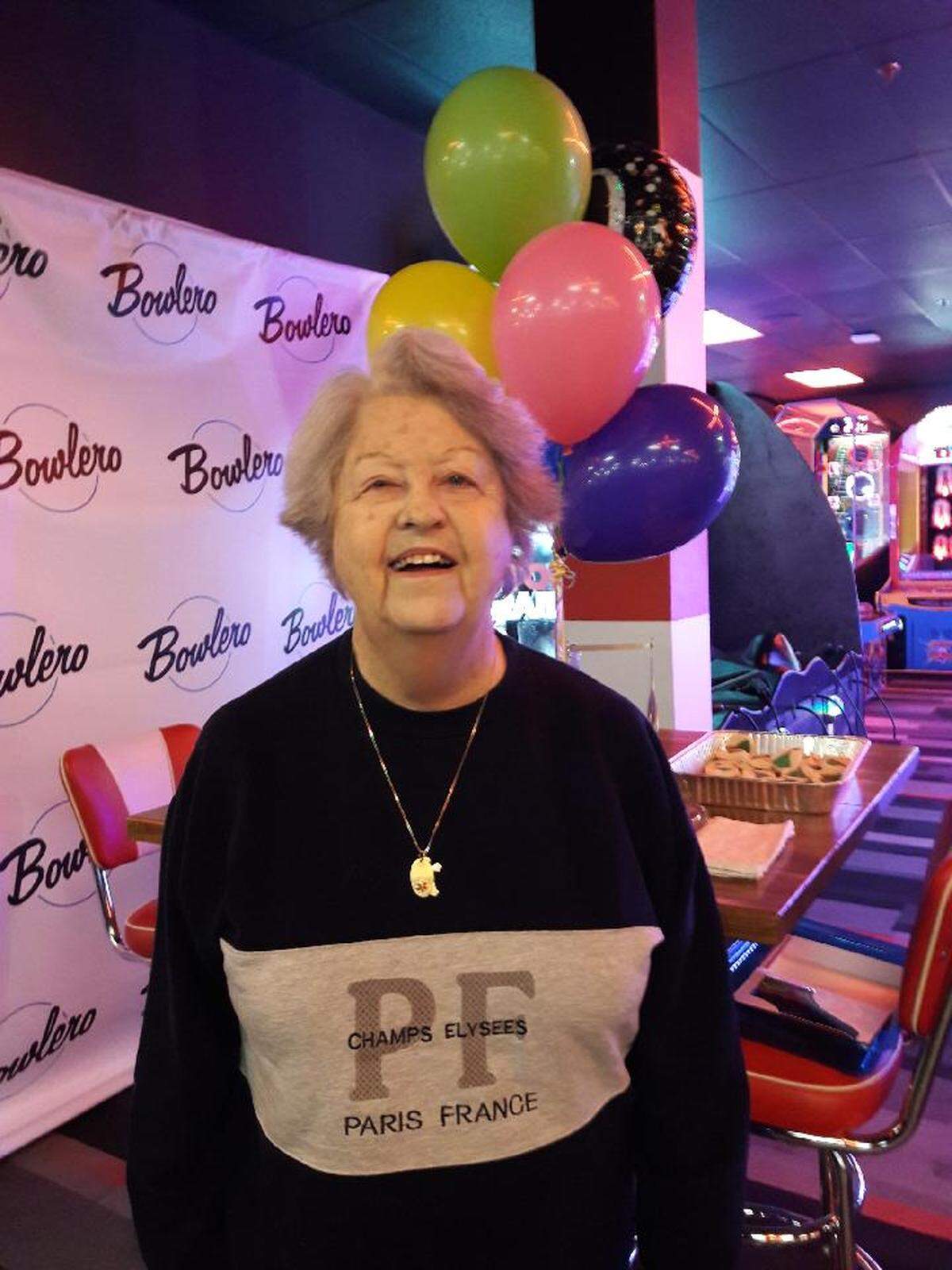
She picked up bowling at the former Showplace Lanes in Euless, now called Bowlero Euless, after Randy’s death to feel closer to him, playing a sport he always enjoyed. One of the men at the bowling alley, a former professional bowler, volunteered to teach her, she said. She started competing in a weekly senior league and later went to a one-month program so she could teach kids to bowl.
For 18 years, she taught kids anywhere from 2 to 18 the fundamentals of the sport, she said. She eventually became too tired to continue coaching and quit.
Conger still likes to bowl twice a week in a league at Bowlero Watauga, and on Wednesday, she celebrated her 30th heart birthday at the bowling alley with her friends.
Often, when she gets up to the line about to roll her ball toward the pins, she said she thinks about Michelle.
And she feels encouraged.
“I say, ‘Come on Michelle, let’s get it, let’s get it,’” Conger said. “It kind of motivates me and kind of fires me up.”
This story was originally published November 27, 2019 at 1:14 PM.