
Texas is exhausting its supply of only antibody treatment effective against omicron
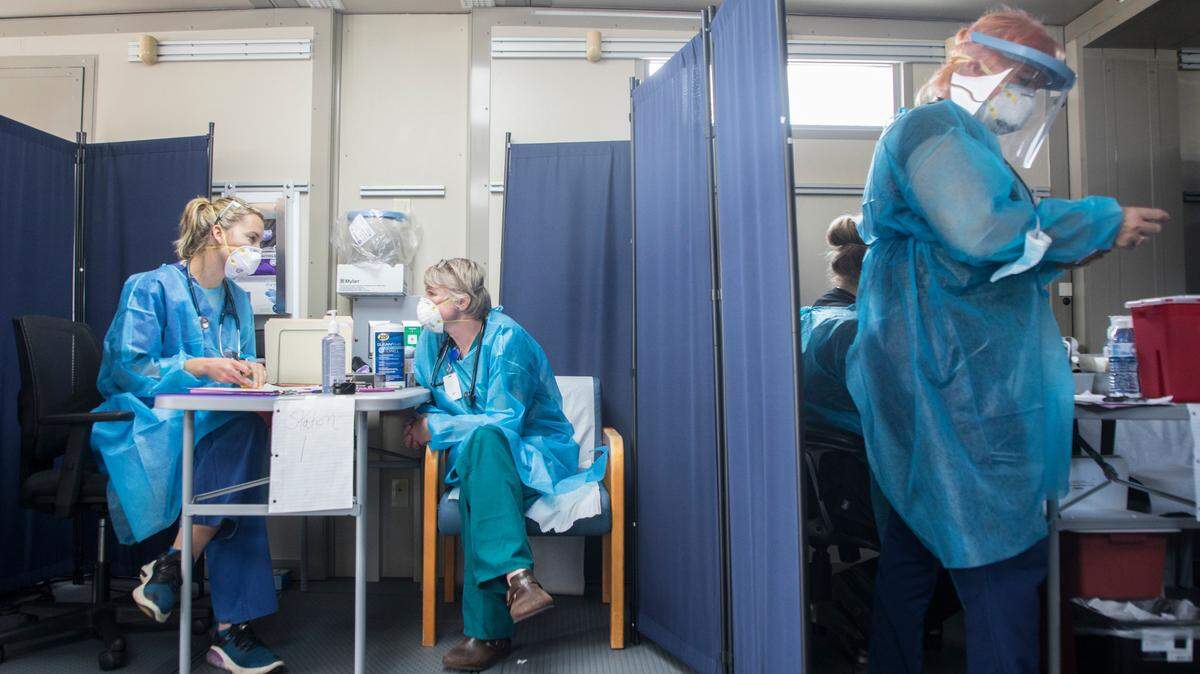
The Texas state health department is running low on its supply of monoclonal antibody treatment to fight COVID-19 caused by the omicron variant, the agency said in a Monday, Dec. 27 news release.
The treatment, sotrovimab, is currently the only antibody treatment known to be effective against the omicron variant, according to The Texas Tribune.
The Texas Department of State Health Services announced that infusion centers in Austin, El Paso, Fort Worth, San Antonio and The Woodlands had completely exhausted their supply of the treatment, and that they won’t be able to offer it again until the state receives another shipment in January.
Chris Van Deusen, a department spokesperson, said it’s likely other infusion centers will use the remainder of their sotrovimab in the next few days, according to The Texas Tribune.
The omicron coronavirus variant continues to spread rapidly across the U.S. and has overtaken the delta variant as the most dominant strain, though the Centers for Disease Control and Prevention lowered its estimate for the variant’s prevalence on Dec. 28.
Monoclonal antibodies are lab-made molecules that act like the antibodies the body develops from infection or vaccination — and which help the immune system respond more effectively to the coronavirus, McClatchy News reported.
Omicron appears to trample the defenses of other antibody treatments, but sotrovimab, the most recently authorized treatment, looks promising, though demand quickly outpaced supply, The New York Times reported.
The state health department noted that two new oral antiviral drugs to treat COVID-19 were recently approved by the Food and Drug Administration, though they’ll be in limited supply and the federal government will be in control of distribution.
The exhaustion of the state’s supply of sotrovimab comes after several hospitals in New York also ran out of the treatment. Those hospitals will also have to wait to receive another federal shipment in January, NBC News reported.
Texas received about 12,000 courses of sotrovimab treatment this year, according to The Texas Tribune. It’s unknown how many additional courses the state will receive next month, the outlet reported.
The federal government previously paused shipments of sotrovimab and all other monoclonal antibodies late last month while scientists studied the effects of the treatments on omicron, a spokesperson for the U.S. Department of Health and Human Services told NBC News.
The government resumed distribution of thousands of doses of sotrovimab over the last few days, and over 300,000 doses are expected to be available next month, the outlet reported.
But some experts fear that the virus could be mutating to evade antibodies more effectively,, McClatchy News reported.
“It is not too far-fetched to think that SARS-CoV-2 is now only a mutation or two away from being completely resistant to current antibodies, either the monoclonal antibodies used as therapies or the antibodies generated by vaccination or infection with previous variants,” Dr. David Ho, a professor of microbiology and immunology at Columbia University, said in a Dec. 17 news release.
As of Dec. 28, 16,418,271 Texans are fully vaccinated, and 4,540,093 have received a booster dose of the vaccine, according to the Texas Department of State Health Services. There are at least 53,656 active cases of the virus in Texas, according to Johns Hopkins University’s Coronavirus Resource Center.
This story was originally published December 28, 2021 at 7:00 PM.