Can private employers mandate COVID vaccines, masks? Maps show rules in every state
Private employers are increasingly considering whether to require proof of vaccination amid lingering COVID-19 vaccine hesitancy and the rapidly spreading delta variant.
But individual state regulations, some of which prohibit employers from doing just that, have added a layer of confusion. Combined with President Joe Biden’s vaccine and testing requirement affecting millions of American workers, some companies are at a loss.
Now legal experts are trying to provide clarity.
National labor and employment firm Fisher Phillips LLP released two maps on Tuesday that track state laws in real-time. The maps were designed as a tool for private companies — particularly those that employ workers in multiple states.
“As the Delta variant surges across the country, many states and localities have implemented mandates or prohibitions on the rights of private employers to require vaccines of their employees, to ask about the vaccination status of employees, and to require masks of their workforces,” said Bob Robenalt of the firm’s COVID-19 Taskforce and Vaccine work group.
“We saw the need for a 50-state map to quickly and effectively address questions from employers at the most basic level.”
What do the maps show?
The maps from Fisher Phillips illustrate where mask or vaccine mandates are allowed and whether certain industries in those states have existing mandates.
But they only show state-level restrictions and, in some cases, local rules that go beyond the state’s mandate, Fisher Phillips said in a news release. The maps also apply exclusively to private employers.
That means any mandates required by public employers, such as state and local governments, aren’t included. The firm said schools, many of which have their own rules separate from state and local governments, are also not covered.
As of Tuesday, the maps show private employers in all 50 states are permitted to require face masks under current state rules.
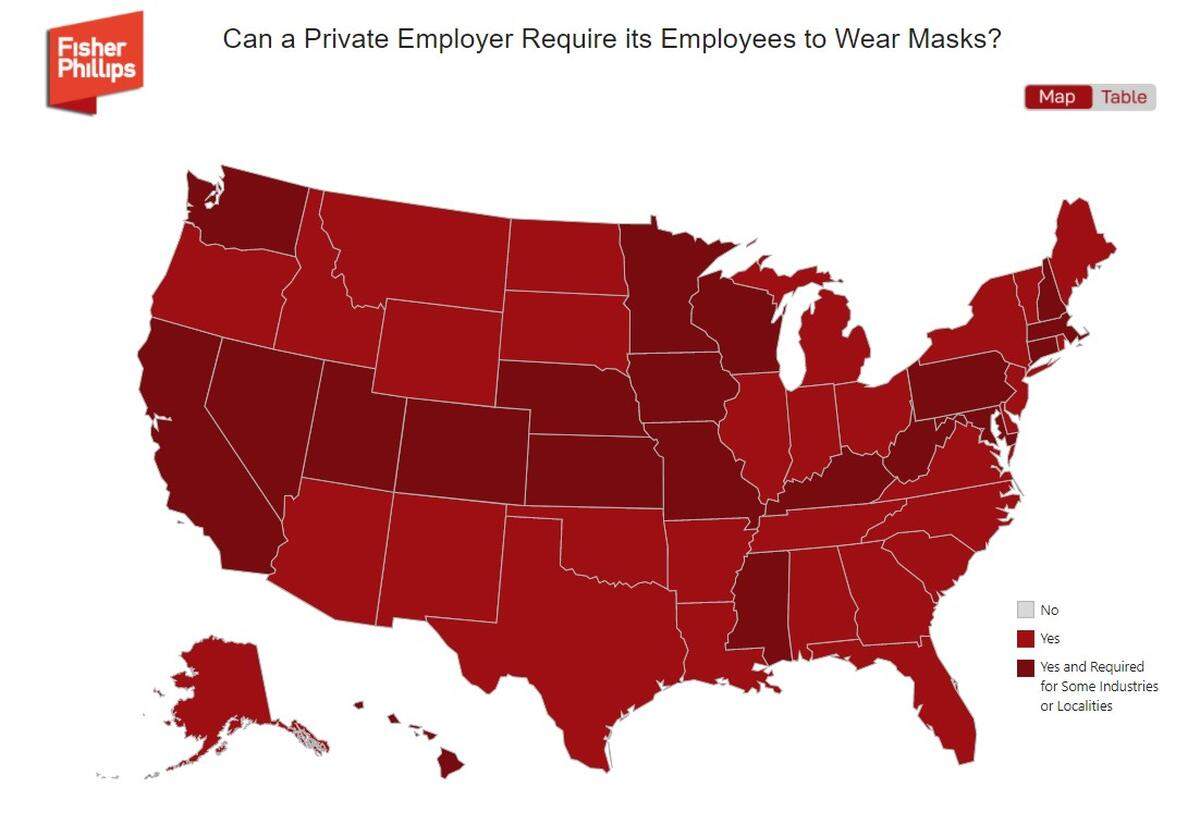
The maps also show private employers in nearly every state across the U.S. can institute a vaccine requirement under current state legislation. A handful have existing vaccine mandates for specific industries, such as health care.
The lone exception is Montana, which bars vaccination status as a condition of employment. State legislators passed a law earlier this year deeming such practices as “discriminatory.” There are, however, some exceptions for employees in nursing homes, long-term care facilities and assisted living facilities, according to Fisher Phillips.
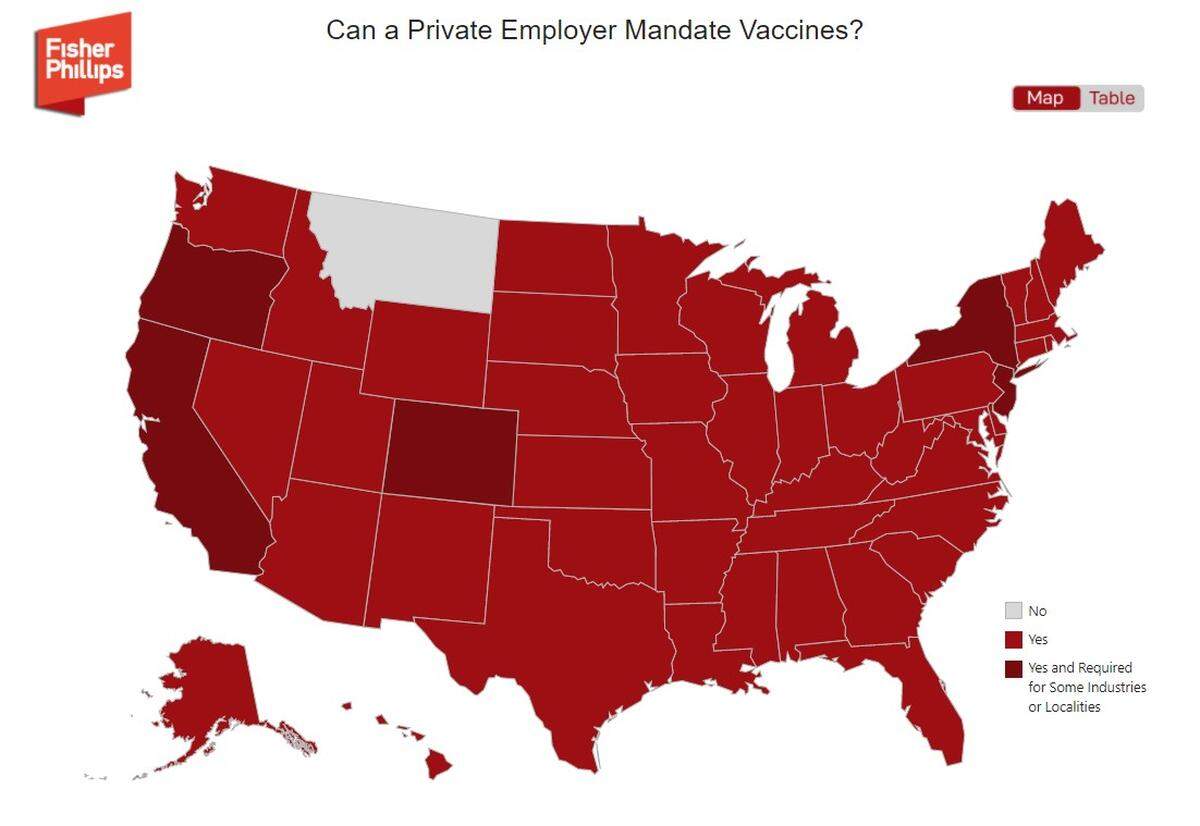
While Montana is the only state to pass such a sweeping ban on vaccine mandates as of Sept. 21, Bloomberg Law reported similar proposals are being considered in Ohio and Pennsylvania.
Roger Trim, a labor and employment attorney with Ogletree Deakins Nash Smoak & Stewart P.C., told Bloomberg states such as Florida, Missouri and Texas could be next, given their governors’ public opposition to such requirements.
Larger debate over COVID-19 vaccine mandates
A forthcoming federal rule mandated by the president will require workers at companies with 100 or more employees to provide proof of vaccination or submit to weekly coronavirus testing.
The move, which came amid a surge of hospitalizations and death spurred by the highly-infectious delta variant, has sparked some legal pushback, particularly among Republican politicians. Two dozen attorneys general have signed a letter blasting Biden’s mandate as “disastrous and counterproductive,” suggesting a legal challenge would be imminent.
But the rule also paved the way for employers that might have previously been on the fence.
“I do think that some employers might actually be relieved,” Faith Whittaker, chair of the employment practice at Dinsmore & Shohl in Ohio, told McClatchy News after the president’s announcement on Sept. 9.
She said some companies feared legal repercussions if they chose to institute a vaccine mandate themselves.
“If authorities are telling them they have to,” Whittaker said, “it might make it easier.”
Legal experts have largely agreed that employers are within their rights to institute company-wide vaccine policies.
“Private employers have considerable leeway,” said Stacey Lee, an associate professor at the Johns Hopkins Carey Business School. “For example, absent a union contract, private businesses can require employees to be vaccinated as a condition of employment as long as they allow exemptions for medical reasons and seriously held religious beliefs.”
Lee said those private companies have an easier time instituting such requirements than a government entity — but both have the authority to do so.
“Government-issued vaccine mandates are legal and have been upheld by the courts both before and after the pandemic,” she said. “I do not see that changing.”
This story was originally published September 21, 2021 at 2:48 PM with the headline "Can private employers mandate COVID vaccines, masks? Maps show rules in every state."