What makes someone a COVID-19 superspreader? New study points to two features
.jpeg "A congested nose and a full set of teeth may make someone a coronavirus superspreader, a study from the University of Central Florida suggests.")
Turns out if you have a full set of teeth and a congested nose, you may be on track to being a coronavirus superspreader, one study suggests.
Researchers from the University of Central Florida used 3D modeling and computer simulations to experiment how far sneeze droplets travel in people with different physiological features, such as nasal flow and teeth structure.
The team found that respiratory droplets travel about 60% greater when shooting out of a congested nose and fully-toothed person than those from an individual with a clear nose and no teeth.
Such features could be behind superspreading events during the COVID-19 pandemic, the researchers said. The study was published Nov. 12 in the journal Physics of Fluids.
“This is the first study that aims to understand the underlying ‘why’ of how far sneezes travel,” study co-author Michael Kinzel, an assistant professor with UCF’s Department of Mechanical Engineering, said in a news release. “We show that the human body has influencers, such as a complex duct system associated with the nasal flow that actually disrupts the jet from your mouth and prevents it from dispersing droplets far distances.”
In short, blowing your nose regularly may help reduce the distance your potentially infected germs may travel after sneezing, the researchers said.
.jpeg "5.0032006.figures.online.f13 (1).jpeg")
Other studies show that some people may be more infectious and deemed a superspreader because they have weak immune systems that allow viruses to replicate more quickly, thus leading to frequent symptoms like coughing and sneezing, McClatchy News reported in June.
Some people also naturally breathe out more particles than others when they talk, which increases with volume, according to a 2019 study on healthy people in the journal Scientific Reports.
Someone’s behavior, or lack thereof, such as poor hygiene and careers such as those in health care could also contribute to superspreading events because of increased contact with many different people.
The researchers of the new study tested the superspreader question by focusing on four types of people: one with teeth and a clear nose; one with teeth and a clogged nose; one with no teeth and a clear nose; and another with no teeth and a congested nose.
The reason why clogged noses are prone to stronger slingshots of snot is because the area for droplets to release is restricted, so their ejection increases in velocity, as opposed to what happens in a clear pathway.
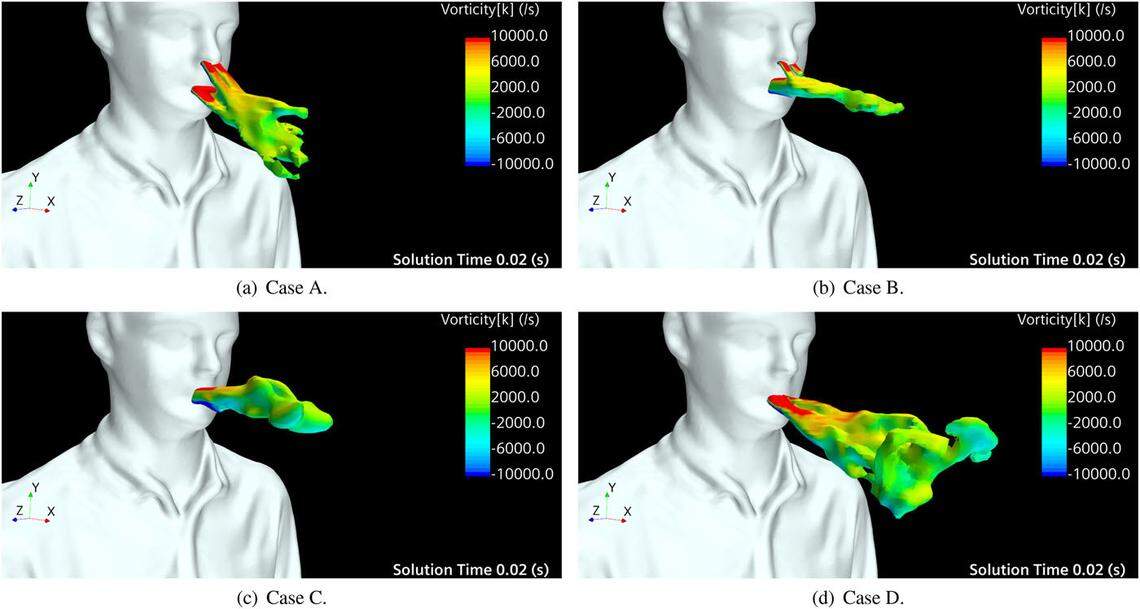
The same idea applies to a mouth full of teeth.
“Teeth create a narrowing effect in the jet that makes it stronger and more turbulent,” Kinzel said. “They actually appear to drive transmission. So, if you see someone without teeth, you can actually expect a weaker jet from the sneeze from them.”
The researchers also tested how saliva thickness played a role in droplet dispersion.
They found that thinner saliva is generally more likely to spread viruses because it is comprised of smaller droplets that float in the air longer than thick and medium saliva.
“For instance, three seconds after a sneeze, when thick saliva was reaching the ground and thus diminishing its threat, the thinner saliva was still floating in the air as a potential disease transmitter,” the researchers wrote in the release.
This story was originally published November 20, 2020 at 5:05 PM with the headline "What makes someone a COVID-19 superspreader? New study points to two features."