Could a face mask lower your own risk of COVID-19 infection? Past outbreaks say ‘yes’
The U.S. Centers for Disease Control and Prevention announced Tuesday that the latest science confirms the use of cloth face coverings as a “critical tool in the fight against COVID-19.”
The agency maintains that face masks may help prevent infected people from spreading the novel coronavirus to others, but that they may not protect the wearer themselves.
However, one California doctor told McClatchy News in an interview that there are several studies on past outbreaks such as severe acute respiratory syndrome (SARS), Middle East respiratory syndrome (MERS) and even SARS-CoV-2, the virus that causes COVID-19, that demonstrate masks can decrease risk of infection for the wearer by about 66%.
The information from Dr. Dean Blumberg, chief of pediatric infectious diseases at University of California Davis Children’s Hospital, could be a game-changer for those who might question the validity of face masks during the COVID-19 pandemic.
“Everyone should wear a mask,” Blumberg said on UC Davis LIVE: COVID-19 last week. “People who say, ‘I don’t believe masks work,’ are ignoring scientific evidence. It’s not a belief system. It’s like saying, ‘I don’t believe in gravity.’”
“People who don’t wear a mask increase the risk of transmission to everyone, not just the people they come into contact with. It’s all the people those people will have contact with,” he added. “You’re being an irresponsible member of the community if you’re not wearing a mask. It’s like double-dipping in the guacamole. You’re not being nice to others.”
Blumberg cites a June paper published in The Lancet that identified 172 observational studies across 16 countries and six continents that included the testing of social distancing, face masks and eye protection in both healthcare and non-healthcare settings.
In the hunt to learn if surgical and cotton masks protect the wearer from infection, the researchers adjusted the odds ratio for six studies between 2004 and 2008 on SARS and found that wearing a mask lowers infection risk by about 66%, Blumberg pointed out.
“Since [SARS, MERS and SAR-CoV-2] are all related and generally transmitted similarly...adding in [these] studies allows for stronger and more precise conclusions to be drawn” for COVID-19, Blumberg said.
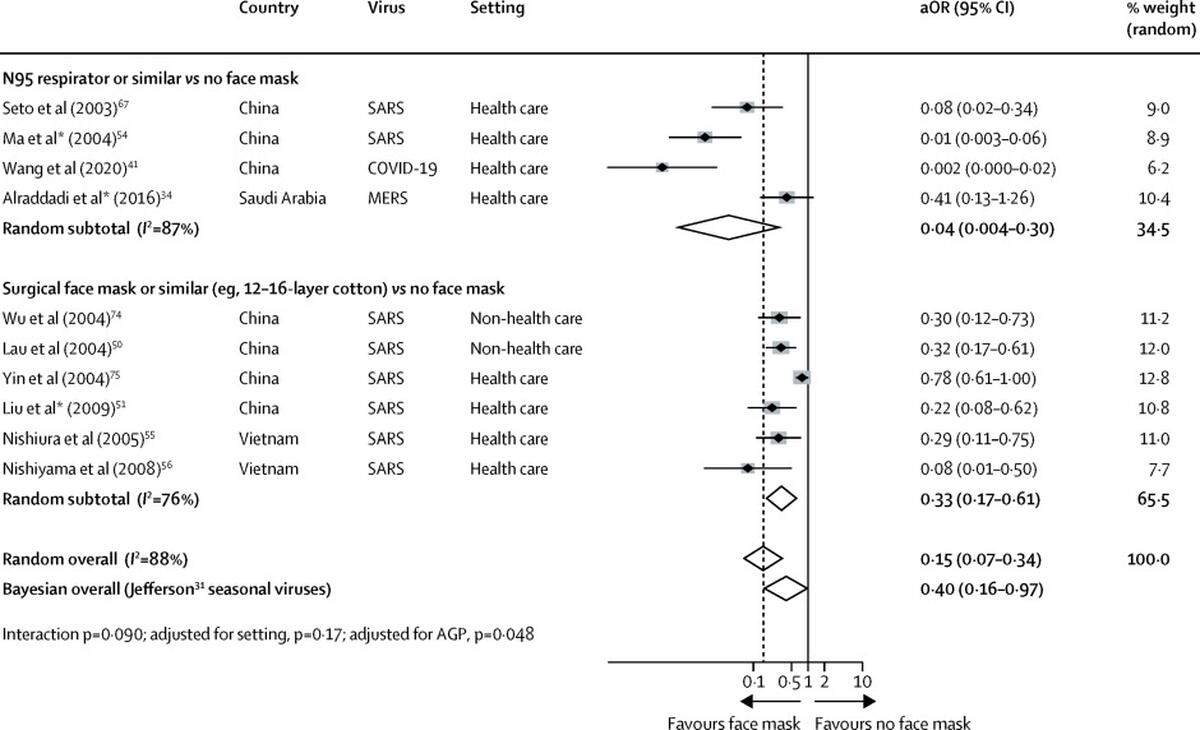
The studies that looked at N95 masks also all favored face masks over no mask.
“Based on this study and others, not only does wearing a mask help protect others and the community, but also wearing a mask can protect yourself, too,” Blumberg said.
Most of the studies took place in healthcare settings where exposure is prolonged and intense, he noted, which means mask wearing in public “would probably work even better, but of course you need to study that to really be confident.”
Last week, the World Health Organization said the possibility that the novel coronavirus spreads via the air “cannot be ruled out,” but it still claims droplet transmission through coughs and sneezes makes up the majority of viral spread.
“We know that the surgical masks will form a physical barrier to those droplets...and yes, there probably are some aerosol transmission, too, but the low-hanging fruit is to prevent droplet transmission,” Blumberg said. “Once we get a handle on that, then we can solve the N95 shortage…but that’s a fight for another day.”
Federal leadership is lacking
When the pandemic sprouted, the CDC urged the public to avoid wearing face masks because they had to be saved for healthcare workers; there also wasn’t enough research to determine if they did more good rather than harm for this particular virus.
Then in April, the agency reversed course and recommended the public wear cloth face coverings to minimize coronavirus spread after learning that a “significant portion of individuals” who lack symptoms can still pass the disease on to others.
The back and forth on public health messaging is the product of a politicized pandemic, where advice comes from politicians rather than credible scientific experts, Blumberg told McClatchy News.
“I think what we can say is there’s been a stunning lack of federal leadership at all levels related to this pandemic,” Blumberg said. “And the CDC has been sidelined, that’s been clear to me.”
Beginning Wednesday, hospitals are required to bypass the CDC and send COVID-19 patient data to Washington’s Department of Health and Human Services, the New York Times reported.
“It’s really disappointing because we’ve seen with past new infections like with Zika, Ebola and H1N1 that the CDC was a leader, and we really looked to [them] for credible, excellent guidance, and we just haven’t been hearing from them,” Blumberg told McClatchy News.
“It’s unfortunate.”
This story was originally published July 15, 2020 at 12:27 PM with the headline "Could a face mask lower your own risk of COVID-19 infection? Past outbreaks say ‘yes’."