North Texas manufacturers start making medical equipment for coronavirus needs
The sewing machines fell silent last week inside of the Lewisville furniture factory, where workers had been churning out around 20 handmade items a day. As one of many “non-essential” businesses during the coronavirus crisis, the owners had to lay off all 41 employees and shutter their operation.
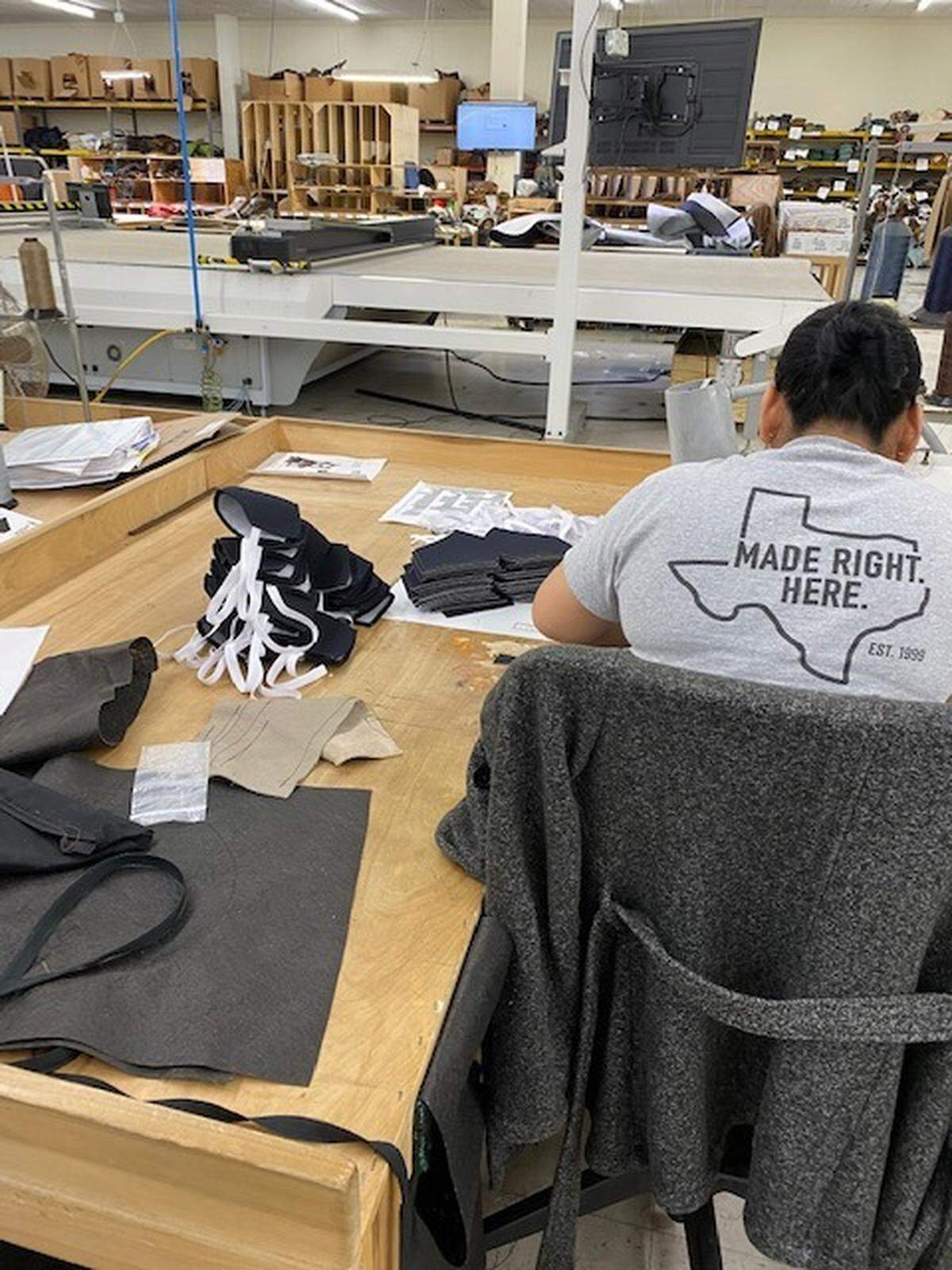
But Mitch Lurie and his wife, DeAnne Lurie, the duo behind DFW’s The Leather Sofa Co., took note of the pleas from local medical professionals who were running low on vital personal protective equipment like masks and gloves. The couple thought about how they could use their own facility and the materials that go into their couches to produce face masks. They would just have to pick up a new trade, fast.
They brought back about 10 workers, temporarily, from unemployment. With zero experience making their exclusive new product, they turned to the Internet to find a good pattern for a standard face mask they could replicate.
In Denton County, businesses including movie theaters, shopping malls and non-essential manufacturing companies have been ordered to cease operations — unless they can retool their business to produce medical equipment in high demand. Dallas County has the same exemption in its stay-at-home order, as medical professionals across North Texas deal with a shortage of life-saving equipment like ventilators and personal protective equipment like face masks.
Lurie, a South African immigrant who “has lived the American dream since 1986,” said he and his wife were motivated by the reports of doctors pleading for help. All they had to do, he said, was have experienced employees work off a pattern loaded into a sewing machine. The seamstresses have learned a little more with each mask.
Lurie sent the first two masks to a man from Texas Health Presbyterian Hospital in Dallas who had put a message on Facebook, and he told him they could use more — a lot more.
The Leather Sofa Co. has so far produced 3,000 masks, and on Thursday representatives from various agencies came in to make purchases, from the oncology department at Texas Health Presbyterian, which collected 1,200 masks, to a hospice facility that bought 100.
The woman who made the purchase, he said, was moved to tears. She hadn’t been able to find masks anywhere else.
“I was lucky enough to have the equipment, to have the people, and Dallas-Fort Worth has just been unbelievable to me and my family,” Lurie said. “I just felt I didn’t have a choice.”
Carlos Castillo, who makes furniture inside the factory, said it wasn’t too difficult to transition into making masks and more people could do it. Digital copies of their face mask patterns are available on The Leather Sofa Co.’s website.
“I think we shared with some other companies so they could use it,” he said.
The shortage of medical equipment across the country is ramping up into a crisis, with governors in hot-zone states like New York and California telling the federal government they need more ventilators to save lives. Doctors and nurses around the country have resorted to re-using their own face masks, occasionally rubbing in hand sanitizer to clean them.
North Texas leaders are hoping manufacturing companies will be inspired to step up and adapt their operations to help medical workers in the fight against COVID-19. And there are signs some businesses are heeding the call.
XCaliber Container, based about an hour northwest of Fort Worth in Graham, is taking its steel shipping containers and transforming them into testing facilities. Hamilton Hospital in Olney began using the company’s “medical assessment” pod on Thursday to test individuals who suspect they might have COVID-19, according to Magan Anderson, an XCaliber spokesperson. The pod, which is equipped with two separate rooms, sits a safe distance away from the hospital.
Its purpose is to separate potential coronavirus patients from those who have other health concerns and test them in a safe, clean environment, Anderson said. That’s the same goal of XCaliber’s new drive-through testing pods, where medical staff can sit inside of a container lined with windows and test the people who walk or drive up.
The Graham Regional Medical Center was set to debut its testing pod on Thursday, Anderson said.
“Most companies have the ability to make a different product, but they don’t really think about it because there’s not always a need,” she said. “Now the necessity was there.”
Workers at XCaliber are making at least 10 drive-through pods or medical assessment pods a day, and there have been more than 150 orders for the two different products, Anderson said. The company received calls on Wednesday from medical agencies located everywhere from New York, to California, to Washington.
Five North Texas power plants have been using drive-through pods to check the temperature of those who want to come in as well as administering a questionnaire, Anderson said.
Adapting in a crisis
The key to pivoting a manufacturing company, it seems, is looking at the products the business typically produces and tweaking the process to meet a new demand.
XCaliber Container is dividing some of its shipping containers into two interconnected-yet-separate exam rooms, and cutting out windows in other containers so they almost resemble a fast-food drive-through window. The medical professionals working at these facilities can either walk up to the patient in their car or interact with them through the window.
The test for coronavirus involves swabbing inside the nose or the mouth.
Brent Isom, the XCaliber owner, was interested in how large companies like General Motors had begun producing items they had never made before like ventilators, Anderson said.
“And he said, ‘We’ve got all these containers just sitting here in our yard,’” she recalled.
The two types of units are equipped with heating, air conditioning and electrical outlets powered by a small generator, making them more comfortable in the Texas heat than tents, she said. The steel pods are left relatively empty except for some chairs and tables so they can be easily disinfected on a regular basis.
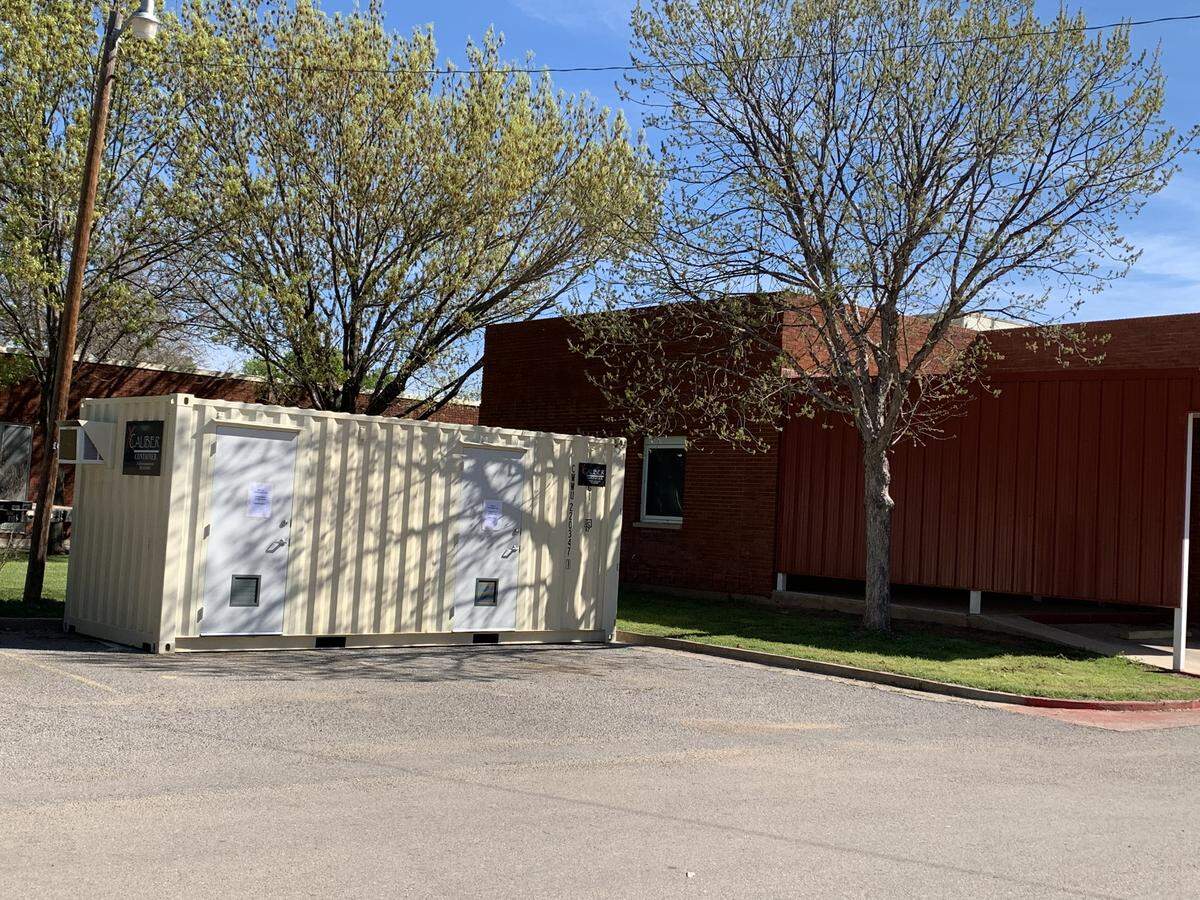
The drive-through facility is designed so as many as 500 people can be tested in a day, Anderson said.
The Young County company is still considered essential under local orders and has been producing its normal products at a fairly regular pace, Anderson said. The testing pods, however, have become the “top priority,” she said.
Companies like The Leather Sofa Co., which opened in 2004 and has four stores all over DFW, don’t have the option to keep making their usual products. That has left them with little choice but to adapt or close.
Workers took material that normally goes into the decking on couches — that line of fabric underneath the cushions — and used it in the roughly 3,000 face masks produced on Tuesday, Wednesday and Thursday. When the company ran out of that material on Thursday, they started making new masks from the nylon and cotton fabric used in back cushions. Both designs involve rubber bands.
The mask designs are more basic than the N95 respiratory masks, which need to be approved by the Food and Drug Administration. But they still provide protection against airborne particles.
Lurie has had trouble finding the fabric and the rubber bands he needs since so many vendors have been closed. The whole operation might have had to shut down on Thursday if he hadn’t been able to find three rolls of rubber bands in a Dallas store.
He said he has enough materials to produce around 3,000 more masks by the end of Tuesday, though he’s hoping he can find a way to keep working past then.
Castillo, who has two children at home, knows he could soon be heading back to a period of unemployment and uncertainty.
But he’s happy they’ve been able to help people who need it.
“We’re all gonna need it,” he said.
This story was originally published March 26, 2020 at 5:58 PM.