Black-owned businesses being hit hard by coronavirus shutdown, may never come back
It was a recent Friday night at Buttons, a popular soul food restaurant that features live bands and a bustling crowd five days a week.
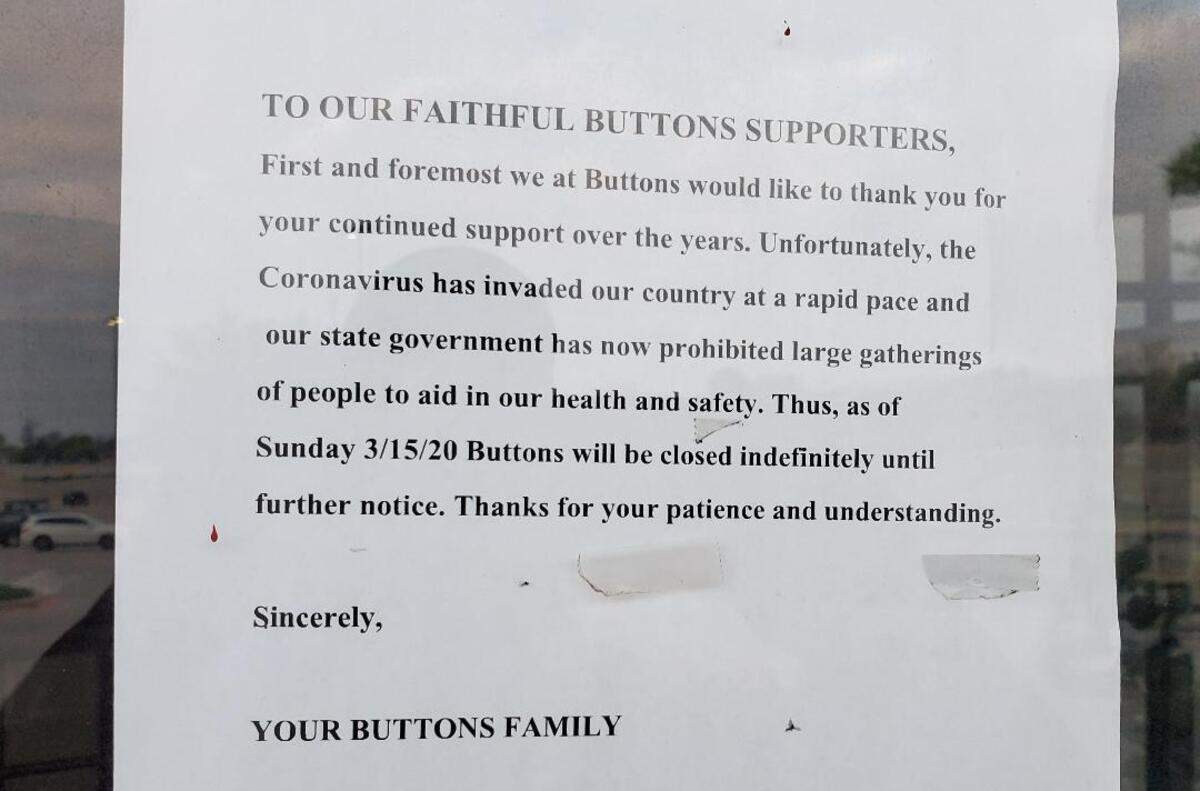
The lights were off and there was a sign on the door, indicating that Buttons was closed until further notice.
Just a few yards away Mi Cocina, a popular chain restaurant in the area, had a line around the corner waiting on to-go orders in what is the new normal for eateries during the COVID-19 shutdown across the state.
But for small businesses, especially minority own establishments, shutting down is more likely the frightful reality.
And that was the case for Buttons who shut down on March 13 well before the shelter-in-place orders were put in place in Fort Worth. They gave all the remaining food to the employees and advised them to file for unemployment.
“We do not have take out and delivery,” said owner Curtis Luper, the former TCU co-offensive coordinator who is now at Missouri. “It would not be economically sound. We simply closed and are monitoring the situation.”
It’s a situation that Bob Sanders, the public relations director for the Fort Worth Black Chamber of Commerce, expects it to play out on repeat for black businesses due to COVID-19.
He invoked an old saying in African-American communities that is often applied during economic downturns: when white folks catch a cold, black folks get pneumonia.
It means economic woes that cripple mainstream businesses are often deadly for black-owned businesses.
“I can assure you black businesses will suffer more,” Sanders said. “That is going to happen. We feel that. The mom and pop stores, the family restaurants. Some of these businesses will have to close their doors. It is not worth it for them to offer take out and keep employees. Black businesses are going to suffer.”
These are issues facing all small businesses during the coronavirus pandemic. But the loss of minority businesses would have a greater impact, not just on the business owners but the communities they serve because of the social, civic and communal services and outlets they provide can’t be obtained anywhere else.
In addition to food and great music, Buttons was a meeting place for charitable and fraternal organizations as well as grass roots political campaigning.
Many black-owned businesses are created to bring access to services specific to the community’s needs.
As a former morning show host and dubbed the voice of the community on KKDA-AM for many years and now the CEO of JBJ Marketing with offices in Dallas, Fort Worth and Atlanta with the primary purpose of helping companies make connections in under-served communities, Willis Johnson knows this all too well.
Johnson knows how black-owned businesses uplift communities, fostering a sense of pride in the people that live there.
So he is keeping a watchful eye on the day-by-day economic impact of the coronavirus pandemic — from restaurants to small minority contractors, who are the first to get the ax from big projects when the money dries up.
He called it the domino effect and believes some of these business will never recover.
“As this thing trickles downhill, they will be hurt significantly,” Johnson said. “Black business work on small margins the first place. They operate on every day cash flow. Now, there is no money coming in. I don’t know if they respond and come back.”
Barber shops and beauty salons have been shut down completely, leaving stylists out of work and at a loss for what they will do for income going forward.
Some will try to conduct business out their homes or make house calls, but that remains a touchy avenue with the mandate for social distancing.
Jamie Grant, owner of JDG Wealth Management in Fort Worth, has also felt the impact but has tried to adjust. Instead of seeing clients face to face, he is doing video calls.
But he said many of his clients in the private sector in sales can’t service their customers, which could result in it trickling back down to him, especially when you consider the money being lost with the stock market slide over the last few weeks.
Blandon Battles made history four years ago when he opened the first black-owned cigar bar in the metroplex with the Boardroom Whisky and Cigar Lounge near the medical district.
Now his business is on life support with a countdown clock already ticking.
Like Buttons, Battles usually does booming business on the weekends, but it’s a different story now. Sales are down to the single digits for what had been reduced to a take-out only business. “Nobody has been in here,” Battles said. “My sales have been nothing. This could be a business killer for me. I can’t survive past April 1.
“I have had a lot of great support. But right now, the support is not there. People are scared out there. You can’t blame them for that. I want everybody to be safe. But I need to pay rent. Pay electricity. Buy inventory. No funds are coming in. I could lose everything. So I am worried and concerned.”
And that was before the recommendation to close all non-essential businesses.
The $2 trillion federal stimulus package may provide some relief, but only a fraction of a fraction of a fraction of that will be used for grants for small business. But there are other provisions to assist those who are self-employed.
Battles plans to apply for a disaster relief loan through the Small Business Administration, but timing may be the real issue.
“By the time the money does get to us, it may be too late,” he said
Percy Bass, owner of Head2Toe Fitness in Grand Prairie, has had to close his gym but he has moved online and video classes. He has rented out equipment to his clients. So far business has held firm with no one dropping their memberships.
For some, it’s already too late.
Michelle Lacy supports her family with a bounce house rental business, a custom uniform/t-shirt printing business and youth athletic leagues. There is no money coming in from any of them right now. No parties. No games. No need for t-shirts or sports leagues.
“I’m not sure how and when I will be able to recover from this,” Lacy said. “I’m in good health, but financially it’s not good. My office lease holder sent out an email about them being closed, but we can submit payments through the drop box. But no business, no money.”
This story was originally published April 1, 2020 at 10:01 AM.