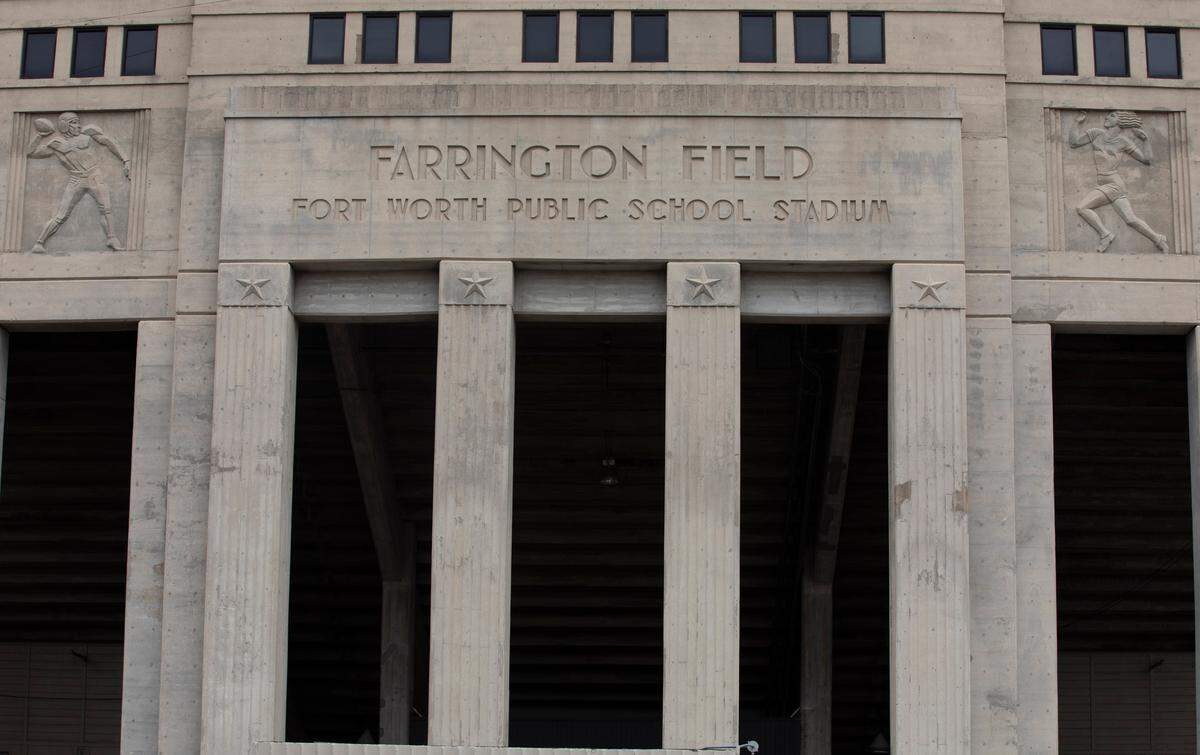
It’s too early to know exactly what a redeveloped Farrington Field would look like, but one thing is certain — whatever comes to the Fort Worth football stadium won’t be a continuation of the West 7th bar district thriving across the street.
The Fort Worth school district announced Nov. 14 that it plans to sell the historic stadium and 17 other underused school properties. The field is a prime spot at University Drive and Lancaster Avenue a few steps from the bustling West 7th District, but Michael Bennett, an architect working on plans for the site, said it should look nothing like the bar and restaurant zone.
“They want this to be bigger than merely more commercial development, shops or bars,” he said. “They want to further their mission of educating kids and making Fort Worth a better place.”
By early next year Bennett and his firm, Bennett Benner Partners, will have several concepts for what the field could look like to entice developers.
He envisions the roughly 32 acres becoming a tech and business incubator that combines research, small business and possibly a major corporate anchor. It would likely have an education component, he said, to continue the school district’s mission. Bennett pointed to successful redevelopments of historic properties like the Pearl District in San Antonio and Urban Outfitters’ headquarters in Philadelphia, a dilapidated Navy shipyard that now features urban green space.
“These kinds of things really tend to generate the sorts of jobs we need in Fort Worth,” he said.
The city has started a medical innovation district in the Near Southside similar to what the school and Bennett see at Farrington. This would be different, he said, with less of a focus on biotech. The site is significantly more compact than the Near Southside as well.
If successful, Bennett said a tech center at Farrington Field could reshape the whole of the West 7th District to the north. Certainly the nightlife and eateries in the district would be attractive to anyone working at offices in the incubator. But if Farrington Field is redeveloped, the market may demand higher density in the West 7th area.
Parking lots may be necessary for car-centric Fort Worth now, but Bennett notes Trinity Metro’s Dash already connects Farrington Field to downtown train stations and bus hubs.
Redevelopment would likely bring millions in new tax revenue into the city and county. The land value of Farrington Field and the adjacent parking lot is a little more than $3.4 million. according to the Tarrant Appraisal District.
“In a way this is creating a whole new part of town,” Bennett said.
The Cultural District has struggled to develop cohesively because the area — roughly bound by White Settlement Road to the north, Interstate 30 to the south, the Trinity River to the east and Montgomery Street to the west — lacks a development plan, said Dustin VanOrne, chairman of the Cultural District Alliance. Developing Farrington Field provides an opportunity to rethink the whole neighborhood, he said.
He said he shares Bennett’s vision for a sustainable redevelopment on the Farrington Field site, but wants to see robust buy-in from Cultural District partners. Plans for the site must be pedestrian- and transit-friendly, provide public space and increase employment.
“It’s a really significant chance to make a very important splash in the cultural district that you rarely get,” VanOrne said. “I think our fear is that if it’s just sold on the open market, it could become a bunch of limited-use apartments. We do need housing in Fort Worth, but that may not necessarily be the best option for what the Cultural District needs.”
Farrington Field on Wednesday, November 6, 2019. Photo by Joyce Marshall Joyce Marshall Courtesy: Fort Worth school district
Historic Farrington Field
The trick will be maintaining portions of the field that are historically relevant, said John Roberts, an architect and member of Historic Fort Worth. The group works to preserve historically significant buildings and placed Farrington Field on its list of endangered properties, citing growing pressure for redevelopment as the west side of the Trinity River boomed.
Farrington is a classic example of Art Deco stadiums popular when it was constructed between 1938 and 1939, Roberts said. Funded through the Works Progress Administration, a federal program as part of President Franklin Roosevelt’s Depression relief New Deal, the stadium is the last of its kind in the city and has been featured in architecture books about North Texas multiple times.
Historic Fort Worth discussed the district’s announcement to sell the field at its monthly meeting Nov. 21, he said, and would like to work with the school and potential developers on the best way to preserve important elements of the stadium.
“A lot of people played there and a lot of people have some great memories there,” he said.
Parts of the stadium, including the east side stands, would likely be demolished, but Bennett said he wants to preserve as much of the west side as possible. It features carved reliefs of male and female athletes. That and the plaza in front are vital to the history of the building, he said. There are also as many as 70 oak, elm and pecan trees around the field that may be worth saving as well, Bennett said.
Downtown skyline
Bennett, Roberts and city officials all repeated that no matter what happens to Farrington Field, development cannot obstruct the tree-lined view of downtown. Roberts said Historic Fort Worth would be skittish of any concept taller than the height of the stadium.
Councilman Dennis Shingleton said he supports the school district selling the field if it helps meet district needs elsewhere. The stadium has served its purpose and was no longer comfortable for most high school sports fans, he said.
His council district includes most of the Cultural District across University from Farrington Field, but not the field itself.
Shingleton said the city is careful about vetting projects in the Cultural District and how they might affect institutions like the museums or the Will Rogers complex.
“The school district needs a shot in the arm and if this does that then that’s great,” he said. “As long as it doesn’t obstruct downtown views, I’m OK.”
Randle Harwood, the city’s director of planning and development, agreed.
As long as future development there adheres to strict preservation guidelines and does not distract from other elements of the Cultural District, Harwood said the city would welcome a blend of commercial and residential on the site.
Redeveloping the site likely wouldn’t compete with other efforts around town, like the Near Southside, because of its “prime location,” Harwood said. But city planners haven’t factored in Farrington Field or the district’s other sites into long-range development outlooks, he said.
“We never thought the school district would put a piece of property like that on the market,” he said.
This story was originally published December 2, 2019 at 6:00 AM.