
Diesel prices playing catch-up with gasoline
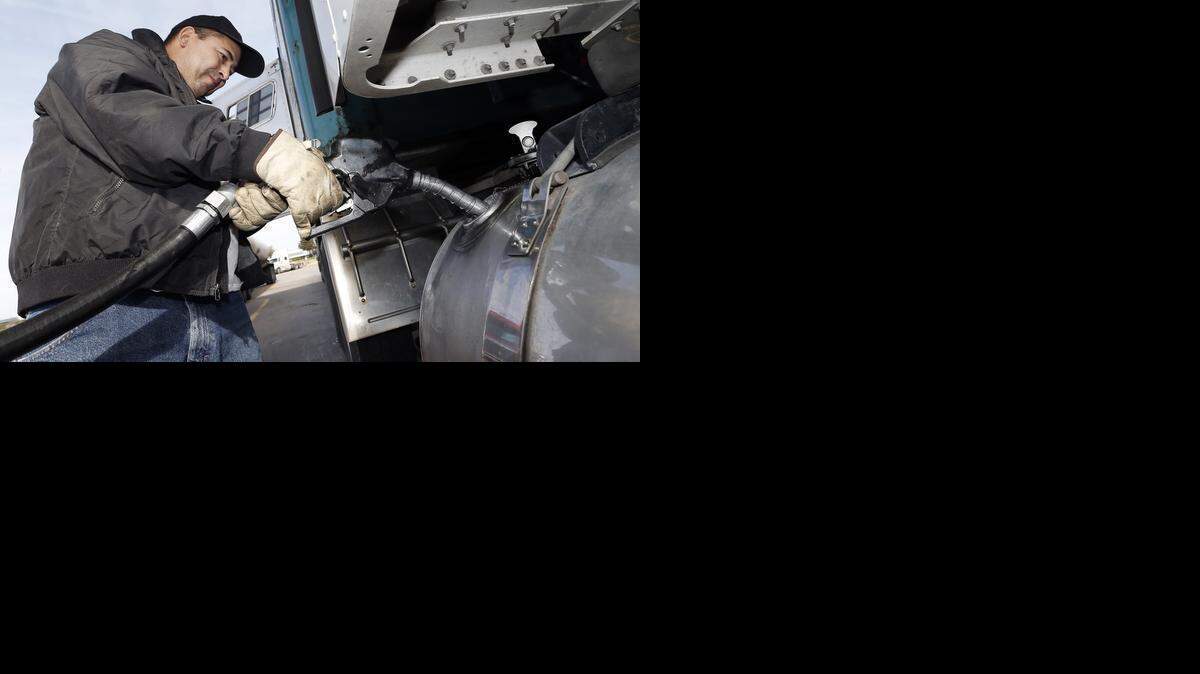
For Rex Pennington, the drop in diesel prices couldn’t have come soon enough.
Pennington’s construction company in Weatherford pours concrete and builds metal buildings. The two trucks he owns burn a lot of fuel.
So when the price of diesel started to drop late last year — long after gasoline prices plunged — Pennington’s fuel bill dropped $100 a week.
“It’s money out of my pocket. Price of fuel goes up 50 cents a gallon, that’s a lot of money,” said Pennington, already expressing concern over when prices will rise again. “I ain’t got no oil wells.”
Diesel, known as the fuel of work and industry, is going down. After staying above $3 a gallon long after unleaded gasoline dropped, diesel is playing a serious game of catch-up. On Friday, the national average price for diesel was $2.81, compared with $3.17 a month ago and $3.89 a year ago, according to the AAA Fuel Gauge.
In Texas, diesel prices were at a high mark last February, March and April, at $3.74 a gallon. Since then, they have fallen to $2.72 a gallon, including more than a 70-cent drop in the last four months.
“I don’t think we’ll go back to that number [$3 and above] in the next 15 months. We may not see it again for a few years,” said Tom Kloza, global head of energy analysis for the Oil Price Information Service. “You will see a bigger diesel price drop in the next 90 days than you will in gasoline. They’ll become much closer in price.”
The U.S. Energy Information Agency also predicts that the average price for a gallon of diesel will be about a dollar cheaper than last year — $2.85. While the agency expects an increase next year, its highest average price for 2016 is nowhere near the $4 a gallon that diesel sold for in March.
Some may wonder why the price at the pump for diesel didn’t plummet as quickly as it did for gasoline. They will find that the answer is global in nature, one that is tied to how refineries work, that reflects market demands as far away as China, and that responds to a cold snap and blizzard in the Northeast.
They will also find that cheaper diesel doesn’t automatically mean that items on store shelves will be marked down, since transportation is only part of those products’ costs. While shippers are seeing their bills drop now, it may take some time for the savings to be passed on to consumers.
“There’s not a farmer out there that is going to turn up his nose at cheaper diesel,” said Jim Sartwelle, an economist with the Texas Farm Bureau. “It is welcome news, but there is more fuel in a loaf of bread after it leaves the farm than when it is at the farm itself.”
A premium fuel
Diesel’s disconnect with gasoline begins at its source.
A distillate, diesel is separated, or “pulled off,” along with kerosene, jet fuel, home-heating oil and other products when oil is processed at the refinery. About 12 gallons of diesel, and 19 gallons of gas, are taken from each 42-gallon barrel of oil, according to the Energy Information Agency.
While diesel is heavier and oilier than gasoline, it burns more efficiently, making it the preferred fuel for larger machinery used in transport trucks, construction equipment and farm implements. The technology of diesel engines allows them to create more torque and pull larger loads more easily.
At one time, diesel was the same cost as, and even cheaper than, gasoline. But since 2004, demand for diesel has risen, particularly in China and Europe, where diesel vehicles are more popular. The United States exports 700,000 to 1 million barrels of ultralow-sulfur diesel a day, according to Adam Schaeffer, director of the Diesel Technology Forum, a nonprofit group that promotes the importance of diesel engines, fuel and technology.
“The overall influences are different,” Schaeffer said. “Diesel is the fuel of work for the global economy, and that keeps the demand for diesel higher. We supply a lot of products for other parts of the world.”
More than half the vehicles on the road overseas are outfitted with diesel engines, but the same is not true domestically, Schaeffer said. So while the demand for diesel is growing, it is still lower. As a result, the nation’s refineries, many of them 50 years old, are built to optimize the production of gasoline.
“What that leaves us with is very little flexibility to dial up more diesel fuel,” Schaeffer said.
Higher federal emissions standards mean diesel is more expensive to produce, making it a premium fuel to create and consume, said John Esparza, president of the Texas Trucking Association. Starting in 2006, refiners had to produce ultralow-sulfur diesel to cut down on pollution.
“Diesel is not cheap to make anymore,” Esparza said.
The time of year also dictates prices. Fall is harvest time, and the agriculture industry will burn a lot of fuel to bring in crops, only to be followed by winter, where a bitter cold snap in the North and Northeast can bump the demand for diesel to run generators when heating oil becomes scarce, Esparza said.
Volume discounts
Most truckers don’t pay the marquee price.
Trucking companies and businesses that have their own fleets of vehicles — large and small — often get a volume discount for diesel from providers like Pilot and the Flying J. The discounts are negotiable, but they can cut 2 to 3 percent off the advertised price, Esparza said.
Buying diesel in bulk and storing it in tanks can reduce the price, too. One day last week, wholesale diesel was selling for $2.05 a gallon while the retail price was $2.45, said John Fershtand, director of fleet services for Ben E. Keith Foods in Fort Worth.
Fershtand, who will buy 7,500 gallons of fuel at a time, is happy to see lower prices. “If you buy 7,500 gallons at $4, then you have to come up with $30,000. … But if it’s down to $2, you pay $15,000, so it helps the cash flow,” he said.
But those savings may not be passed on immediately to the consumer of the food that is delivered to the local Potbelly Sandwich Shop or Lonesome Dove restaurant.
Because diesel prices are volatile, companies will tack on a fuel surcharge to the base rate for shipping to cover higher costs. The surcharges are usually calculated weekly and monthly, Esparza said.
And the recent price drop comes as the base rate — driver salaries, trucks, tires, insurance — is going up and the demand for services is going up, said Bob Costello, chief economist for the American Trucking Association.
Last year, truckers delivered about 70 percent of the tonnage carried by all modes of domestic freight transportation, including manufactured and retail goods. Tonnage also grew by 3.3 percent for the first 11 months of 2014 when compared with 2013, the association reported.
“Even though we are passing along the bulk of the savings to customers, we are capturing some of the savings and we are using the money for [wages] and for new equipment,” Costello said.
Not everyone is happy
Ken and Nancy White see the price of diesel dropping, but they aren’t smiling.
On Tuesday, the Whites — independent truckers from French Lick, Ind. — had been trapped at the Pilot Travel Center near Alliance Airport for five days. The couple, who lease their truck to a Florida trucking company and specialize in hauling oversize freight like bulldozers, were waiting for a job that made financial sense.
The Whites don’t get a volume discount: What you see on the marquee is what they pay. While that price has been dropping, the kind of job they’ve been looking for has been hard to come by.
So when Nancy White pulls out a sheet of paper to calculate a $1,000 load going 500 miles, she explains that they get $780 and from that they would pay $265 for fuel because the truck gets about 5 miles per gallon. From the $515 that’s left, they pay for permits, maintenance, tires, food. It comes out to about $1 a mile.
They need about $2 a mile to really make a living, leading Ken White to say that lower diesel prices “ain’t doing me a bit of good because there ain’t no freight.”
Rancher Pete Bonds has not seen the benefits of lower diesel prices in his business, either. At least not yet.
Bonds has about 1,000 acres north of Fort Worth near Saginaw and has a 5,000-acre farm near Marlin. He also works cattle in Florida, Georgia and New Mexico. He hopes his cattle shipment is cheaper.
“They don’t want to come down and I don’t blame them, but we need them to,” Bonds said.
In his renegotiations, he said, it will be: “You want the business or not? I’ll find somebody cheaper.”
That would make Bonds as happy as when he fills up the 35-gallon tank on his diesel pickup. When diesel was $4 a gallon, he had to restart the pump because his credit card had a $100 limit per purchase.
“So it’s nice to be able to pull up to the pump and pay less than $100,” Bonds said.
Max B. Baker, 817-390-7714
Twitter: @MaxBBaker
This story was originally published January 31, 2015 at 1:48 PM with the headline "Diesel prices playing catch-up with gasoline."