Will Kohl’s-Amazon partnership make you more likely to return online purchases?
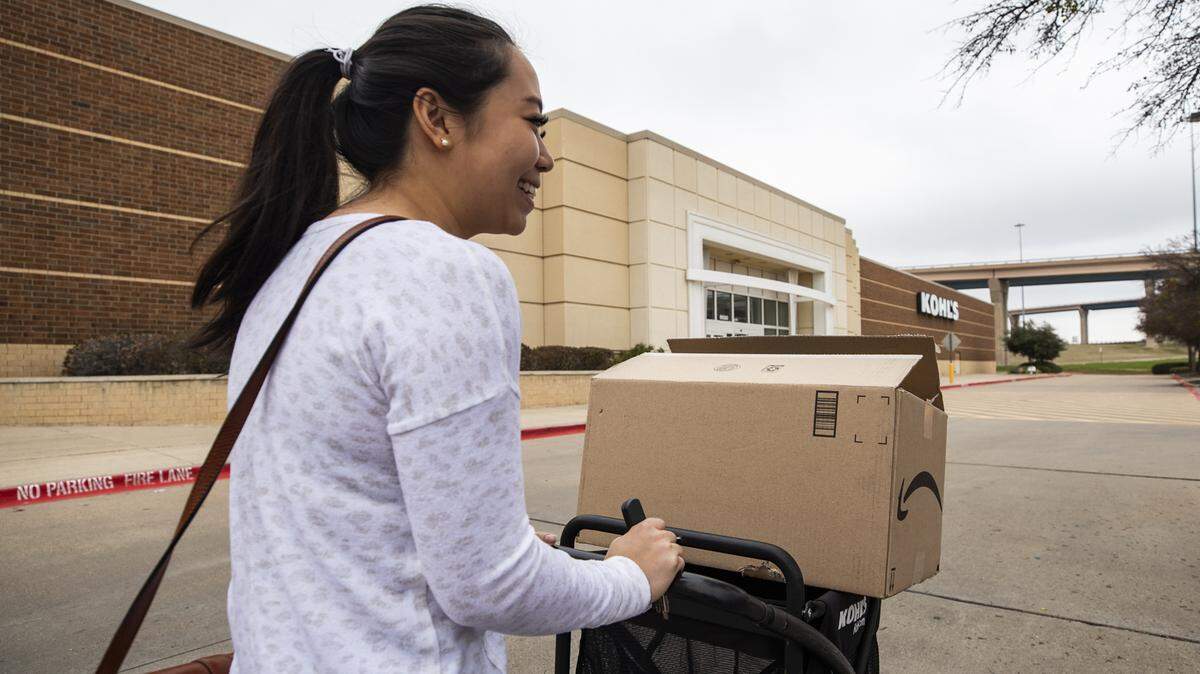
Monica Feid is a self-described Amazon Prime junkie.
She does most of her shopping online, and she rarely goes into retail stores anymore. But when she ordered the wrong size iPhone case as a Christmas gift for her daughter, she decided to visit the brick-and-mortar Kohl’s down the street from her home in Plano to take advantage of a service the department store started offering this year.
In July, Kohl’s partnered with online retail giant Amazon to accept items for returns. In all of its 1,100 stores nationwide, Kohl’s opened a service desk that would facilitate returns for items bought on Amazon in an attempt to increase foot traffic to its stores.
For a customer, all you have to do is indicate on your Amazon account that you will return an item at Kohl’s. Then Amazon sends you a QR code that Kohl’s will scan after you’ve arrived at the store. From there, Kohl’s takes care of the packaging and shipping.
When Feid took her item for return, she was pleased with how easy the transaction went.
“It was really rather simple, not a hassle,” Feid said. “They had a separate station set up … there was a physical person that took it and handed me a little receipt of the credit on my account.”
On Thursday, the Amazon return desk at Kohl’s Hulen had a long line of people lugging cumbersome boxes, either hoping to return an unwanted gift or just something they bought that didn’t work out.
Stephanie Haley was one of many Amazon shoppers who took advantage of being able to return things to Kohl’s. Once she pulled into the parking lot, she grabbed a cart and pushed her Amazon box into the store.
“I got a fan, but I didn’t really like it,” she said. “This was one of the options to return it.”
After the holidays is typically a busy time for returns and exchanges. In 2017, order fulfillment company RedStag reported that 28% of gifts were returned, representing $90 billion for retail companies.
Avoiding the hassle
More people have been doing most of their holiday shopping online. In fact, this year represents the first time that a majority of people will take advantage of online retail — a survey by business accounting firm PwC showed that 54% of shoppers planned to shop online versus the 46% who planned to go to retail stores.
But return behavior for online purchases and brick-and-mortar purchases differ widely. Last year, an NPR/Marist poll showed that 91% of online shoppers “only rarely” or “never” return online orders. What’s more, 56% of people kept an item they bought online even though they wanted to return it.
There are a lot of reasons for this.
Daniel Howard, professor of marketing at the Cox School of Business at SMU, said the biggest barrier to online returns is the hassle. For online returns to Amazon, for example, you have to print out a return label, package the item for shipping and find a place to ship it back.
“People don’t like to do it,” he said. “After they receive something that they decide they really don’t want, they search their minds desperately for reasons to keep it.”
Stores don’t like returns either. To them, it represents a loss in revenue. Remember in 2017 that 28% of gifts were returned, representing $90 billion? That’s a $90 billion loss to stores. Additionally, returns mean excess inventory that’s harder to get rid of. Once something’s been returned, it takes a lot of convincing on a store’s part to get someone else to buy it.
Haley has run into this as an online shopper. In the past she’s kept things she ordered, even if she didn’t really like them. But unlike a pair of leggings that she can shove in the back of her closet, she said, it made more financial sense to return the fan she bought. And taking it to Kohl’s meant she didn’t have to pay shipping and handling.
“This was the only free option,” she said.
A hidden opportunity
But there’s an opportunity in returns. Depending on how a retailer handles it, it could be a boon for the store, and Kohl’s is taking advantage of this opportunity.
When Feid returned her item, she said it was easy, and Kohl’s gave her a coupon for 25% off on items bought in the store while she was there. She took advantage of that by buying a new pair of shoes for a holiday party.
“I physically went into a store, and I did shopping while I was there,” she said. “They got me.”
And that, says TCU Assistant Professor of Marketing Yashoda Bhagwat, is what Kohl’s is hoping to accomplish with this partnership.
“Kohl’s biggest problem is foot traffic,” she said. “They need people to get in the store.”
Getting people in the door is half the battle. Once they’re in, it’s much easier to convince someone to buy something, especially if you put the return counter all the way in the back of the store, so you have to pass aisles of enticing items before you can get to the whole point of your journey.
“For marketing, it can be a great opportunity,” Bhagwat said. “What happens is customers return and often times exchange and spend more on themselves. They get credit, and it can be really an opportunity for retailers.”
Haley’s trip on Thursday to Kohl’s was not only the first time she returned an item through the Amazon/Kohl’s partnership, it was her first time at that Kohl’s period. Since she does most of her shopping online, she doesn’t see the need to go to physical stores. But this could mark a change.
Depending on what she sees, she might even buy something at Kohl’s.
“Potentially,” she said with a laugh.