Jane Austen’s England: 6 Real-Life Spots Every Pride and Prejudice Fan Needs on Their List
More than 200 years after her death, Jane Austen still has a grip on the cultural conversation — and not just because Netflix keeps rebooting her novels. The author of Pride and Prejudice, Persuasion and Northanger Abbey completed six novels before dying in 1817 at age 41, and the real-life corners of England tied to her life and work have become full-blown pilgrimage sites.
If you have ever paused a Pride and Prejudice rewatch to ask “wait, where is that lake?” — this list is for you. Here are six spots in England that Austen fans actually need to know about.
1. Jane Austen’s House, Chawton
This is the one. The cottage in the Hampshire village of Chawton is where Austen lived from 1809 to 1817, and where she wrote, revised and published her major novels. The house was provided by her wealthy brother Edward Knight after their father died — a small but crucial detail in the Austen origin story.
Today it operates as a museum, with letters, portraits and first-edition books on display. The headline artifact is the small writing table where she actually worked. Visitors can also walk the Jane Austen Trail between Chawton and Alton, which traces places she frequented.
More info at the Jane Austen’s House official site.
2. Chawton House (Yes, It’s a Different One)
Here is the detail that trips people up: Chawton House and Jane Austen’s House are two separate places in the same village. Chawton House was the manor home of Edward Knight — Jane’s brother, who was adopted by distant relatives Thomas and Catherine Knight and made their heir.
The estate was built by the Knight family in the 1580s, and Jane, her mother and sister regularly walked over from their cottage to visit. If you want the full picture of Austen’s daily Chawton life, both houses belong on the itinerary — not just the one with the gift shop.
3. The Jane Austen Centre, Bath
Bath is where Austen lived from 1801, after her father retired, until 1806. She stayed on with her mother and sister after her father’s death, and the city directly inspired Northanger Abbey and Persuasion. The Jane Austen Centre, set inside a Georgian townhouse, focuses on those Bath years specifically.
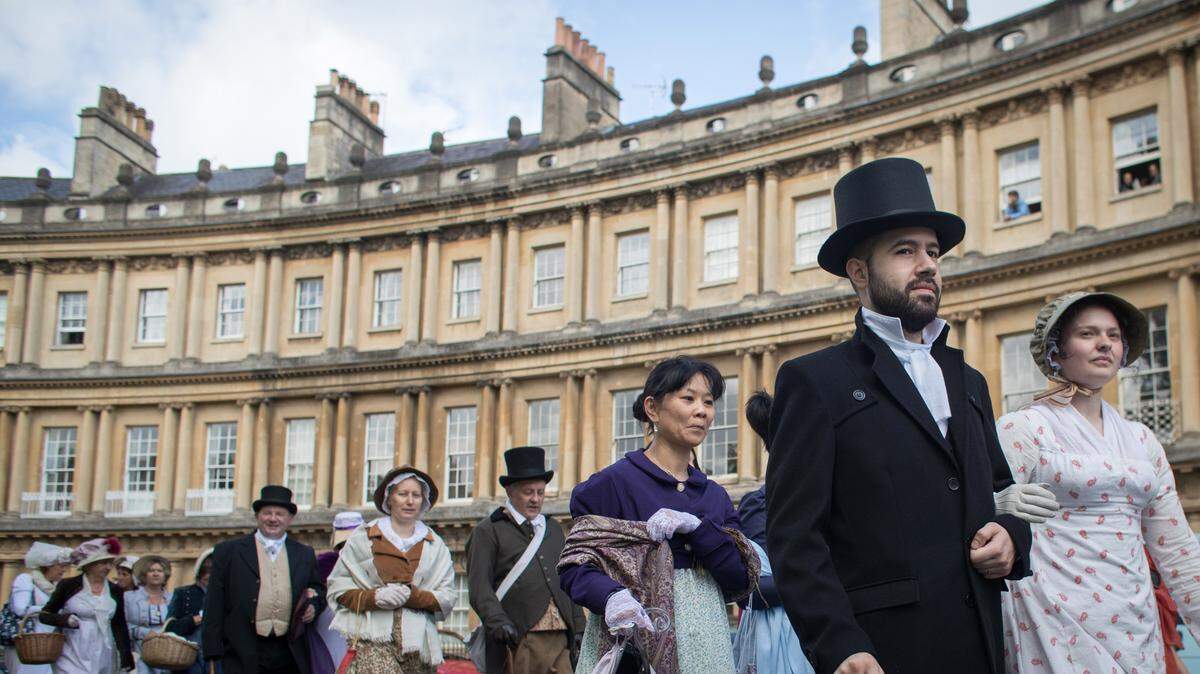
The bigger draw for serious fans? The annual Jane Austen Festival every September — billed as the largest and longest-running Austen festival in the world. Expect promenades, readings, Regency balls and themed gatherings packed with people who took the dress code very seriously. The 2026 festival runs Sept. 11–20.
Details at the Jane Austen Festival official information page.
4. The Royal Crescent, Bath
Stay in Bath for this one. The Royal Crescent is a sweeping curved row of 30 Georgian terraced houses, and it is one of the city’s most recognizable architectural landmarks. It also gets name-checked multiple times in Northanger Abbey, and its grandeur reads all over Persuasion.
Screen adaptations have leaned in. In the 2006 film of Persuasion, Sally Hawkins’s Anne Elliot runs after Captain Wentworth on the Crescent. In the 2022 Netflix adaptation of Persuasion, the Royal Crescent stands in for Camden Place. If you want to walk a film location and a literary one in the same step, this is it.
5. Lyme Park, Cheshire
The lake. That lake.
Lyme Park, a historic estate in Cheshire, was used as Pemberley — Mr. Darcy’s home — in the 1995 BBC adaptation of Pride and Prejudice. It is the location of the iconic scene where Colin Firth’s Mr. Darcy dives into the water, an unscripted swim that became one of the most replayed moments in costume-drama history.
It remains one of the most visited filming locations for Austen fans, even though the lake scene itself is not from the novel. That is part of the inside-angle fun: the moment that defined Darcy for a generation of readers was invented for TV — and you can still go stand next to it.
6. Winchester Cathedral
Austen’s final resting place is Winchester Cathedral, where she was buried in the north nave aisle. The exact reason she was buried there has not been definitively settled, which is its own quietly intriguing footnote.
Her memorial stone praises “the extraordinary endowments of her mind.” Notably, the inscription does not mention her career as a novelist — a detail that hits differently once you know how foundational her six novels became to English literature. It is now one of the most meaningful literary pilgrimage sites in the country.
Six novels, two centuries, one very dedicated travel itinerary. Whether you are chasing the writing desk in Chawton, the lake at Lyme Park or a Regency ball in Bath, Austen’s England is still very much open for visitors.
This article was created by content specialists using various tools, including AI.