
Taking the Frank Lloyd Wright tour in Phoenix
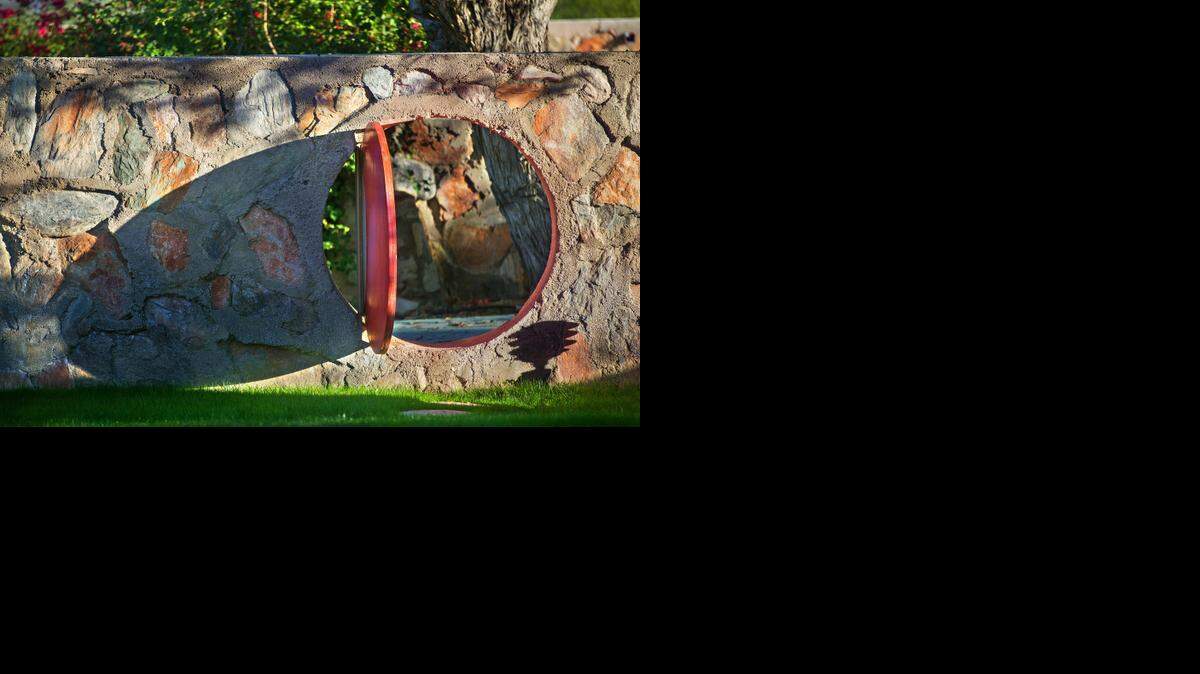
Thousands of senior citizens migrate to the Phoenix area each year seeking sun, golf and the good life.
Then there’s Frank Lloyd Wright.
He landed in the Sonoran Desert as a 62-year-old snowbird in 1929 and went on to generate one of the greatest architectural legacies of the 20th century. Here, in the final, remarkable flowering of a career that ultimately spanned seven decades, he built a winter home and studio; established a school (which still operates today); and conjured a handful of the most influential and inspirational pieces of architecture in America — including New York City’s Guggenheim Museum.
Though many of the masterpieces he crafted during this period were erected elsewhere, he also designed and built about a dozen significant projects in and around Phoenix, many of which still stand and offer public tours.
Here’s a small selection of Wright (and Wright-related) sites on the must-see list.
Taliesin West
In 1937, having already spent some time in the Sonoran Desert, Wright bought a plot of land at the foot of the McDowell Mountains and started to dream.
He envisioned a style of architecture that grew out of the sweeping vistas and sun-baked rocks of Arizona. And piece by piece, with the help of students, apprentices and acolytes, the dream he called Taliesin West began to take shape.
Today, the compound consists of about a dozen interconnected structures that house the Frank Lloyd Wright School of Architecture and Frank Lloyd Wright Foundation. Together, the buildings function as a sort of 3-D sketchbook, introducing visitors from all over the world to Wright’s revolutionary concept of “organic” architecture.
An organic building, in Wright’s view, was one whose site, form and materials coalesced into a unified whole. The apotheosis of this idea is Fallingwater, the architect’s residential masterwork in rural Pennsylvania. It’s built over a waterfall and is so sublimely formed and scaled that it appears to be blooming out of the hillside, instead of sitting on it.
Likewise, Taliesin West looks and feels like an extension of the desert — low, rocky, spare and flooded with light. Its walls are masonry; the ceilings are canvas; and in Wright’s time, the windows were wide-open apertures to the desert air. (After he died, his more pragmatic wife had glass installed.)
Visitors may choose one of several docent-led tours, including the Panorama (one-hour highlights, $24-$28) and Insights (90-minute overview, $32-$36).
Devout design geeks should opt for the three-hour Behind the Scenes tour ($70-$75), which includes tea in the Taliesin Fellowship dining room, a talk by a Wright specialist and a peek into the architect’s humble living quarters, complete with his books and his surprisingly modern stainless-steel shower. 12345 N. Taliesin Drive, Scottsdale, 480-627-5340, www.franklloydwright.org.
ASU Gammage Memorial Auditorium
Wright undertook the commission for this concert hall on the campus of Arizona State University in Tempe when he was nearing 90; it was one of his final public projects. While it may not be the equal of his best work — it looks a little like an upside-down wedding cake on stilts — it has an interesting origin story.
In the 1950s, Wright designed an opera house for the city of Baghdad, at the behest of Iraq’s King Faisal II. But the king was assassinated in 1958 and his family’s monarchy deposed, so the plans were shelved.
Not long after, ASU President Grady Gammage approached Wright to design a signature concert hall for the campus. Wright (the story goes; some details are in dispute) took the Baghdad plans, brushed them off, stripped them down to fit a university budget — and Gammage Auditorium was born.
Wright didn’t live to see the 3,000-seat hall built, but today you can tour the interior, with its graciously intertwining curves and tiered balconies, or see a show there almost any weekend night. In earlier days, Gammage hosted artists such as Ray Charles, Johnny Cash and the Bolshoi Ballet; today it primarily presents touring Broadway productions.
Free building tours are offered Mondays and also other days by appointment; a schedule of performances is on the website. 1200 S. Forest Ave., Tempe, 480-965-6912, www.asugammage.com/shows.
First Christian Church
This arresting building is another Wright project designed for one site but erected on another. It was originally meant to anchor the campus of a proposed Southwest Christian Seminary, but the seminary folded and the school was never built. More than a decade after Wright’s death, his widow granted Phoenix’s First Christian Church the right to implement the plans.
The finished structure, with its tall, pointy spire and even taller, pointier bell tower, makes a strange and wonderful architectural gesture: the artist stretching toward the divine.
The metaphor holds indoors, too, as worshipers pass through a low-ceilinged lobby into an open, airy room of worship, moving from the earthly to the celestial. All around are rough stones — characteristic of Wright’s Arizona projects — and angles moving all directions, while small stained-glass windows overhead call to mind the intricately patterned skin of a snake.
Back outside, the scaly roof evokes another desert animal (though not one native to Arizona): the armadillo. And the 120-foot bell tower confounds: It’s designed to appear triangular from all sides, but it’s actually four-sided; and is said to be constructed of 300 tons of concrete, stone and steel, with no interior supporting structure. Services are at 9 and 10:30 a.m. Sundays, 6750 N. Seventh Ave., Phoenix, 602-246-9206, www.fccphx.com.
Arcosanti
This stop on the Frank Lloyd Wright tour of central Arizona was not designed by Wright at all, but by Paolo Soleri, a revered architect, urban planner and philosopher who passed through the Taliesin Fellowship in the late 1940s.
Soleri, who was born in Italy in 1919 and died just two years ago in Phoenix, extended the idea of organic architecture in new and different directions. His philosophy of “arcology” — the integration of architecture and ecology — has inspired generations of thinkers concerned with pollution, population, consumption and quality of life.
Arcosanti, whose origins date to 1970, was conceived as a kind of living laboratory to explore some of Soleri’s ideas about living structures, communities and urban planning. Essentially, it’s a counter model to urban sprawl, in which people live, play and work in a very compact area. A windbell foundry is based at Arcosanti, providing much of the community’s income.
Arcosanti’s master plan is ambitious: It points ahead to a desert Utopia, where 5,000 people will coexist, sharing values of proximity, reduced consumption, creativity, frugality and so on. However, after four decades of planning and construction, it’s still in a formative stage: Fewer than 100 people currently live on site year-round, with many more coming and going as long- or short-term students, volunteers and visitors.
At once visionary and unfinished, Arcosanti’s geometric, concrete forms look oddly like relics of the future.
Visitors are welcome at Arcosanti for a day or overnight. Hourlong tours set off from the windbell gallery/gift shop several times a day ($10). Longer specialty tours focusing on architecture, urban planning, desert birds and archaeology can be arranged for groups with advance notice.
A cafe serves buffet meals daily, and simple rooms with desert views can be booked overnight at moderate prices ($30 for a small room with a shared bath; $100 for a suite with kitchenette and living space).
Arcosanti is about an hour north of Phoenix in Mayer on Interstate 17. To find a taste of Soleri closer in, visit the Soleri Bridge and Plaza in downtown Scottsdale. 13555 S. Cross L Road, Mayer, 928-632-7135, https://arcosanti.org. Soleri Bridge and Plaza, 4420 N. Scottsdale Road (www.scottsdalepublicart.org).
If you go
Where to stay
El Dorado: This modestly priced hotel is well-suited to fans of midcentury design. Don’t expect anything fancy, but the rooms are large (with kitchenettes and living spaces) and the whole place has a mod, garden-apartment vibe that’s irresistible. Usual weekend rates are $125-$150 per night; 6825 E. Fourth St., Scottsdale.
Hotel Valley Ho: Designed by Edward L. Varney, a student of Frank Lloyd Wright, this circa 1956 property has more groovy orange-and-aqua details than Zsa Zsa Gabor had husbands. (Gabor was a regular visitor here, by the way.) Take the 90-minute Magical History Tour offered by the hotel to learn more about the Southwestern brand of modernism ($19.56). Usual weekend rates are $300-$360 per night; 6850 E. Main St., Scottsdale.
Arizona Biltmore Hotel: Wright was a consulting architect on this stunning luxury resort, which opened in 1929. The original hotel was built entirely of precast blocks made of desert sand and imprinted with deco patterns inspired by palm trees. If you’re priced out of staying here (and most people will be), pull up a stool at its Wright Bar, have a glass of wine and marvel at the surroundings. 1 1/2-hour tours of the Arizona Biltmore are offered three times a week. Weekend rates begin at $360 per night; 2400 E. Missouri Ave., Phoenix.
This story was originally published April 15, 2015 at 12:30 PM with the headline "Taking the Frank Lloyd Wright tour in Phoenix."