
Neil Sperry: Plant your cabbage, broccoli and cauliflower now
If you’re going to be successful at vegetable gardening in Texas, you’re going to have to pay very (as in “VERY”) close attention to timing. Cold weather early in the season is your nemesis, but hot weather later in the spring is the mortal enemy.
You absolutely must get seeds and transplants in the ground within the narrow two- or three-week window, or your plantings will be doomed to failure.
Picture yourself at the end of a conveyor belt. That belt is constantly moving, and the crops are already loaded and rolling to your end of the belt. They’ll come off in chronological order, and the next ones to fall into your hands will be the cole crops (cabbage and its relatives). Timing for their plantings will be mid-February (Feb. 10-20), with slight modifications allowed for cold spells and rain.
These crops all tolerate light freezes quite well, but they’re hurt badly by late spring heat. Here are some specific guidelines for each.
Cabbage
This is perhaps the easiest of all the crops from this family. You can plant it from seeds sown directly into the garden, but it’s far better (and not much more expensive) to buy transplants of the best varieties. Space the plants 18-24 inches apart in their rows, and let the rows be 30-36 inches apart.
Keep cabbage transplants growing vigorously by not allowing them to dry out and by applying an all-nitrogen plant food when the plants have been growing in the garden for a couple of weeks, then again as they begin to form heads.
Harvest cabbage when the heads are 5-6 inches across. Leave them in the garden too long and they’ll begin to sun scald and split.
Cabbage loopers are the major threat to this crop. The adult form, which you’ll see fairly early in the spring, is a white butterfly that will be gliding about in the garden seemingly harmlessly. It’s the green looping larvae that do the damage, filling the leaves (and the heads if not controlled early) with scores of chewed holes. Apply Bacillus thuringiensis to control the loopers when you first see them. Just ask your nurseryman for “B.t.”
Broccoli
What a popularity surge this crop has seen in the past 25 years. It’s one of the most healthful vegetables you can grow, and it’s also one of the easiest. Choose from the fast-maturing hybrid varieties.
Space the transplants about 2 feet apart in their rows, and allow 3 feet between rows. Initially, they’ll look like cabbage transplants, but their stalks will start shooting upward immediately. Keep them growing vigorously by an all-nitrogen fertilizer (similar to what you’d use on the lawn and shrubs).
After a couple of months, the plants will start forming their flower heads. They’ll develop fairly quickly, and as they do, your goal will be to let them get to almost full size — but without letting any of the flowers begin to open. If you blink and they come into bloom, you’ve blown it for that round.
Harvest the heads with a sharp knife, and leave the plants in place to form a second harvest a few weeks later. Successive heads won’t be as large as the first batch, but you never eat an entire head without cutting it anyway, so let them grow, and you can enjoy fresh broccoli over a several-week period.
Cabbage loopers and aphids are the only pests you’re likely to see. B.t. will control the loopers, and there are many organic and inorganic controls for the aphids. You can even even simply wash them off with a hard stream of water.
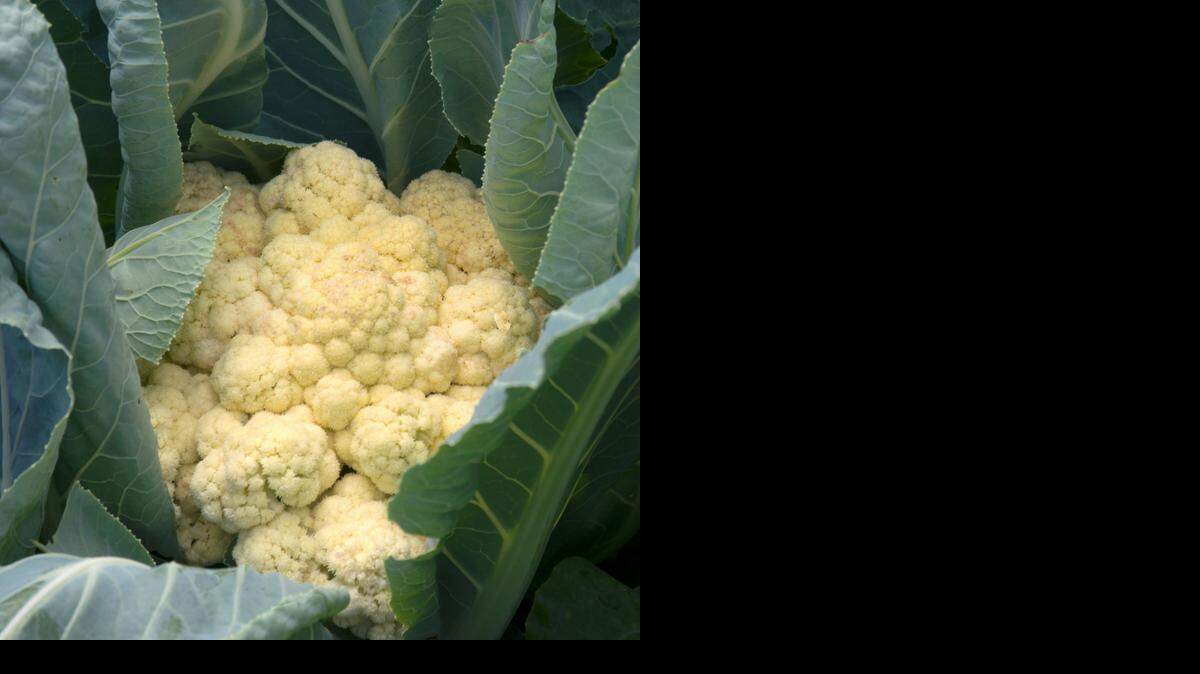
Cauliflower
Now the task becomes a little more challenging. Cauliflower takes a little longer to the time of its harvest, and that puts you into the first parts of hot weather — a risk for this family.
Start with transplants spaced just as you do broccoli. Give them the same care, including protection from loopers.
As the cauliflower heads start to form, secure the top leaves up and over the heads with large rubber bands. Known as “blanching,” this technique will keep the heads almost pure white. Note, however, that the nutritional quality of cauliflower is the same with or without chlorophyll. In fact, there are many varieties that produce heads of different colors, all the way to deep burgundy. Blanching is not needed for any of them.
Brussels sprouts
It might be because they’re not nearly as popular, or, more likely, because they’re considerably more difficult to grow, but Brussels sprouts are rarely found in North Texas gardens.
If you’re up for the adventure, you can include them by starting with transplants from the nursery. Plant these, like their other relatives, about the middle of February. Initially they’ll look like the others, and you’ll care for them in much the same way.
However, when you start seeing tiny heads forming in the axils of the leaves (usually when the plants are 18 or 20 inches tall), remove the leaves from the bottom halves of each plant and pinch out the growing tip from each stem. That will cause the plants to send water and nutrients into the small heads, encouraging growth.
Harvest Brussels sprouts heads when they’re 1 to 11/2 inches in diameter. They’ll still be tightly formed up and down the stems.
That’s a primer for planting the most popular cole crops. Kale, rutabagas and others are grown in the same way, and this is their planting time, too.
Neil Sperry publishes “Neil Sperry’s GARDENS Magazine” and hosts “Texas Gardening” 8-10 a.m. Sunday on WBAP 820AM. Reach him during those hours at 800-288-9227. Online: http://neilsperry.com.
This story was originally published February 6, 2015 at 6:00 AM with the headline "Neil Sperry: Plant your cabbage, broccoli and cauliflower now."