
Julie Dawson collects stories about the bells of the world
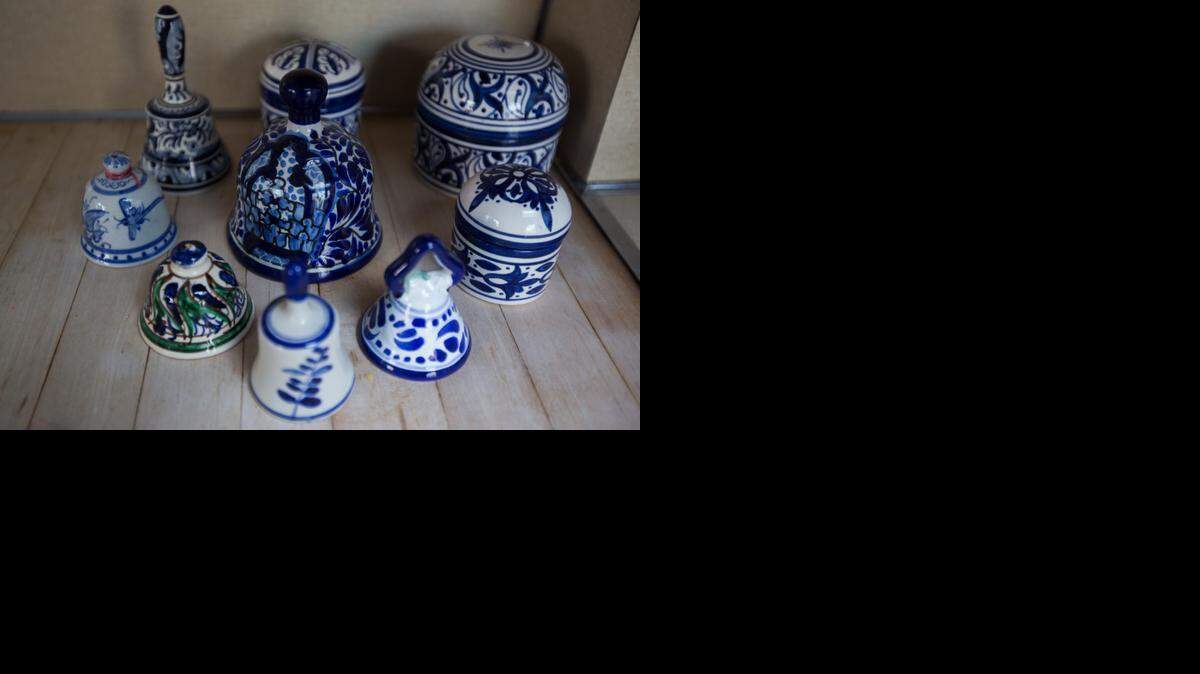
Julie Dawson hears life in all its clanging, chiming, gonging, bonging charm. That’s because she has spent decades tracking and finding bells all over the world.
She has 15,000 photographs of bells and nearly as many stories. And she has written a book about world bells — Seeing the World Through the Heart of Its Bells (2015, Detroit Free Press) — that has 500 pictures in it, and she has already compiled enough pictures to make another, this time about bells found only in the U.S.
“Every culture and country throughout the world, through history, has used bells in the most extraordinary ways,” says Dawson, a Birmingham, Mich., watercolor artist and avid traveler who visited her 100th country, Turkmenistan, in October.
Dawson has found strange and quirky bells in all corners of dozens of countries: at a hospital in Norway, at a farm in Cambodia, even at the New York Stock Exchange. She has photographed cowbells, telephone bells, church bells, school bells, bells that hang around the necks of elephants and camels, bells on the lively legs of traditional British Morris dancers, bells made of splendid brass or carved crudely of wood, bells that have rung in wars or greeted emperors, and bells rung by trained swans pulling on a string to get treats.
Once she visited a barn in Lithuania where an artist had collected bells that had been stolen across the countryside by the Russians — and he traded vodka to get them all back.
Bells are used differently in the U.S. than in the rest of the world, she says.
“Throughout the world, bells are more utilitarian, to make life function,” says Dawson, 77. “In the U.S., because we are inventive and because we are affluent, we can use bells in creative, silly ways as well as serious ways.”
A traveler first
For all that, bells are not the reason Dawson travels and not the reason she started or keeps going with her work and art. She gives credit for the trajectory of her life to two influences: the Girl Scouts and her late husband, Peter.
Born in Highland Park, Ill., Dawson made her first trip abroad at age 17 when she went to Switzerland with the Girl Scouts. There she met nearly two dozen girls from seven countries, destined to remain lifelong friends.
After college at DePauw University in Indiana and another Girl Scout forum in Mexico, at 22, she traveled alone for four months to Europe, visiting other girls she’d met at the scout conferences.
Eventually, she moved to Detroit as a Girl Scout administrator. To try to meet new people, she signed up for watercolor painting classes at the Birmingham Bloomfield Art Center, and found she had a talent for it.
She married Peter Dawson in 1966, a race car driver and engineer at Chrysler, and later Ford. He shared her travel bug. They’d save up his vacation days so they could be gone a month at a time in December. Without children, they just went.
When he retired, “we could extend it to seven weeks at a time” or as long as they felt like it.
But they traveled differently than most people did. They rarely made reservations and did not go with a group. They once showed up in India with hotel reservations for only two nights, got kicked out because Nelson Mandela was coming to visit and ended up spending a month in India visiting not only classic sights but “the most backwater places, and it was just wonderful,” she says.
By now a professional artist, Dawson shot photographs on her trips that could be used for later painting inspiration, of children and flowers mostly.
Then one day in Detroit, she met Susan Berry, an authority on handbell ringing who owned a shop in Dearborn, Mich. Dawson started shooting photographs of bells on her trips to make note cards Berry could sell in her shop. Soon, the bell quest took on a clanging life of its own.
Constant clamor
Meanwhile, the artist had about 12 other things making noise at the same time.
She has had 87 one-woman art shows and still works 60 hours a week in her home studio. In addition to the bells book, Dawson creates and sells intricate paper cutouts. She writes poetry and has created four children’s books. She just did a holiday table design for charity that featured nearly 200 tiny handmade penguin cutouts that she designed and made herself.
She takes commissions to paint portraits of people’s pets (although not their children, because “lots of parents think their children are better looking than they are”). She also takes commissions from families, companies and organizations for kaleidoscope watercolors — huge, round paintings filled with tiny, puzzlelike images from the person’s own life or company’s mission. It is biography in art.
Still ringing
After her husband’s death, Dawson had to readjust, but she kept on traveling.
“I decided that my new job was to make the rest of my life good — not just good, but wonderful,” she says. “That is not to say I don’t miss him. And it’s not to say I wouldn’t give everything up if I could have him back, but I can’t. So I’m plowing ahead.”
The trip she just came back from, taking a train along the Silk Road in Kazakhstan and Turkmenistan, took two weeks. She is planning to go to Iceland soon.
The only place she has had trouble finding a bell was Antarctica. There was only one. It was on their cruise ship. She took a picture of it while the ship sailed along a bitterly cold mountainous shoreline.
“But it had a nobility to it,” Dawson recalls.
Her friend Susan Berry says Dawson is not a classic bell collector — in fact, most bells were given to Dawson by others.
“For Julie, I think what it is is the spirit of the bells,” she says. That and the quirky aspect.
“She is always interesting. She’s always positive. She’s been through a lot. She just stays strong and maintains and travels.”
A line Dawson writes in one of her children’s books — “Each has a merry bell to keep each full heart light” — reflects the author’s own belief: that each of us has an obligation to ring out clear and steady throughout life as best we can.
“There isn’t anybody who doesn’t have bells in their lives,” she says, and like people, “bells can have every attitude.”
Dawson’s top travel spots
▪ Most beautiful: Switzerland
▪ Most spectacular scenery: Nepal
▪ Most fascinating: India, China and Russia (“All are complex and hard to figure out.”)
▪ Best animals: Botswana, Tanzania, Kenya
Where to see bells
▪ Marrakech, Morocco: For centuries, men who sell water have walked around ringing brass bells to attract customers.
▪ India: Bells are often used around working elephants’ necks.
▪ Algarve, Portugal: Even the goats and sheep wear bells in this mountainous region.
▪ Namibia: At a remote river hotel, guests ring a big bell to let the innkeeper know they’ve arrived.
▪ Whitehorse, Yukon, Canada: The Whitehorse fire bell from 1900 has saved many a home from flames.
Or buy the book Seeing the World Through the Heart of Its Bells by Julie Dawson ($48; available at www.juliedawsonartist.com or www.amazon.com).
This story was originally published January 24, 2015 at 6:00 AM with the headline "Julie Dawson collects stories about the bells of the world."