A Primatologist, 46 Ariel Toucans and a 50-Year Experiment No One Was Watching — Until Now
Imagine running an experiment and then… just leaving it alone for half a century. No tracking devices. No scheduled check-ins. No one watching to see what happens next.
That’s essentially what primatologist Adelmar Coimbra Filho did in 1970 when he released 46 ariel toucans into a damaged forest in Rio de Janeiro.
At the time, it looked like a hopeful gesture. Now, more than 50 years later — and nearly a decade after Coimbra Filho’s death in 2016 — we’re finally starting to understand just how big of an impact that decision had.
And it turns out, those birds didn’t just survive. They got to work.
Why Were 46 Ariel Toucans Released?
Back in the 1960s, the ariel toucan (Ramphastos ariel) had disappeared locally. The forest it once helped sustain — Tijuca National Park — had been heavily degraded.
Coimbra Filho’s idea was simple in theory: bring the birds back and let nature take its course.
Tijuca is no ordinary forest, either. It’s one of the largest urban forests in the world, sitting right in the heart of Rio de Janeiro. Reintroducing a key species there wasn’t just about conservation — it was about restoring a living system in the middle of a city.
So he released 46 toucans into the park.
And then… nothing. No long-term monitoring. No formal follow-up. For decades, the birds were essentially left to figure things out on their own.
Coimbra Filho never got to see the full results of his experiment. He died in 2016, long before the data began to tell the story. But now, ten years later, that story is finally coming into focus.
What the Ariel Toucans Were Doing All Along
A new study published in Nordic Society Oikos in February 2026 picked up where the experiment left off.
Researchers spent a full year tracking the toucans through the forest — sometimes walking more than 20 kilometers a day — to understand what they were eating and how they were interacting with the ecosystem.
What they found was striking.
The birds had reestablished feeding relationships with about 76% of the native plant species they were historically known to consume. When it came to medium and large seeds — the kinds that are hardest to disperse — that number jumped even higher, approaching 90%.
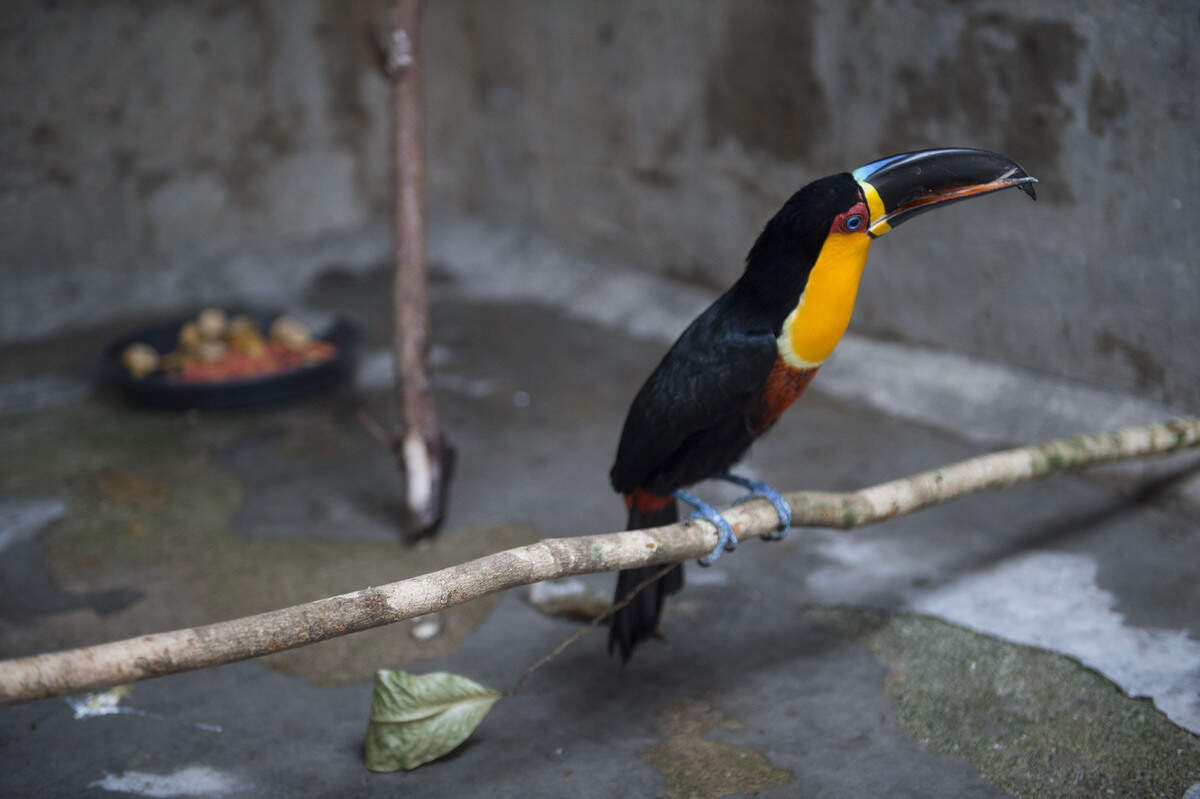
That matters because toucans aren’t just pretty birds. They’re frugivores — fruit eaters — and that makes them critical seed dispersers.
They eat fruit, carry it across the forest, and deposit the seeds far from the parent plant. It’s one of the most effective ways forests regenerate.
And these particular toucans have a unique advantage: they can crack open tough, thick fruit that many other animals can’t access. That makes them especially important for spreading larger seeds — the kind tied to some of the forest’s most vulnerable tree species.
Ariel Toucans Fill a Role No Other Species Could
Other animals have also been reintroduced to Tijuca over the years, including red-rumped agoutis and brown howler monkeys.
But the study found very little overlap between their diets and the toucans’.
In other words, the toucans weren’t just helping — they were filling a specific ecological gap that no other species was covering. And that gap turned out to be crucial.
Two threatened trees in particular — the jussara palm and the bicuíba-branca — showed up frequently in the toucans’ diet. Both have lost more than half their natural range, and both rely on animals to spread their seeds.
The jussara palm, especially, stood out as the toucans’ most commonly consumed food source.
A Second, Quieter Discovery in Rio de Janeiro
The story doesn’t end in the forest.
Between 2017 and 2023, researchers also tracked toucans in the Rio de Janeiro Botanical Garden — another urban green space. The findings were published online by Cambridge University Press on March 3, 2026.
Over roughly 290 weeks, they recorded 850 feeding events across 91 plant species. They also followed 29 young birds across 10 nests and found that nesting sites were reused year after year by different pairs.
It’s a small but important detail: it suggests these birds aren’t just passing through urban environments — they’re establishing stable, long-term populations within them.
The 50-Year Experiment That Answered Itself
There’s still a lot scientists don’t fully understand — especially when it comes to exactly how much the toucans are driving forest regrowth. But the big picture is becoming clear.
A half-forgotten reintroduction effort from 1970 has quietly helped rebuild ecological relationships that had been lost for decades. And it did it without constant human oversight.
Coimbra Filho never got to see the outcome of his work. But ten years after his death, the forest is, in a way, speaking for him.
Sometimes, the most powerful experiments aren’t the ones you control. They’re the ones you trust enough to let go.
This article was created by content specialists using various tools, including AI.