
Neil Sperry: Climbing, twining vines for the spring garden
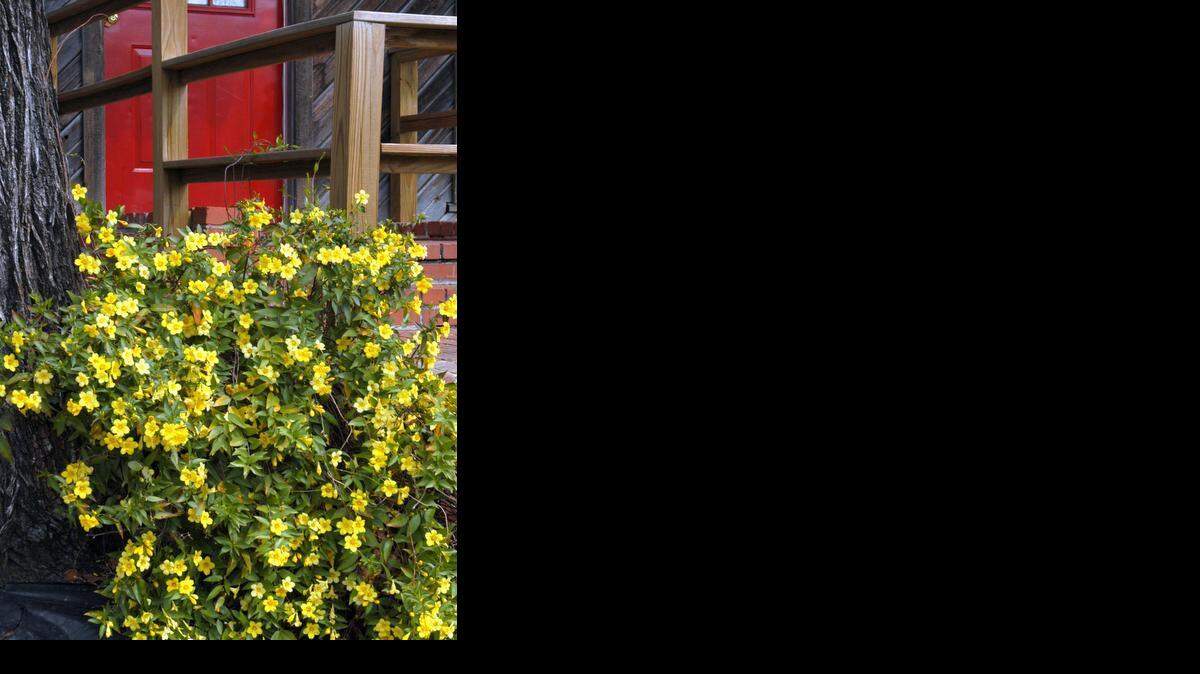
It’s handy to have plants that screen, shade and bloom. It’s even better if they take little or no space in your garden. How can that happen? They’re vines, and they’re able to clamber into our hearts by twining, leaning or adhering to their supports. All they need is a few inches of ground space, and they’ll take over from there.
Here are five of the best types for spring-flowering color.
Carolina jessamine
This great little East Texas native has several things going for it. Its flowers are bright lemon yellow, tubular and fragrant, while the vine is evergreen with small, glossy, dark green leaves. Carolina jessamine grows to be 12-18 feet tall. It does best in deep, well-draining soils.
Since it’s native to East Texas and the Gulf South, it also does better in acidic soils, though it gets comfortable in our alkaline, black clay gumbo. It climbs by twining, and it’s the best vine we have for moderate to heavy shade.
Lady Banksia rose
This plant arrived in Texas before the Battle of the Alamo, so when we’re talking about plants with proven staying power, this one is a winner. It makes a big plant, growing to 15-25 feet tall and wide. If you’re going to grow it on a patio roof or fence, be sure it’s well-anchored and properly supported.
Lady Banksia’s flowers are quarter-size and appear in great profusion. The plants are thornless and they almost never show any evidence of black spot or powdery mildew. On the down side, they have no fragrance, and the plants bloom only one time each year, in March or early April.
The Lady Banksia roses ascend by leaning against a strong support. It might be a fence or wall, or — at least, for a while — it could be a small patio cover. Whatever your choice of support, Lady Banksia will serve your needs handsomely.
Wisteria
This is probably the most iconic spring-flowering vine for much of America. Its cascading clusters of fragrant lavender (less commonly white) blossoms are abundant. A robust vine, it requires a strong support of heavy posts and rails. Allow it to grow to be 25-35 feet tall and wide if you can let it go untrimmed. However, that can take it up and into trees and across hedges, so be forewarned.
I’m frequently asked why wisterias fail to bloom. Most commonly, gardeners are pruning them in the winter (they set their flower buds in fall), or the vines are being given big doses of nitrogen when the lawn is fertilized in September.
If neither of those isthe issue, you might try root-pruning your plant with a sharpshooter spade in early September. Cut a slit through its root system 15-18 inches out from the trunk and 8-10 inches into the soil. By cutting the lateral roots, you may be able to shock the plant enough that its “survival of the species” reproductive mode will kick in to set flower buds.
Crossvine
Although native to East Texas, crossvine wasn’t common in landscapes until the past 20 years. It climbs by twining and sending up tendrils, and its trumpet-shaped blooms show shades of orange, red and gold. Crossvine adapts to both sun and part sun. It blooms once each spring. The rest of the growing season, it’s a handsome vine worthy of inclusion in many gardens.
Coral honeysuckle
You’ll see this growing on abandoned old fence rows around DFW and throughout East Texas. It’s perhaps the smallest of the spring-flowering vines in our list, maturing at 10-15 feet as it twines up its supports. Its showy blooms are toned in coral-red, pink and white, and they are produced over a two- or three-week period. The round leaves are blue-green, and unlike most plants, they are attached directly to their stems (no petioles).
You’ll find several improved selections of coral honeysuckle in area garden centers this spring. This vine is especially attractive twining up posts, latticework and wrought iron. It can become rather leggy with age, so be sure to shear the old stems back following the spring blooming season.
Other possibilities
If you visit nurseries during the next few weeks, you’ll find several other, less common vines. Northern clematis is a glorious spring bloomer, but it struggles with our heat. Hall’s honeysuckle is fragrant and pretty, but it’s aggressive to the point of being invasive.
The benefits of vines don’t end with the spring bloomers, however. Don’t overlook annual vines like cypress vine, black-eyed Susan, morning glories, moonvine and hyacinth bean, among many others.
Summer-flowering woody vines such as Madame Galen trumpet creeper and sweet autumn clematis round out the list and can help make a garden retreat welcoming year-round.
Neil Sperry publishes “Gardens Magazine” and hosts “Texas Gardening” from 8 to 10 a.m. Sunday on WBAP/820 AM. Reach him during those hours at 800-288-9227. Online: http://neilsperry.com.
This story was originally published March 6, 2015 at 6:00 AM with the headline "Neil Sperry: Climbing, twining vines for the spring garden."