Soon tree trunks’ beauty will shine. Here’s how to protect them
With trees, as with elephants and in swimming, trunks are important. They’re part of trees’ beauty, strength, majesty, and mystique. We have things to discuss.
Like people, trunks come in all shapes and sizes. They’re straight and they’re crooked. They’re slick and they’re gnarly. They’re black, brown, red, green, and nearly white. They may be singular, or they may come in multiples. Generally, in that latter case, odd numbers are more restful visually. Three trunks look better than two, five better than four.
Trees are, or soon will be, losing their leaves. That will make their trunks all the more visible. That’s when you’ll begin to notice how attractive some trees’ trunks really are. You won’t see it so much in the summer when they’re cloaked in heavy shade, but when the winter finds them naked in the sunshine, the trunks’ true beauty shines forth.
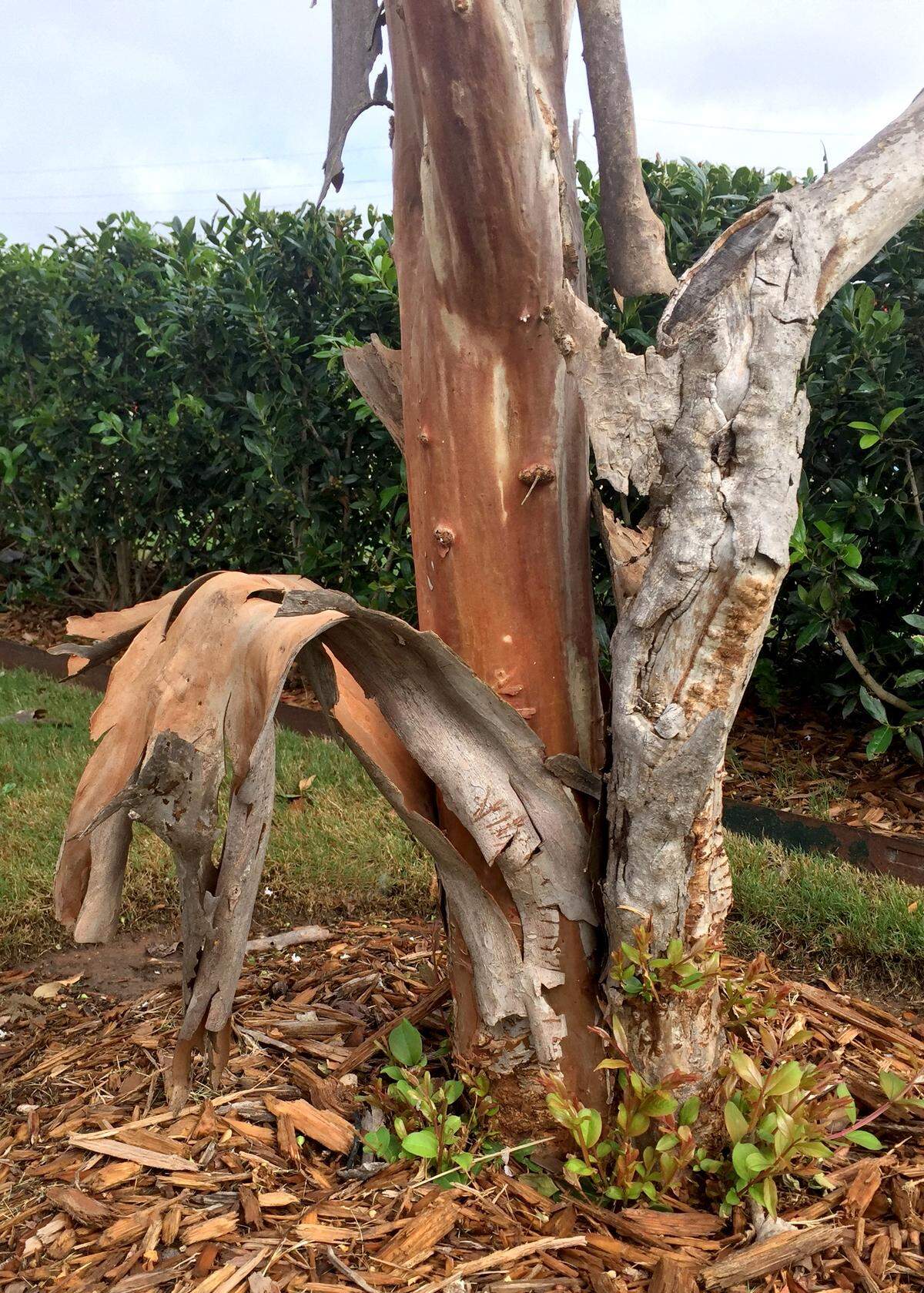
Botanists and arborists refer to bark as “sloughing off.” Bark is the outermost tissue of a tree’s trunk, and, as such, it’s a dead tissue. It cannot expand as the trunk grows larger over time. Think of a balloon partially inflated. Dip it in soft mud. Let the mud dry, then try to blow the balloon up a little bit more. The mud will have lost its elasticity, so all it can do is crack and pop off. Bark does that same thing.
For most trees the bark comes off in small chunks — pieces small enough that we rarely notice them. They fall to the ground, and they decay along with fallen tree leaves and grass clippings.
It’s when larger slabs of bark split away and fall that we get alarmed. Pecans are notorious for doing that. Vertical chunks 12 or 15 inches long will pop loose and drop. Usually there is new bark already forming beneath them and it’s all completely normal — no cause to worry.
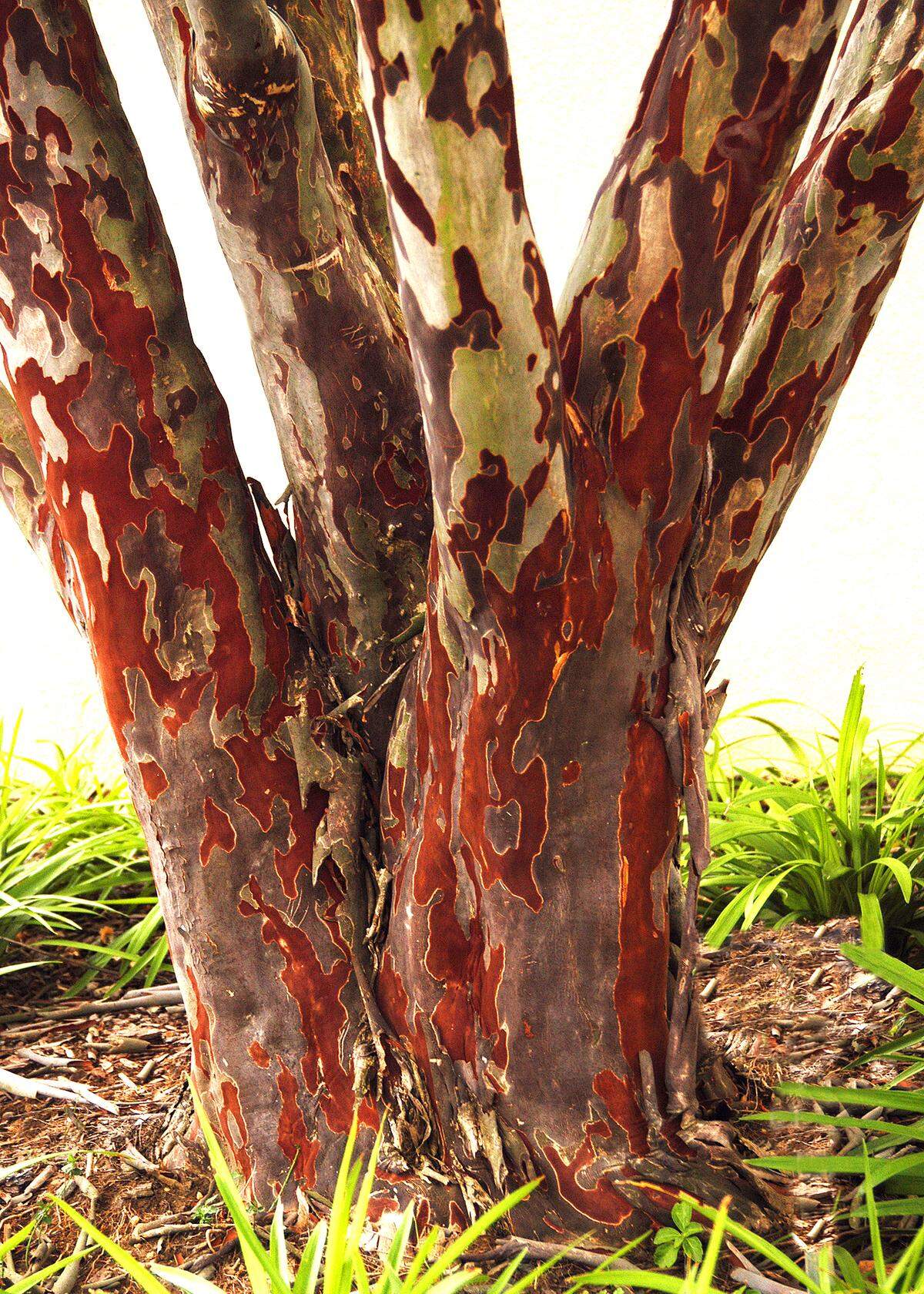
There are two other very common trees that have peeling bark. Crape myrtles are one. Trunks and branches that are 1 to 2 years old peel away freely, especially in late spring or early summer. It can involve half or more of the bark of the trunk at any given time. Folks get very concerned. Given a couple of years though, those sections of the trunks and major branches become slick and smooth, almost as if they’d been sanded and varnished.
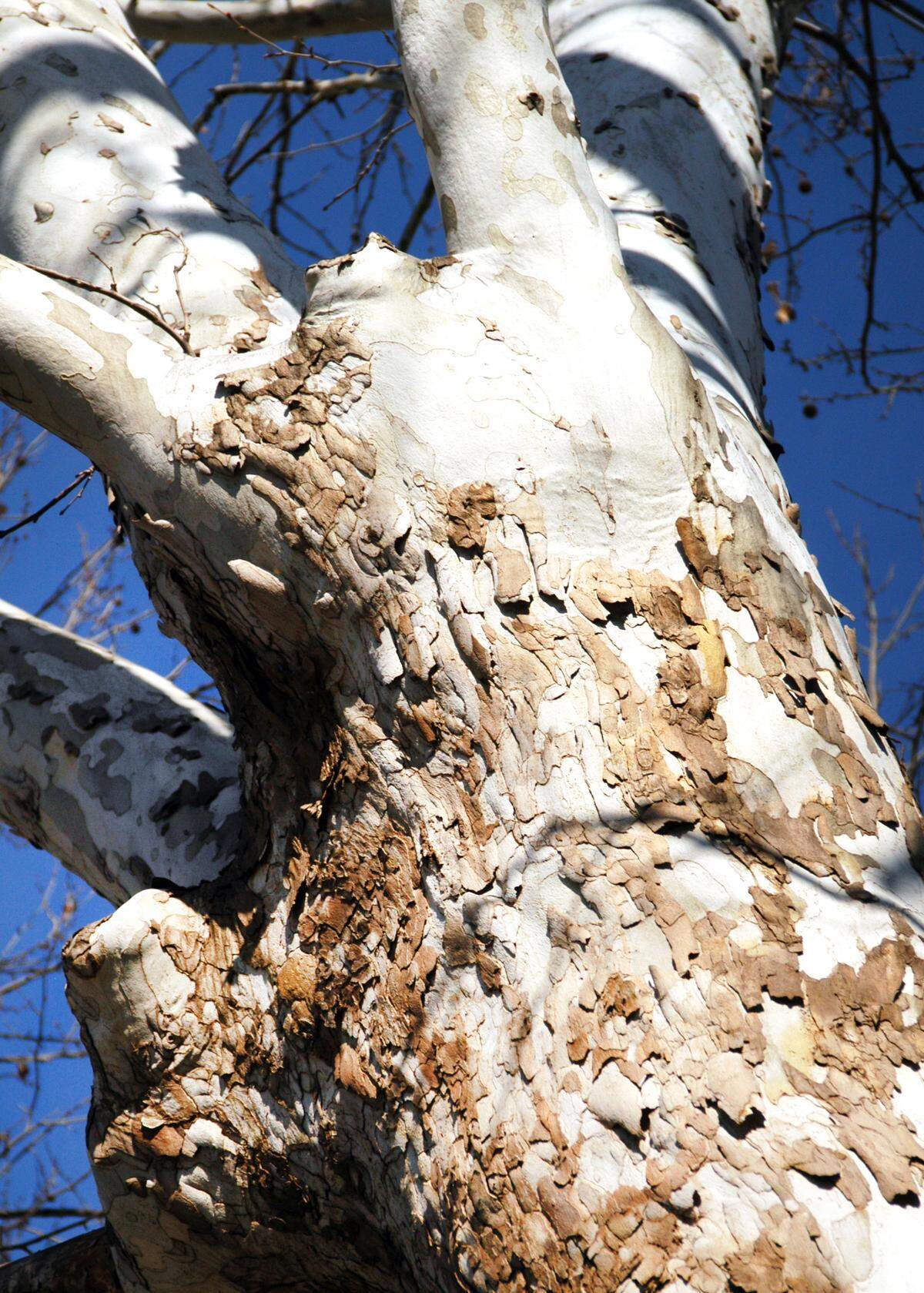
Sycamores lose big portions of bark, too, leaving white trunks behind. They’re stunning against a clear blue winter sky. Unfortunately, sycamores, as trees go, are not the best trees for Texas landscapes. They have a serious disease problem (anthracnose), and lace bugs frequently attack their foliage by late summer. But if you have one already, enjoy its great trunk color.
Thin-skinned trunks
Some of our shade trees have notably thin bark, at least when they’re young. We’ve had this lecture here in the classroom before. The examples include Shumard red oak, Chinese pistachio, and red maples (Acer rubrum, as opposed to Japanese maples Acer palmatum), but there are others. Growers produce these trees pot-to-pot in wholesale nurseries. The trees’ canopies shade the trunks of the adjacent trees. Then we buy them and plant them out in full sun. Two or three years later we wonder why their trunks are splitting and starting to decay. The tops of the trees are starting to die, almost always on the sides corresponding to the sides with the big bark splits.
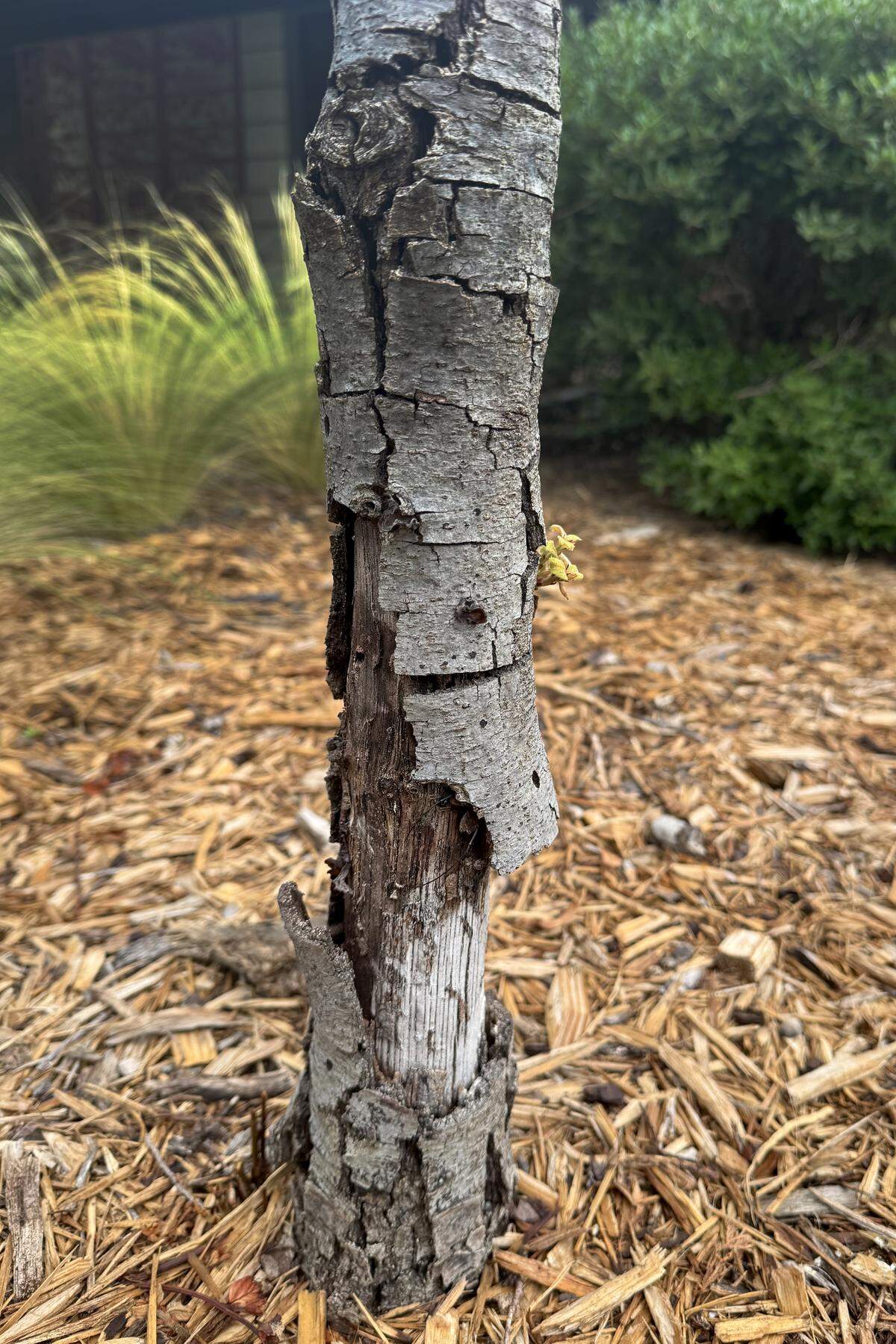
What has happened is that the trunks have suffered catastrophic sun scald. It takes a couple of years for the tissues to be destroyed, but when you look at them, you notice that it’s the west sides of the trunks that are damaged. Usually, by the time the damage is observed, it’s so severe that the trees cannot be saved.
So, what’s a gardener to do? Wrap the trunk with paper tree wrap. Several forms are available. I have no ties whatsoever commercially with the old brand Treekote, but it’s what I’ve used since I was a kid. It’s still on the market, and it costs only a few dollars per tree to save a tree from an ugly, painful death. That’s after you’ve spent scores, if not hundreds, of dollars to buy and plant that tree. I love my nursery industry, but frankly, I do not understand why tree wrap is not more widely sold and used. You may have to buy it online.
Tree trunk anatomy
The bark, as we’ve discussed, is the outermost tissue of a tree’s trunk. Just inside the bark is a cylindrical tissue called the phloem. It’s in that tissue that sugars manufactured in the leaves during photosynthesis are carried down to the roots. They are essential for keeping the roots alive and growing.
Just inside the phloem is the cambium layer. It is a cylinder of tissues that is dividing to produce more phloem cells to the outside and more of the tissue known as xylem to the inside. The xylem makes up the bulk of a large tree’s trunk. It is the “wood” of the trunk. The xylem cells are dead, and they function somewhat as straws pulling up water and minerals from the soil, through the roots and trunk to the limbs and leaves. The cambium keeps laying down new layers of xylem as the tree’s trunk grows larger in diameter.
When damage is done to the trunk, either by sun scald, by a line trimmer, or perhaps by a dog chain or old nylon twine tied around the trunk years ago, it cuts through the bark, then the phloem (so the roots die), then the cambium in a process called “girdling.” If damage goes as far as halfway around the trunk of a tree it is often substantial enough to kill a formerly vigorous shade tree.