
A few plants to consider after scrolling through thousands of photos in my cell phone
I was scrolling through the 32,000 photos on my phone a few days ago and I found some that I really did intend to share with you at the time that I took them. But something else came up – probably a bigger story or a flashier photo, and so there the photos sat in the log jam.
I’ve pulled a few of them out for you now. Most wouldn’t have enough substance to make a whole column, but maybe they can bolster one another and make it all look like it deserves your attention. And it will get eight photos off my camera. (It’s a start.)
Agarita. This plant doesn’t get a lot of press coverage. After all, it’s as thorny as a roll of barbed wire. It’s slow-growing, and at maturity it’s only 3 or 4 feet tall. But it’s a tough old plant that grows in arid Southwest Texas, out where rattlesnakes and prickly pears are its neighbors. It blooms in late winter/early spring, and it sets fruit that birds love – in fact, I’ve even eaten agarita jelly. It’s a sister to mahonias, nandinas and barberries, and frankly, it ought to be planted a whole lot more often.
Kaleidoscope abelia. I’m a fan of standard glossy abelia. It’s a large, arching shrub that’s suited to all of Texas, both for climate and soils. This is an intensely variegated form that stays short (around 3 feet tall). It colors up best in nearly full sun, although a little shade from mid-afternoon sun in the summer is a good plan. Give it highly organic planting soil and keep it consistently moist. Its margin of error care-wise is just a little narrower than for its standard big sister.
Hearts of Gold Redbud. There has been quite a surge of interesting redbuds coming into the market in the past 20 years. This is one of the most stunning. It has the typical redbud growth habit and leaf shape as well as normal redbud flower color, but its new growth is vibrant lemon yellow. The several well-kept specimens I see on my daily travels are stunning all spring and summer, and that’s coming from a guy who typically doesn’t lean toward variegated foliage. This one is just so eye-catching.
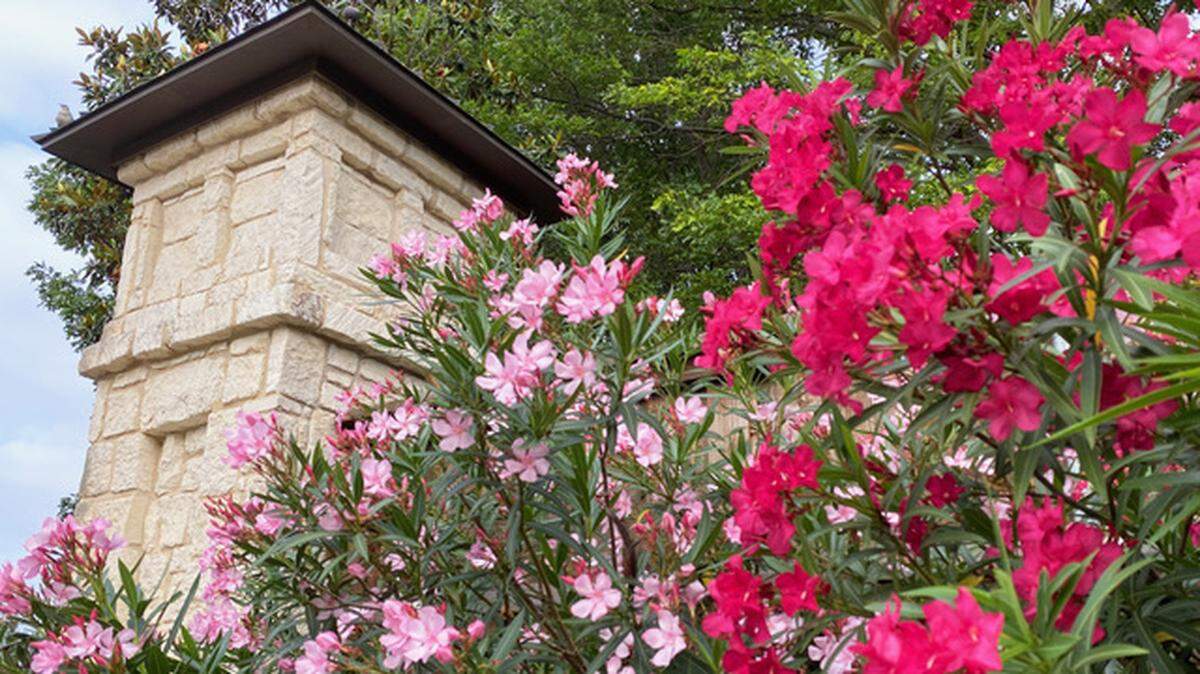
Pink and red oleanders. There’s nothing special about the varieties in this case. It’s just that my photo brought back fond memories. For most of us in and around Fort Worth and Dallas, our oleanders froze to the ground. Most are coming back strongly, but we won’t be seeing flowers on them until 2022 at the earliest. And that depends on what happens this upcoming winter, also on how much new growth the old plants throw out.
Spores on the backs of a holly fern leaflet. When I was a teenager, I had a plant stand in the local IGA supermarket in Bryan. One day the store called to tell me that a lady had brought back all of my holly ferns, upset and demanding a refund. She had actually cut off all of the leaves because they had insects on the backs of the foliage. But, in reality, her plants were very healthy. Those were just spores – the reproductive phase that all vigorous ferns will go through. It’s normal. Certainly nothing to worry about. And certainly no reason to destroy your ferns, whatever the type.
Various types of pink polka dot plants. It’s crazy what the hybridizers have done with this plant. It used to be a mundane pink (or white) speckled foliage plant that you’d occasionally see in greenhouses. Now, though, it’s available in a wide range of reds, pinks and whites, and it’s used both in beds and in patio pots, often in dramatic combinations of flowers and foliage. It grows best in sun until mid-morning, then bright shade the balance of the day. Proven Winners has a selection called Hippo Pink Polka Dot Plant that has brought home 30 major awards.
Dwarf Chinese holly with berries. I took this photo at our own front door. These plants have been growing there for 44 years, and they never bore fruit until six or seven years ago. In fact, I always knew dwarf Chinese hollies to be a male selection that could, therefore, never have fruit. A veteran nurseryman was at our house a couple of days ago, and he noted the green fruit on our shrubs by saying, “I’ve never seen that on dwarf Chinese hollies before.” But there they were.
Red-Spotted Purple Butterfly. I photographed this tropical-looking beauty on our front porch earlier this week. That’s it’s actual name, or if you prefer, it’s a Limenitis arthemis. The reference I read after I was able to identify it says that it’s “not an abundant species,” and that it normally lives high in forest canopies, coming to the ground mainly to feed and sip from puddles and stream banks – neither of which we had on our porch. But we were glad to welcome it to our home.
You can hear Neil Sperry on KLIF 570AM on Saturday afternoons 1-3 pm and on WBAP 820AM Sunday mornings 8-10 am. Join him at www.neilsperry.com and follow him on Facebook.
This story was originally published August 6, 2021 at 5:30 AM.