
Review: Melvin Edwards’ sculptures at the Nasher
In 1988, New York Times art critic Michael Brenson cited Melvin Edwards as “one of the best American sculptors...[and] one of the least well known.”
Nothing has changed.
Edwards is still one of the best sculptors, and more than 50 years into his career, still not an art star.
Nor is anything likely to change. The retrospective of Edwards’ work currently on exhibit at the Nasher Sculpture Center will enhance his already sterling reputation, and he will continue working with or without the anointment of celebrity.
He describes his art as, simply, “work.” The best outcome, he says, “is that hopefully my ideas will reach a level of some significance beyond the work. Perhaps in expressing my ideas there will be some value in what I see.”
Edwards has been producing museum-worthy artworks since the 1960s. He had a solo show at New York’s Whitney Museum of American Art in 1970, when he was 33 years old. He says it was a gesture of tokenism, because the Whitney was trying to make amends for excluding African-American artists.
He took advantage of that opportunity and then proceeded to reject subsequent overtures from other institutions that wanted to similarly lump all African-American artists in a single show under an all-inclusive banner.
The barbed-wire installation from the Whitney has been recreated by the Nasher for this retrospective. In the downstairs gallery, lengths of shiny new barbed wire have been strung across corners climbing to the ceiling in Pyramid Up and Down Pyramid.
The prickly wire hangs in crazy curling loops from the ceiling in “Look through minds mirror distance and measure time,” a title contributed by Edwards’ wife, poet Jayne Cortez, who died in 2012.
In some ZIP codes, barbed wire might be synonymous with incarceration; in Texas it is a tool of ranching life, so the installations border on the beautiful. This happens regularly in Edwards’ work. He uses materials that have a cruel and violent history, but his constructions, while including the horrors, are often quite lyrical.
The catalog for the exhibition contains a conversation between the show’s curator, Catherine Craft, and Edwards, in which he explains why he uses barbed wire: “... you have to be aware that it was a way to keep the cows at home. But then people tuned it into concentration camps. Before it happened with Jewish people in World War II, it happened in Namibia. Those contradictions, or contradistinctions, are things that have occupied me in visual art. As a way to realize the dynamic in a situation, art or otherwise, they’re very important to me.”
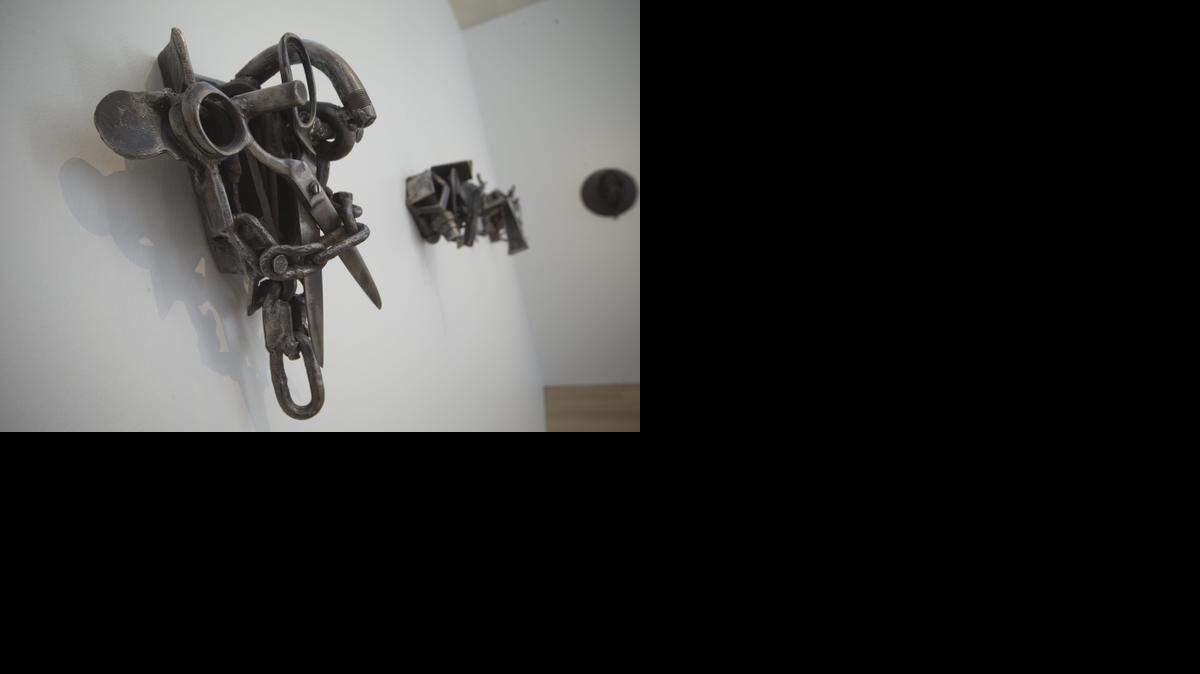
This contradiction of horror and grace is found in many of Edwards’ works, especially the “Lynch Fragments” series. These human-scaled abstract assemblies of tools, chains, scissors, hammer heads, spikes, shackles and locks are unapologetically political, and even with their overt references to a brutal history, they are stunningly beautiful.
“I wanted a loaded up title to make people think, because I didn’t see why there couldn’t be some language and expression in the modern art world that was honestly about what I came from,” he says in a video produced by the Getty in 2010.
He began making “Lynch Fragments” in the 1960s, evoking the racial tensions and political struggles of the civil rights movement. Several times during his career, he though he was done with the series, but he never stopped making them. The ones from the ’70s were a response to the inequity in numbers of black servicemen killed in Vietnam.
More recently, in 2003 he produced the “Iraq (Lynch Fragment)” series. These highly valued works are his most famous, and they are on loan to this exhibition from major art museums and private collections.
Native Texan
Edwards was born in Houston in 1937. His education took him to California and his professional career to New York, then beyond — to Zimbabwe, Japan and Cuba. He spends about six weeks each year in Senegal, working in metal foundries alongside the local workers.
Then he returns to his studios in New Jersey and New York to make more artwork.
He admits the small “Lynch Fragments” are personal commentary; he sees the larger pieces as a relationship with other people. Lately he is all about working with other people.
A series of “Rockers” works, large welded sheets of steel on rounded bases, are playful with a serious presence. They move easily on their rocking bases, no matter their heft. It’s all about the balance, Edwards says.
These pieces that he began in the 1970s are the transitional works that moved him toward very large public artworks. They have permanent homes, and only the drawings or maquettes (models) for these are in the retrospective.
He is aware that undertaking such commissions comes with a great deal of public debate.
“People’s immediate response to public art is often negative, but when they get familiar with it, they have their high school graduation or wedding photos taken with it,” he says. “That is the outcome of a public relationship with art. That’s the key. When people know more, and become familiar with it, they have a relationship with it. It becomes natural to their lives.
“I am a student of history, but I live in the present, and I hope my work will affect the future.”
So, Edwards keeps toiling. Keepin’ on is a strong current in his gene pool.
His mother, Thelma Felton Edwards, who is 94, just published her first book, Silver Tracks and Running Roses: Memories of a Goose Creek Girl. Her mother, Edwards’ grandmother, lived to be over 100 years old, so time is in the family’s favor.
What Edwards may lack today in public adulation and recognition, his work should gain in the years to come.
Gaile Robinson, 817-390-7113
Twitter: @GaileRobinson
Melvin Edwards: Five Decades
▪ Through May 10
▪ Nasher Sculpture Center
▪ 2001 Flora St., Dallas
▪ $5-$10
▪ 214-242-5100, http://www.nashersculpturecenter.org/
This story was originally published February 5, 2015 at 1:27 PM with the headline "Review: Melvin Edwards’ sculptures at the Nasher."