Meet the man behind the sound of this year’s Cliburn International Piano Competition
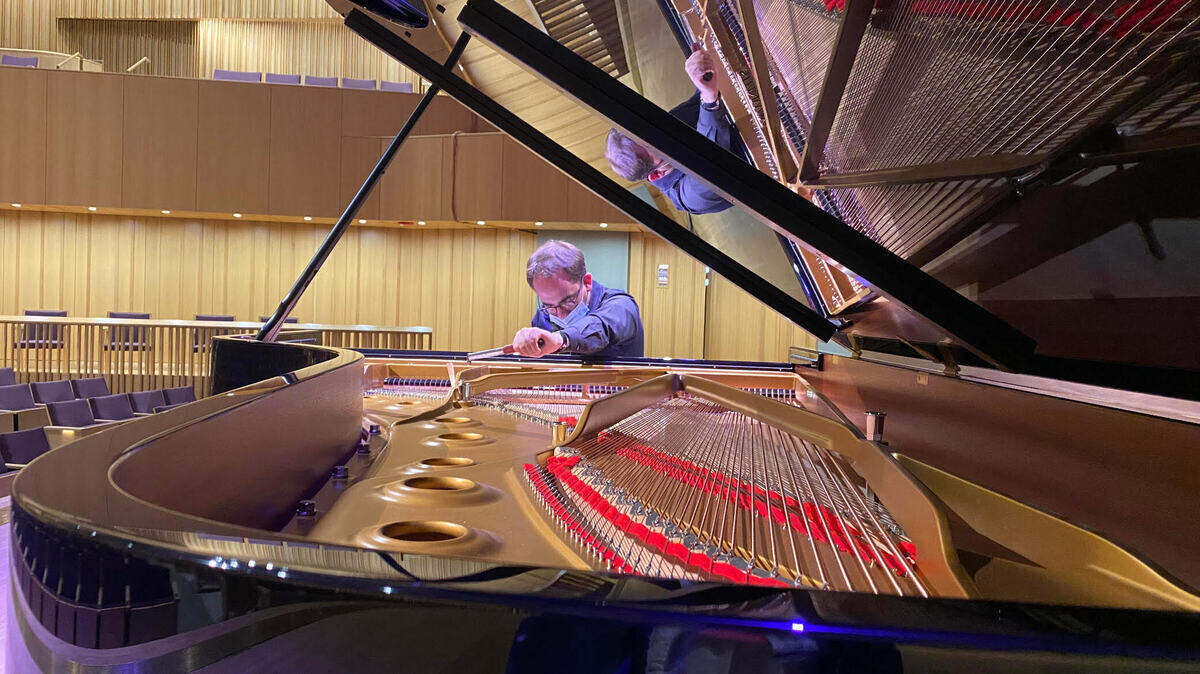
We meet 33-year-old Alex Moore halfway up the scale.
In his black button down and khakis he sits at the head of a German Steinway concert piano onstage at TCU’s empty Van Cliburn Concert Hall, tapping on each key to check the pitch.
He works thoughtfully with a tuning lever in his right hand and a handmade yellow key tapper strapped around the other. Somewhere inside the piano sits his phone with a tuning app pulled up, but Moore is really relying on his ears to do the work. If he has the tool, Moore says, he may as well use it. His pride hasn’t gotten big enough to do it with just with his ears.
There’s pressure riding behind this work — after all, the performances of 30 of the world’s best pianists ride on whether or not the sound is just right.
Moore, who was recently hired as TCU’s chief piano technician after a career at Steinway, is in charge of tuning pianos for the Sixteenth Cliburn International Piano Competition, which runs through June 18 in Fort Worth.
He got into tuning in 2009 after what he calls a failed trumpet career as a result of chronic pain. When he played, it felt almost like when cheeks burn from smiling too hard. The pain, coupled with Type 1 diabetes that Moore says hindered his body’s ability to bounce back, ultimately led to his decision to take a step back from playing, and subsequently his dream of being a jazz musician.
But the University of Louisville’s major requirements for Moore’s degree turned him on a different path.
Moore was required to take a piano course. He remembers a practice piano being broken and wondering if he could fix it. A mentor showed him how, and now over the next couple weeks, he’ll tune pianos for some of the world’s best players at the Cliburn.
The perfect piano is about creating the best palette for the performer, he says. There has to be power, a colorful sound range and plenty of tone. As he tunes, Moore listens for a meow-like noise that drags the note out.
On Friday afternoon on the second of three days of preliminary recitals, it was the second time he’d tuned the German Steinway — worth somewhere in the range of $200,000. Performers at the competition have a choice between two pianos: this one and a New York Steinway. Most are partial to the German one, he says.
It typically takes Moore about an hour-and-a-half to get the sound right depending on how out of whack it is, and he normally tunes about three pianos a day for the competition.
He’ll tap the keys and turn the lever to adjust the strings as he moves up the scale. He’ll reveal the insides of the piano by pulling them out like a drawer and shave off pieces of the hammers that tap the strings with thin strips of sandpaper to make sure they smack just right.
As he tested keys, D5 was hitting just a bit too high. So he pulled out a three-pronged needle tool and jabbed it into the meat of the key’s hammer to lessen its density, then tested the key again. This time, it was perfect.
The tuning is really all about making sure the pianos are maintained, Moore explains. As the performers play the pianos, the instrument settles into place.
“I try to settle it in before they do, because their settling in will be knocking it out,” he says. “I try to knock it in before they can knock it out.”