
This artist was highly innovative during his lifetime. Now his art is at the Kimbell.
One of Britain’s best-loved artists, J.M.W. Turner (1775-1851), enjoyed great success during his lifetime.
All the wealthy people of the day had to have a Turner. His dramatic landscape paintings and topographical watercolors captured the industrialization of England and the Napoleonic Wars.
Much to the dismay of fans and critics, he eventually made experimental works that focused on light, color, and atmosphere. But Turner was a highly innovative revolutionary artist, a precursor to impressionists like Monet, and a founder of modern art who influenced movements like Expressionism.
Organized by the Tate Britain where it was first exhibited, “Turner’s Modern World” is mostly arranged chronologically and covers the key elements of his legacy with over 100 works. This rare showcase of the European pioneer’s paintings is on view in Fort Worth at the Kimbell Art Museum through February 6.
“His engagement with the modern world ties into his evolution as a painter,” said George Shackleford, Kimbell’s deputy director and curator of the exhibition.
Turner began in the late 18th century with traditional British picaresque watercolor paintings of landscapes. One of the largest paintings in this show, “England: Richmond Hill, on Prince Regent’s Birthday,” captures a view that remains the same today. But Turner wasn’t just a landscape painter, he wanted to show the developments of his era. He includes a crowd and focuses on the latest fashions as much as the natural scenery.
He starts including scenes of industrialization. His work illustrates how blacksmiths, steel plows, canal building, and the invention of the steam engine were quickly changing how goods were produced and shipped. He also documented the rapid growth of London, which suddenly had ships crowding rivers like traffic jams. He painted skies filling with smog for the first time, masterfully contrasting the manmade smoke with the power of a natural climate, like a rain shower.
Turner also painted scenes of England at war with France. From 1809, “Ploughing Up Turnips, near Slough” references a food shortage in England during the war. People and livestock are vivid in this painting, and the landscape behind them is faded. The dark colors convey the grimness of a time when peasant farmers were eating turnips, which were previously meant for cattle. It is a painting that resonated with any English viewers from the early 19th century.
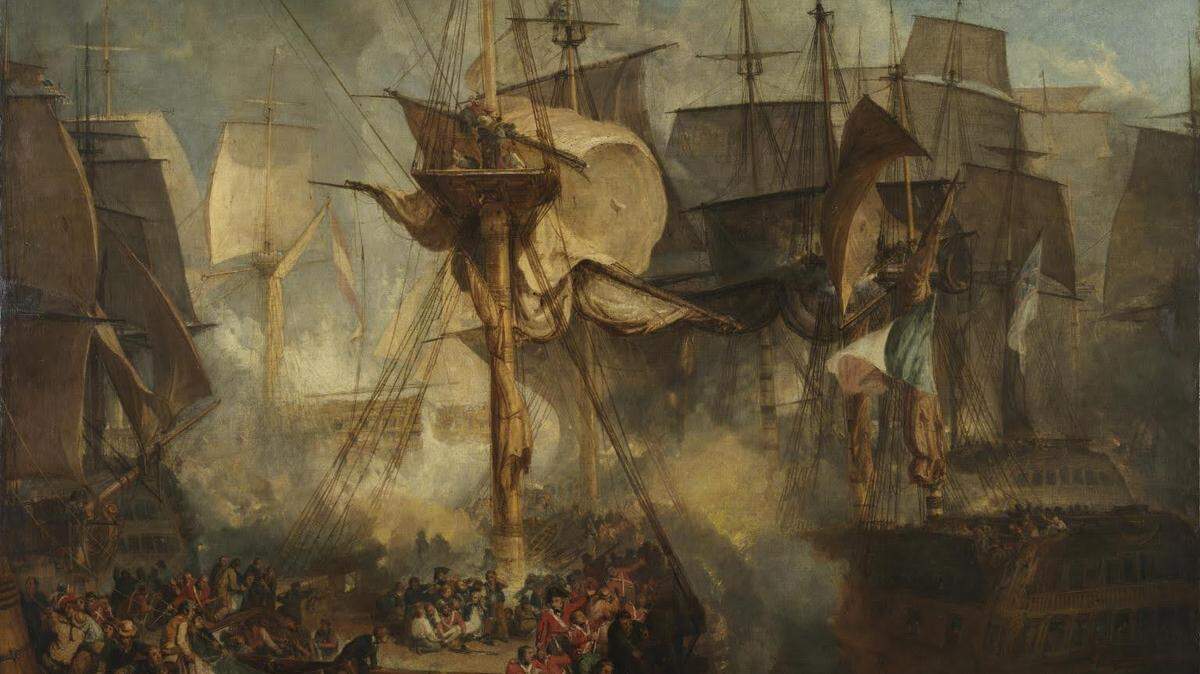
“The Battle of Trafalgar, as Seen from the Mizen Starboard Shrouds of the Victory” captures one of the war’s most heroic battles with an astonishing level of detail and a masterful interplay of shadows and light. There are explosions of smoke from muskets, the French are surrendering, and ships are painted with the detail of architectural renderings.
Turner’s work is largely naval and there is always plenty of angst and turmoil, especially when he was painting storms. Included here is “Snowstorm – Steam-Boat off a Harbour’s Mouth.” In a classic example of Turner’s dramatic scenes of shimmering light, a ship fights winds, snow, and rising waves. He shows us whalers harpooning their prey in works like “Whalers.” We also see the horrors of nautical disasters with heavy casualties in paintings like “The Wreck of a Transport Ship” from 1810.
A painting of women searching for survivors among the dead, “The Field of Waterloo,” is a less patriotic representation of war that addresses its gruesome aftermath. But an exuberant light in the distant background represents hope.
“The Burning of the Houses of Lords and Commons, 16 October 1834” finds Turner painting the Houses of Parliament burning uncontrollably with his trademark brushwork developing. His brushstrokes are visible, and the painting is clearly an artist interpreting a subject. Along with a brush, Turner used a knife to detail flames and reflections hitting the water.
And Turner’s work was getting more abstract with paintings like “The Fall of Anarchy,” a vision of a white horse galloping through clouds with a skeleton wearing a gold crown draped on its back. It is perhaps the most jarring and cryptic image exhibited here. With more abstract imagery, “The Thames above Waterloo Bridge” gives us an early look at the London fog from factories that came with the arrival of industrial revolution. Plumes of smoke from the smokestacks of a steamboat add to the pollution engulfing central London and the bridge is barely perceptible in the background. Aside from the river, the rest of the city is mostly obscured by the fog and steam.
The show also features drawings and unfinished paintings that capture Turner’s process. Often resembling modern gestural paintings, sketchy abstract pieces like “Whalers (Boiling Blubber) Entangled in Flaw Ice, Endeavouring to Extricate Themselves” influenced artists as much as his finished works.
By the time Turner painted “The Arrival of Louis-Philippe at the Royal Clarence Yard, Gosport, 8 October 1844,” he was mainly interested in the surface of the painting, emotion, and a lack of specificity that Abstract Expressionists would appreciate. Meant to represent the king arriving by boat, there is not a man, ship, or harbor to be found in this work. Turner’s particularly modern rendering of light and color may have been rejected while he was alive, but it inspired other artists posthumously and has helped keep his work relevant to this day.
The show ends with a trio of small paintings, including a rumination on Napoleon in exile with the sun setting into what looks like a sea of blood, “War. The Exile and the Rock Limpet” from 1842. Also included here is “Peace – Burial at Sea,” a haunting remembrance of Turner’s friend, artist David Wilkie, who died of typhoid aboard a ship.
By the end of his life, Turner had achieved a modern way of painting.
“Somebody who has been moved by a late Monet could be in fact absorbing part of the DNA of Turner,” Shackleford said. “He’s an unwitting influence on the development of modern painting in ways that he never would’ve been able to predict.”