
A remarkable 19th-century woman gets a true champion in an interactive play about beauty
She was compared to a gorilla and became a freak-show attraction billed as the Ugliest Woman in the World.
The cruel and dehumanizing treatment continued even after her death — long after. Her husband traveled the world with her embalmed body and continued to display her as a sideshow curiosity. A century and a half later, in our own time, she was still an exhibit, part of a collection of anatomical specimens languishing in a museum. In basement storage, no less.
Julia Pastrana, born in Mexico in 1834, had two rare diseases: hypertrichosis lanuginosa, which covered her body and face with hair, and gingival hyperplasia, which caused thickened lips and gums and the appearance of a protruding jaw. She grew into a brilliant woman who spoke three languages, was an accomplished dancer and had a beautiful mezzo-sporano singing voice, but she was cast out of her village. This being the 19th century, she was taken up by opportunistic hucksters who could make money off her distinctive appearance. One of them, American impresario Theodore Lent, married her. She died in 1860 from complications of childbirth (her infant son also died).
Pastrana’s extraordinary story has been important in the history of Fort Worth’s Amphibian Stage Productions, the groundbreaking theater founded in 2000. In 2003, the fledgling company got a big shot of attention for the American premiere of Shaun Prendergast’s "The True History of the Tragic Life and Triumphant Death of Julia Pastrana, the Ugliest Woman in the World," which was performed entirely in the dark. Then in 2012, the theater revived the play to kick off its new permanent home on South Main Street.
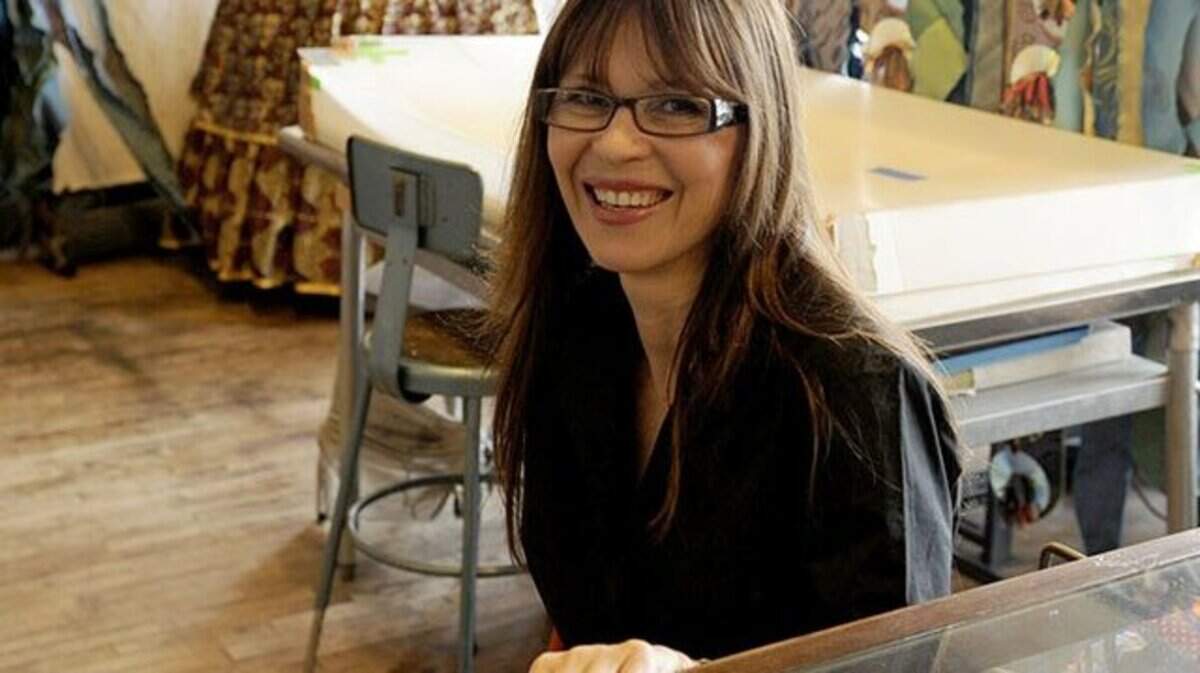
This weekend, Amphibian will premiere a new work inspired by the latest turn in Julia’s story. "The Eye of the Beholder," a one-woman show, gets just two performances Friday and Saturday night. It’s written and performed by Laura Anderson Barbata, the prime mover behind an effort that rescued Pastrana from a museum in Norway and gave her a proper Catholic burial at last near her birthplace in Mexico.
Sisterhood is powerful
The saga of Julia Pastrana is especially meaningful to Amphibian co-founder and artistic director Kathleen Anderson Culebro, who grew up in the same Mexican state, Sinaloa. Julia has loomed even larger in the life of Barbata, who is Culebro’s sister. Barbata, the costume designer for the 2003 show, was, like almost everyone who saw that show, deeply affected by it.
“When you listen to that play, when you hear the story for the first time, you immediately feel a sense of sadness, of injustice — that this is a wrong that has to be corrected,” she says. Amphibian started a petition that patrons could sign. “Coming out of there, everybody felt indignant about it and said, 'What can we do?' That was my first response. But I experienced the play so many times, it really grows on you. Sometimes signing a petition isn’t enough.” Life soon gave her an opportunity to do more.
Culebro and Barbato were born in Mexico City and moved to Sinaloa, where their father was a restaurateur. “But he and my mother were always very passionate about the arts,” Culebro says.
“Mexico has a very different approach to the arts. Here, you constantly have to explain to people that it’s important, but there’s such a different attitude there. On Sundays, you’ll see lots of people lining up around the block for the museums. It’s everywhere. You’re surrounded by this cultural beauty that’s really rich.”
Culebro moved to Fort Worth in the early ’90s when her first husband, a surgeon, took a job here. She started taking theater classes at TCU and eventually earned a second degree (her first was in languages). “I just was always obsessed with theater, writing plays in the closet. I was sure I’d be an outcast among all these people — I was in my early 30s.”
But she fit right in. Today, Amphibian is in the first rank of local theaters, with a history of innovative, engaging programming. It brings the best of London’s stages to town through live broadcasts at the Modern Art Museum of Fort Worth. It also maintains strong connections to the New York theater world (actor Kevin Kline chaired the capital campaign when Amphibian needed to raise funds for its permanent home).
Culebro’s sister is one of those New York connections, though theater is just one of her fields. Barbato, who lives in Brooklyn and Mexico City, is a visual artist who makes things such as sculptures, photographs and theatrical costumes. But she works primarily in what she calls the “social realm.”
“She likes working with communities and having whatever communities she’s in be a part of the story she’s telling,” says her sister. “She wants to serve the community but not in a paternalistic way, rather in a way that’s an exchange of ideas. She’ll walk away having learned just as much as she has taught.”
Barbato visited the Yanomani people of the Amazon rain forest and asked them to teach her canoe-making. In return, she taught them something she knew how to do: paper-making. She helped them write and illustrate an award-winning book and now they can tell their own story to the world, instead of just being subjects for visiting anthropologists (or artists).
In another project, Barbato helped traditional stilt-dancers in Mexico by creating dazzling wearable sculptures for them to perform in. It raised their profile and attracted the interest of young artists — all of which helped strengthen the tradition and secure its future.
When her body of work led a museum in Oslo to offer Barbata a residency, it turned out to be the very place where Pastrana’s body had landed. “Julia was in the basement,” she says bluntly. “So I began to inquire and to learn more about her story. What were the justifications, what were the thought processes that could keep a person like Julia Pastrana as part of a collection? I was trying to understand how this could be today.”
She did research on indigenous rights, on repatriation, on the exhibition of human beings before she began the process of bringing Pastrana's body back to Mexico. The whole process took 10 years, but Pastrana was finally laid to rest in Sinaloa in 2013. Her burial got international press attention — The New York Times credited Culebro and “a theater in Texas” for the American premiere of the show that inspired Barbata.
For Barbata, however, the story was not over. She noted that people came from all over to witness the burial, and many were carrying signs calling for things like an end to exploitation of indigenous people or an end to violence against women.
“I feel that Julia Pastrana’s story is a contemporary story even though she was born in 1834, died in 1860 and was buried in 2013. Because many of the issues that kept her under oppression and exploitation are, in a way, still operating today — her dehumanization, “beauty” utilized as a form to justify her objectification, because of her indigenous background. I felt that was important to continue exploring, that having successfully achieved the repatriation of Julia Pastrana to her homeland — my country, my state, where I grew up — that it wasn’t enough, that I needed to take it further.”
On beauty and seeing
Amphibian is calling “The Eye of the Beholder” an interactive performance piece. Barbata and director Tamilla Woodard, a noted director and Yale School of Drama graduate who is especially known for her work in creating immersive theater experiences, are in Fort Worth for just one week “in residence” to finalize aspects of the piece, then present it twice.
They had been in touch for months, working on the script and the ideas. It’s a “hybrid,” says Woodard, “involving theatrical performance, lecture and multimedia conversation.”
Barbata will be the only performer, but the show is highly collaborative. It will include projections designed by well-known multimedia artist Kate Freer (her collaboration with composer-choreographer Meredith Monk debuted this month at Brooklyn Academy of Music). Local photographer Loli Kantor, known for her work with almost every major local arts group, will contribute on-site photos (which the creative team doesn’t want to say too much about).
The audience is another collaborator — both Barbata and Woodard are clearly inspired by audience participation as an essential dimension of their art.
“This is participatory, but in the most inviting way,” Woodard says. “You don’t have to solve math problems or anything.”
On Tuesday, three days before the opening, they are sitting around a table inside the black box theater. They aren’t even sure yet how the chairs will be configured for the audience. On the table are densely illustrated ’zines by Barbato that focus on different aspects of Pastrana’s story and the issues it raises: our perceptions of beauty, for instance.
In the show, she will raise questions about beauty and how we see it. “Laura is a visual artist and what I’m learning from her is how to see things,” Woodard says. “And that is essentially the experience we hope the audience will have. There’s more in front of you than you can actually see — just like extraordinary musicians they have incredible ears, visual artists have incredible eyes. That is what this evening is.”
Amphibian is working to ensure the show will have a life after Fort Worth. Calebro invited numerous curators and artistic directors to the performances. This is the kind of piece that might get performed not just in theaters but at community centers, libraries, museums and galleries.
There also is talk of an opera. Musician Magne Furuholmen of ‘80s band A-ha (“Take On Me”) is interested, as is avant-garde director Robert Wilson, who has famously worked with David Byrne, Laurie Anderson and Philip Glass.
“Now that Julia is buried, it is easier to have these conversations,” says Barbata. “Before, it was still painful to recognize how this person was treated her whole life and even after. So we’re in conversations.”
Opera projects take a long time to develop, she says, but because Pastrana was a singer, it will be a way to let her speak for herself. “It’s a way to honor her and to remember her not as a victim but to remember her as the powerful artist that she was.”
'The Eye of the Beholder'
- 8 p.m. March 23-24
- Amphibian Stage Productions
- 120 S. Main St., Fort Worth
- $20
- 817-923-3012
- http://www.amphibianstage.com/
This story was originally published March 21, 2018 at 5:12 PM with the headline "A remarkable 19th-century woman gets a true champion in an interactive play about beauty."