
Why a Texas Tech quarterback would routinely receive death threats in his DMs
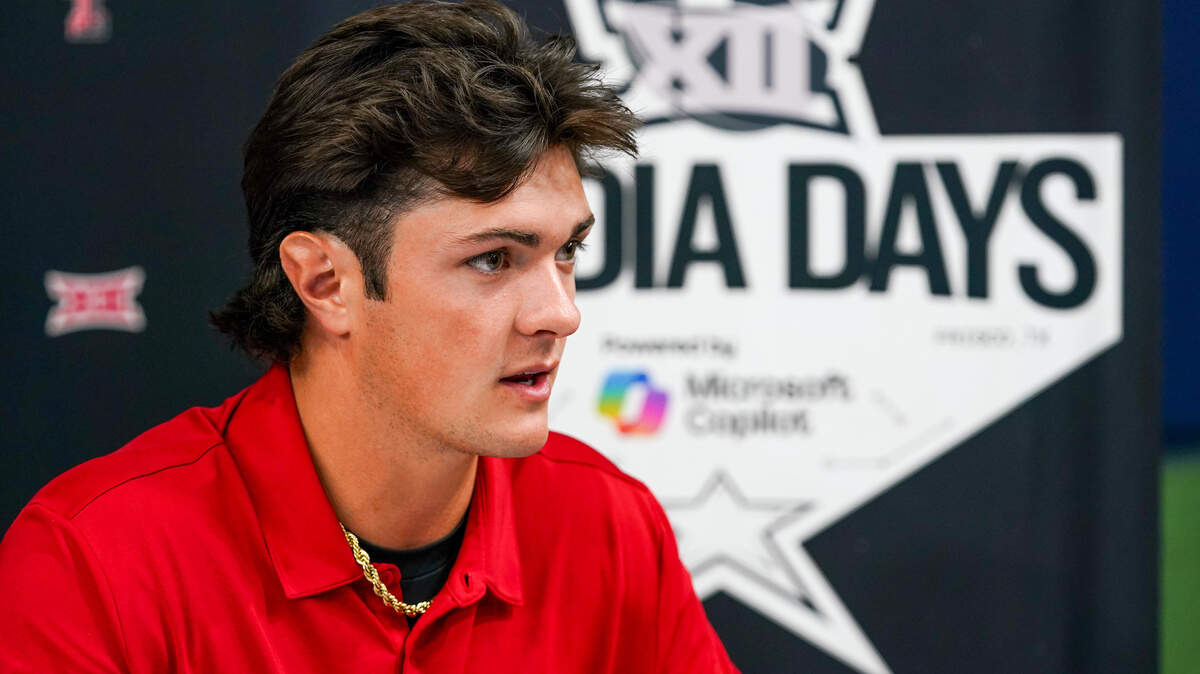
When Behren Morton checks his DMs, he is mentally prepared for everything from undying devotion and love to full combat and assault.
“I’ve received death threats, for sure,” he said. “People who send me messages that they know where I live. They know where my parents live. They show me the addresses.”
The Texas Tech starting quarterback says this disgusting piece of news with a chuckle in his voice, and a grin on his face. It’s not funny. He’s a 23-year-old college senior who is numb to anonymous threats from gamblers.
He is hardly the only one.
America’s out-of-the-closet relationship with sports gambling has created a river of revenue for multiple properties, and a powerful stream of consequences that we are only now beginning to realize.
On Monday, the Cleveland Guardians announced that closer Emmanuel Chase was placed on non-disciplinary leave stemming from a sports betting probe. Earlier this month, Guardians pitcher Luis Ortiz was put on indefinite leave because he was being investigated by MLB for activities related to betting.
In late June, the U.S. District Attorney’s office started to investigate Detroit Pistons guard Malik Beasley for alleged activity regarding betting on NBA games, and specifically prop bets.
These are the repercussions we can all see, or easily Google. Another part to all of this gambling that is far less visible, but potentially damaging, is the anger that gamblers fire at players after a game relating to prop bets.
“It’s a part of college football nowadays,” Morton said at Big 12 Media Days earlier this month. “I have been sent multiple Venmo requests for an unreal amount of money because a person missed a parlay bet on something that involved me.
“It does scare you, but our media team (at Texas Tech) does a good job of this. If someone messages me something threatening, like my address, then I notify them and they handle it.”
For a seasoned gambler, the prop bet is often more attractive than betting on the point spread, or the money line. The odds are slightly better for the gambler. The list of potential prop bets on a player is as far and as wide as the imagination of the bookie, or oddsmaker.
Over/under yards the quarterback will throw in a game. Over/under interceptions the quarterback will throw in a game. Touchdowns scored by the running back in a game. If you can think of a statistic for an individual skill position player, or any player who will generate a stat line, there’s a 98 percent chance you can bet on it.
That’s all well and good until the quarterback “blows it” by throwing for 304 yards, three touchdowns, and no interceptions in 27-24 win over his rival school. The over/under on his passing yards was 305, and touchdowns was four.
This is when angry gambler finds the college kid to send that person a potential varying degree of insults and threats over social media that they would never dare say to the player’s face.
“Even when I was at New Mexico, I ran into this quite a bit,” Utah Utes quarterback Devon Dampier said during Big 12 Media Days earlier this month. He began his career at UNM before transferring to Utah. “I don’t do social media during the season, but I have scrolled past all of that, for sure.”
The only real solution is for a person to try to ignore it. Unless the player has no social media account, which these days is nearly impossible, an angry fan can easily find that person online to say whatever they want. And they do.
“You take it on the chin in this business and it’s worse than it used to be. That thing you are recording me with right there - that cell phone - has given everybody a voice. Ugly opinions,” Central Florida coach Scott Frost said. “It used to be easy not to read the newspaper, but it’s really hard to block it out now when it’s in your hand 24/7.
“That can be dangerous. It’s dangerous to young kids. There are attempts to stop it because it does affect our young kids, and it affects our coaches, too. There is not a lot you can do about it other than shut it all off and try not to pay attention it. It affects me if I let it affect me.”
Minimize screen time. Try to ignore the ugly. This is about all any player, or coach, can do. Unless it’s really bad.
“It hasn’t happened to me a lot because I haven’t played much but talking to my teammates they did get some crazy messages last season,” Central Florida running back Myles Montgomery said. “For one of my teammates, he just didn’t pay any attention to it and that’s what you have to do. Just don’t look at it.
“Unless it’s a threat, like, ‘I know know where you live.’ That one you take seriously.”
Or, a player can do what West Virginia receiver Jaden Bray suggests, “Delete the apps, or turn the phone off.”
Few of us have the will power to actually do one, the other, or both.
This is just another part of being a player that that no coach, mentor or counselor can adequately prepare them to navigate, but is all now a part of college sports.