
The celebration of New Year’s babies in Fort Worth wasn’t just about human births
The New Year has long been a time to celebrate new life, whether the birth of human babies or, in the case of longtime Fort Worth Zoo director Hamilton Hittson, photogenic animal babies. The tradition of celebrating the first baby born in the New Year has an interesting history and, in the case of Fort Worth, a charming plot twist.
During the nineteenth century – and through the early years of the twentieth century – most babies were born at home. That, plus a high infant mortality rate (estimates are as high as 30% during the nineteenth century and about 16.5% in 1900), made it difficult to identify the first baby born each year and chancy to promote the infant’s birth. Milk pasteurization, a safe water supply, improved living conditions, prenatal care, and other public health measures facilitated a dramatic drop in infant mortality during the 1910s and 1920s. Hospital births also increased dramatically, making it easier to determine the first baby born each year.
The Star-Telegram began Identifying Tarrant County’s first birth of the year during the late 1920s, periodically including that information along with the first arrest and automobile accident of the New Year. Publicizing the first birth of the year increased during the 1930s, perhaps because good news was needed during the Great Depression. The post-World War II baby boom only accelerated first baby reports, with runners-up from throughout the county listed. A photograph of the infant – held by its mother or a nurse – began to appear regularly.
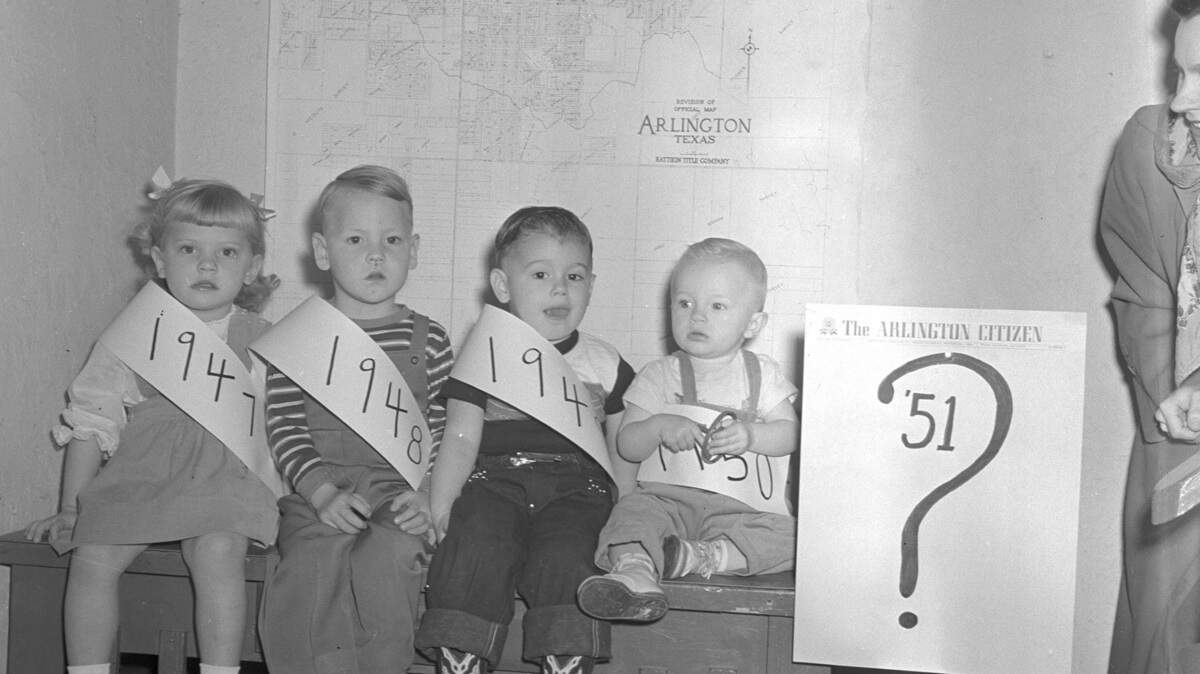
The Arlington Citizen played to the theme, rounding up the first infants from the previous four years and posing them in stair-step fashion atop a desk with a big question mark teaser about who might be the first baby of 1951. After all, photos of infants and children sold papers – especially to the child’s parents and relatives.
Forest Park Zoo (the name shifted to the Fort Worth Zoo about 1960) director Hamilton Hittson was shameless about promoting both the zoo and himself, so animal babies were the perfect piggyback “first baby” opportunity. Hittson, named to the chief zookeeper position in 1933, provided a story about the birth of a Mangabey monkey on Jan. 2, 1934, which noted that, “Forest Park Zoo had its New Year baby, too.” Zoo animal babies were far fewer in number than human ones, so Hittson settled for January births whenever he could get them. In the absence of a 1945 New Year’s baby, he placed the zoo’s Sandhill Crane as the overworked “stork” that delivered seven babies on New Year’s Day. Although the human babies got most of the copy, the crane masquerading as a stork snagged the photo spot.
.jpg "20059032_Zoo_dir_Hamilton_Hittson_holds_baby_lion_Khartoum_1-29-1947_born_1-14 (2).jpg")
One of the cutest photo opportunities came in 1947, when Hittson was pictured holding Khartoum, a newborn Nubian (or Barbary) lion cub. Eventually renamed Brownie, for Brownie Scout troop 88 from Oak Lawn in Dallas, which contributed $8.43 to the zoo’s animal acquisition Ark Fund, he proved to be a photogenic fundraiser for several months before disappearing from the record – likely sold to another zoo where he could breed.
Other zoo New Year’s babies included a pair of wild Australian dingo puppies featured in January 1953. They, too, went on to live at other zoos – like many of the human first babies, living ordinary lives despite their initial fame.
Carol Roark is an archivist, historian, and author with a special interest in architectural and photographic history who has written several books on Fort Worth history.
This story was originally published January 1, 2022 at 6:00 AM.