
Watching the birds has been unusually interesting this winter
Lynn and I have been holed up in our “bubble” for the past 10 months. We both work at home, and we’ve accomplished a lot just staying in place.
One of the things that has brought us the most pleasure has been watching the backyard birds at our feeders. That’s been especially true through the past couple of months as northern birds have flocked into town. They’re stirred themselves in with the wild birds that are here 12 months a year, and the blended families have had curious reactions to one another.
We had a couple of red-bellied woodpeckers and a handful of blue jays trying to feed from one of the long cylindrical feeders. The poor things could barely hang on. I called my local birding supply store and asked for their suggestions. They suggested in-shell peanuts and a compressed cylinder of seeds and meal worms.
The store staff member met me curbside with the goodies. We had them in place early the next morning, and by noon the woodpeckers and several jays had come in for a sampling.
And then…. And then Mr. Mockingbird blew into town. We’ve had feeders for 25 years, and I’ve had the cylinders and peanuts before, but we’ve never had mockingbirds come in to dine. Well, I have to tell you. Mockingbirds are at the tip top of the pecking order. The woodpeckers left and have never come back. Five blue jays had a skirmish with the mockingbirds, and the whole herd of jays decided it wasn’t worth it, so they moved along.
The mockingbird, and now his mate, have those two feeders all to themselves. Luckily, they’re in the far “out-back” of our landscape, far away from most of the rest of our feeders. If any new bird arrives and thinks about dining, it’s quickly popped from the rear and urged to find another roost to call home. The mockingbird reminds me of the iconic “Come and Take It” Gonzales flag of the Texas Revolution – the cannon aimed and ready for any unwitting intruder.
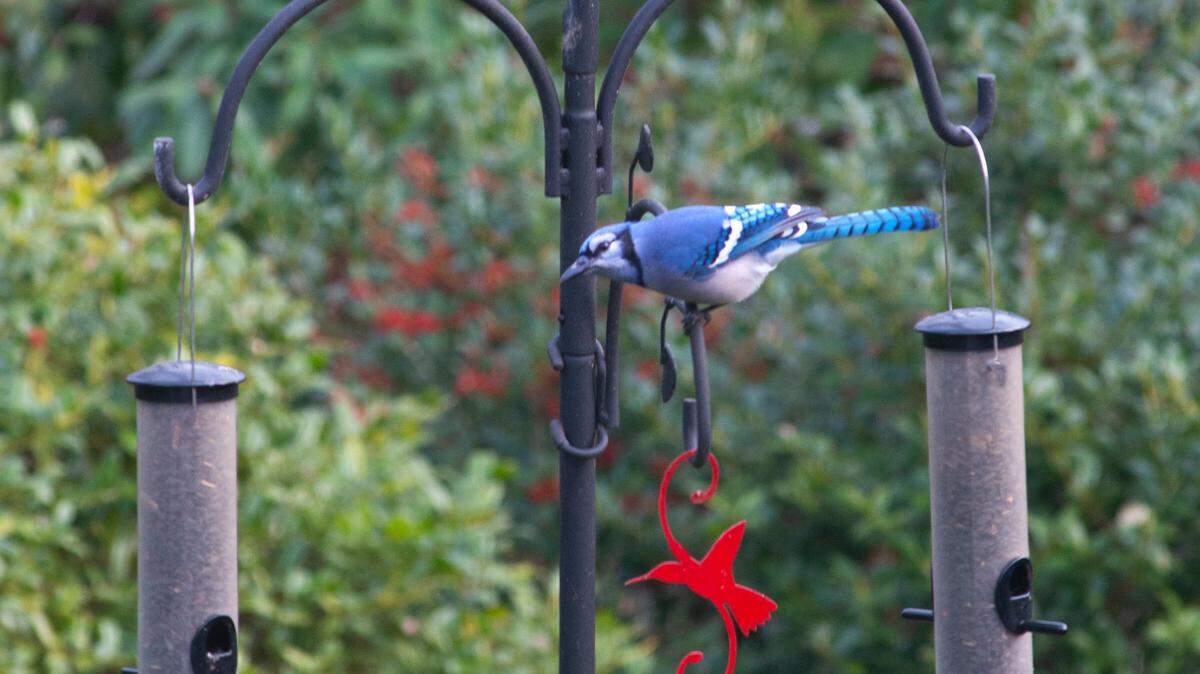
Still wanting to help the blue jays, and any woodpeckers that might still be willing to give it a try, I mounted a second set of feeders for the non-mockingbird birds. We’ve been delighted to watch the jays find this second cache of peanuts. They land atop the feeder, shout out their loud cries, then drop down to pluck out the peanuts while still in flight. They fly away to distant branches where they hold the peanuts under their feet while they peck out the nuts with their beaks. Smooth and easy. Fun to watch. Titmice and other mid-sized birds try to simulate it all, but their rates of success aren’t nearly as great.
Goldfinches arrived around Christmas. They’re tiny birds that migrate in from the northern U.S. First there was one goldfinch. The next day there seemed to be thousands. And then house finches. And then flock after flock of pine siskins. I don’t recall ever seeing them at our feeders before. They’re also quite tiny, marked with numerous white stripes. They’re busy moving all of the time.
We’ve had a number of white-breasted nuthatches (always coming down tree trunks upside-down) and their cousins, the red-breasted nuthatches. They’re pretty little birds that stay at the feeders barely long enough to pull out one little sunflower seed.
The “perky bird” award goes to the titmice. With their bright little eyes and tufted crowns, they seem so alert. They’re in our landscape year ‘round. As are the beautiful Carolina chickadees. They look like they’re dressed for a formal dinner, yet they only stay long enough to pluck out a seed before taking it far away.
Our population of cardinals is building quite rapidly. We have perhaps a dozen pairs, and at times they seem to occupy every shrub and tree in our landscape.
I do a feature with our pastor, Dr. Tommy Brumett of the First United Methodist Church of Downtown McKinney each Saturday at 2:45 p.m. as part of my radio program on KLIF. Tommy is an avid birder, and he introduced us all to, he said with a chuckle, the “yellow-rumped warbler.” I had never seen one, but it wasn’t more than a few days before we had them at our feeders as well.
I’ve had really good luck using the compressed cylinders containing a variety of seeds and nutrients as well as meal worms that are like little candy bars to wild birds. And high-quality black, oil-type sunflower seeds, the in-shell peanuts and thistle seed for the goldfinches (although they love the sunflower seeds, too). Our hollies are loaded with berries. They’re ready for the robins (some have already been by for an appetizer) and the cedar waxwings.
There are a couple of suggestions I’d specifically like to pitch out to help you enjoy your birding endeavors even more. First, to avoid bird strikes to your windows, the folks at Wild Birds Unlimited have unobtrusive window decals in several different designs. They list them on their website and in their stores as “Window Alert” decals. After several loud thumps and stunned birds a couple of weeks ago, I applied them to our windows, and I have watched maybe a dozen birds fly right toward them, then at the last instant, make 90-degree turns to avoid painful collisions. They really work!
I’d also like to send you to a fabulous website. It’s the Cornell Ornithology Laboratory’s site (allaboutbirds.org/news/), and it’s the place to go to learn every last detail about birds native to North America.
I leave it bookmarked so I can get to it quickly. It features sparkling photography, maps of their native ranges, descriptions of their habits and habitats and recordings of their calls. It even tells you those birds that look similar and how to tell them apart. If you enjoy birds, you must see this website.
You can hear Neil Sperry on KLIF 570AM on Saturday afternoons 1-3 pm and on WBAP 820AM Sunday mornings 8-10 am. Join him at www.neilsperry.com and follow him on Facebook.