
Set your mind gears in motion for the changes needed in your garden
The Victorian World wasn’t quite ready for Charles Darwin’s 1859 “Origin of the Species” in which he introduced the concept of evolution by natural selection.
Perhaps you’ve heard that it raised quite a stir.
I’m going to roll out my own concept of evolution, and I’ll simply call it “The Sperry Theory of Landscaping Change.”
Hopefully it won’t cause civil unrest.
My goal, quite to the contrary, will be to set your mind gears in motion to think about changes you might make in the look of your garden this spring. Landscapes, you see, are never really finished. They’re always works in progress. Let me present a few examples.
Shade where there used to be sunlight
You’ve seen me write about this one before. Shade is most coveted commodity when each of us begins our new Texas landscape. Summers are long and they’re hot, and those shade trees are precious shelters as we enjoy our yards in the evenings.
But, what happens when the shade becomes so heavy that our turfgrass no longer will grow? What can we do to fill in the voids?
Many people keep trying new sod. Year after year they plant new grass where the old turf has failed, hoping that this time something will have changed, but the sad news is that the only thing that has changed is that the shade has gotten heavier.
It’s time to switch over to shade-resilient groundcovers such as mondograss (“monkeygrass”), liriope, wintercreeper or English ivy (requires perfect drainage). Short-growing, shade-tolerant shrubs such as dwarf yaupon, Carissa and Burford hollies all work well, as will ferns and shade-loving perennials.
So you see, shade isn’t a landscaping negative. It just requires a readjustment in thinking.
Shrubs that have outgrown their boundaries
Folks’ questions here usually begin with, “Neil, how far back can I prune my __?” And then they fill in the blank with the name of the offending shrub.
My answer usually advises that most shrubs can be trimmed back by 30 or 35 percent once or twice, but then I warn them that they probably have chosen the wrong plant for the placement because it’s going to grow right back.
They’ll end up having to prune it again and again, and eventually they’ll have a very short shrub with a disproportionately large trunk. I advise them to move it to a location where it can grow to its own genetically predetermined height. Then I suggest that they replace it with a much shorter type of plant.
Changing bed size and layout entirely
It’s just my wild-eyed guess, but probably 95 percent of all home landscaping beds were originally laid out in long, straight lines. Unfortunately, that merely reflects the linear nature of most of our houses. It doesn’t bring much of a natural look to our plantings.
Current style suggests that we plant in long, sweeping curves, so while you’re replanting your overgrown shrubs, consider doing a major redesign of the entire bed layout. It’s easy and it will make for a great new look in your landscape.
I use a supple garden hose on a sunny day to configure the bed edges, and I try to do it in one long, continuous swoop across the face of the house.
As for the bed size, make it proportionate to the height and visual “weight” of the house. Most original beds are woefully narrow. Be flamboyant. Let your bed extend out 6 to 10 feet from the house. That will allow ample room for groupings of shrubs, groundcovers, flowers and small accent trees. You don’t “landscape” the inside of your house with rows of chairs around all the walls, and you shouldn’t do that with the outside, either.
Plants that have become drab and dreary
Shrubs can grow tired looking in their old surroundings. You look at them for months or years, and you think about how nice things might look if you just changed them out. But bringing yourself to do it is a really tough step. I’m here to tell you that it can feel like pulling a splinter. Almost immediately you’ll wonder why you didn’t make the decision much earlier.
Sometimes our shrubs wear out because we prune them too much or too often. Sometimes they run into poor subsoil and they just can’t get the nutrients they desperately need. That’s what often happens to azaleas, hydrangeas and other acid-loving plants when we plant them into high-amended soils here in the Blackland Prairie. After the organic matter that we have added breaks down, the plants start going downhill and we’re forced to make that big changeout. Well, gardener, fear no more. Go ahead and do it this year. You’ll be glad that you did.
Shrinking the landscape to match our time and energy
And finally, there are times when our bodies simply can’t keep up with what we did 10 or 25 years ago. It’s time to simplify our surroundings by pulling back the intensely landscaped parts of our gardens.
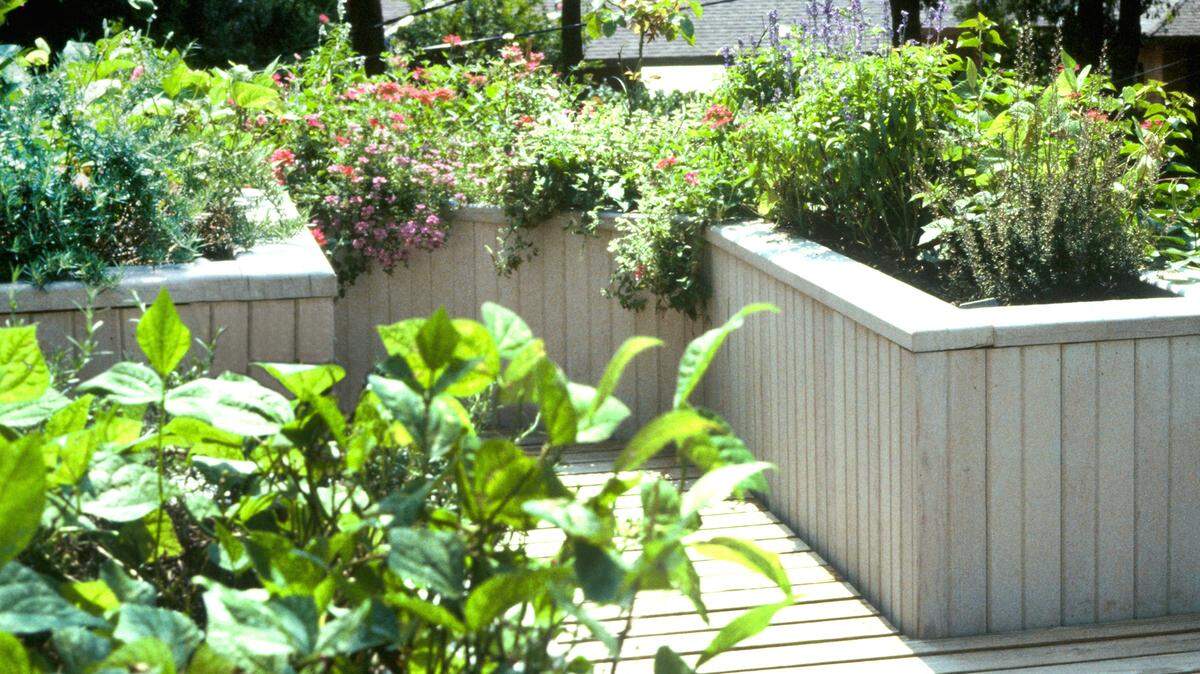
Return some of that “out-back” to turf and simple shrubs, and concentrate the color beds up nearer the house. Reduce the size of your vegetable plantings to what your family can eat, and plant primarily types that grow most easily for you in the smallest amount of space. Raised beds and container gardens are also helpful for people with limited mobility or too little available time.
You can hear Neil Sperry on KLIF 570AM on Saturday afternoons 1-3 pm and on WBAP 820AM Sunday mornings 8-10 am. Join him at www.neilsperry.com and follow him on Facebook.